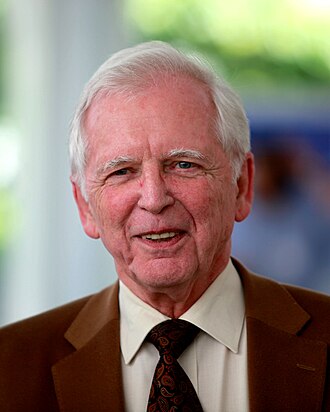
格物
H·罗伯特·霍维茨1947—
H. Robert Horvitz
生物学家, 美国
霍华德·罗伯特·霍维茨,美国生物学家,以研究线虫动物门的秀丽隐杆线虫而著名。因发现器官发育和细胞程序性细胞死亡(细胞程序化凋亡)的遗传调控机理,与悉尼·布伦纳、约翰·E·苏尔斯顿一起获得2002年诺贝尔生理学或医学奖。
摘自维基百科「H·罗伯特·霍维茨」,CC BY-SA 4.0
- 出生
- 1947 年 5 月 8 日,芝加哥
- 国籍
- 美国
- 学科
- 生物学、医学、博物与综合
- 职业
- 生物学家、大学教师、遗传学家、医生
- 母语 / 工作语言
- 英语
- 母校
- 哈佛大学(哲学博士,1974 年)、麻省理工学院、Niles East High School、麻省理工理学院
- 工作单位
- 麻省理工学院、霍华德·休斯医学研究所(1988—)
研究领域
师承
博士生25
来自 Wikidata 的「博士导师」「师从」「博士生」「学生」记录,可能不全。
所获奖项(21)
- 1986W·艾尔登·斯宾塞奖
- 1988NAS分子生物学奖
- 1994Hans Sigrist Prize
- 1996契巴-德鲁奖
- 1997罗森斯特尔奖
- 1998小艾尔弗雷德·P·斯隆奖
- 1999盖尔德纳国际奖
- 2000保罗·埃尔利希和路德维希‧达姆施泰特奖
- 2000路易莎·格罗斯·霍维茨奖
- 2000March of Dimes Prize in Developmental Biology
- 2000夏尔-列奥波·马亚奖
- 2001Bristol-Myers Squibb Award for Distinguished Achievement in Neuroscience Research
- 2001美国遗传学会奖章
- 2002诺贝尔生理学或医学奖
- 2002格鲁伯遗传学奖
- 2007Mendel Medal
- 2009英国皇家学会外籍会员
- 2018honorary doctor of the University of Miami
- —哈佛百年奖章
- —美国文理科学院院士
- —威利奖
学会与院士
百科正文
英文维基百科补充中文条目比较短,下面是英文条目「H. Robert Horvitz」的原文
Howard Robert Horvitz ForMemRS (born May 8, 1947) is an American biologist whose research on the nematode worm Caenorhabditis elegans was awarded the 2002 Nobel Prize in Physiology or Medicine, together with Sydney Brenner and John E. Sulston, whose "seminal discoveries concerning the genetic regulation of organ development and programmed cell death" were "important for medical research and have shed new light on the pathogenesis of many diseases".
Early life and education
Horvitz was born in Chicago, Illinois, to Jewish parents, the son of Mary R. (Savit), a school teacher, and Oscar Freedom Horvitz, a GAO accountant. He majored in mathematics at Massachusetts Institute of Technology, where he joined Alpha Epsilon Pi and spent his summers working for IBM, at first wiring panels for accounting machines and then in his final summer helping to develop IBM's Conversational Programming System.
During his senior year, Horvitz took his first courses in biology and was encouraged by his professors to continue to study biology in graduate school, despite his limited coursework in the field. After he completed his undergraduate studies in 1968, he enrolled in graduate studies in biology at Harvard University, where he studied T4-induced modifications of E. coli RNA polymerase under the direction of Walter Gilbert and James Watson. He completed his PhD in 1974.
Career
In 1974, Horvitz took a postdoctoral position at the Laboratory of Molecular Biology (LMB) in Cambridge, England, where he worked with his future Nobel prize co-winners Sydney Brenner and John Sulston on the genetics and cell lineage of C. elegans. In 1978, Horvitz was offered a faculty position at MIT, where he is currently Professor of Biology and a member of the McGovern Institute for Brain Research. He is also an Investigator of the Howard Hughes Medical Institute.
Horvitz serves as the chair of the board of trustees for Society for Science & the Public and is a member of the USA Science and Engineering Festival's advisory board.
Research
At LMB, Horvitz worked with Sulston to track every non-gonadal cell division that occurred during larval development, and published a complete description of these lineages in 1977. Later, in cooperation with Sulston and Martin Chalfie, Horvitz began investigations first characterizing several cell lineage mutants and then seeking genes that controlled cell lineage or that controlled specific lineages. In 1981, they identified and characterized the gene lin-4, a "heterochronic" mutant that changes the timeline of cell fates.
In his early work at MIT, Horvitz continued his work on cell lineage and cell fate, using C. elegans to investigate whether there was a genetic program controlling cell death, or apoptosis. In 1986, he identified the first "death genes", ced-3 and ced-4. He showed that functional ced-3 and ced-4 genes were a prerequisite for cell death to be executed. He went on to show that another gene, ced-9, protects against cell death by interacting with ced-4 and ced-3, as well as identifying a number of genes that direct how a dead cell is eliminated. Horvitz showed that the human genome contains a ced-3-like gene.
Horvitz's later research continued to use C. elegans to analyze the genetic control of animal development and behavior, as well as to link discoveries in the nematode to human diseases, particularly cancer and neurodegenerative diseases such as amyotrophic lateral sclerosis (ALS). He made further advancements in defining the molecular pathway of programmed cell death, and has identified several key components, including: EGL-1, a protein which activates apoptosis by inhibiting CED-9; transcription factors ces-1 and ces-2, and ced-8, which controls the timing of cell death. He continued working on heterochronic mutants and other aspects of cell lineage, and established lines of research in signal transduction, morphogenesis, and neural development. Horvitz has collaborated with Victor Ambros and David Bartel on a project to characterize the complete set of the more than 100 microRNAs in the C. elegans genome.
以上内容摘自英文维基百科「H. Robert Horvitz」,按 CC BY-SA 4.0 使用,去掉了参考文献、外部链接等尾部小节,公式改写成了纯文本。全文、配图和出处见原文。
同年获同一奖项
同一学科、同时代的科学家










同一学科的科学家
更多 ›