格物
裴顿·劳斯1879—1970
Francis Peyton Rous
病毒学家, 美国
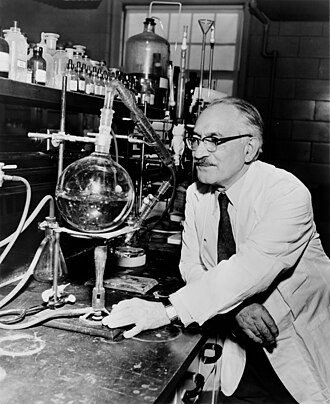
弗朗西斯·裴顿·劳斯,美国生物学家,出生于马里兰州的巴尔的摩,他在1911年发现一种的鸡癌症是由一种病毒(后来被命名为劳氏肉瘤病毒)所引起的,这也促成了后续对于病毒在某些类型癌症发展中的作用之发现及理解,因而获得1966年的诺贝尔生理学或医学奖。
摘自维基百科「裴頓·勞斯」,CC BY-SA 4.0
- 出生
- 1879 年 10 月 5 日,巴尔的摩
- 逝世
- 1970 年 2 月 16 日,纽约
- 国籍
- 美国
- 学科
- 化学、生物学、医学
- 职业
- 病毒学家、化学家、大学教师、医生
- 母语 / 工作语言
- 英语
- 母校
- 约翰·霍普金斯大学医学院、约翰·霍普金斯大学
- 工作单位
- 洛克菲勒大学
研究领域
所获奖项(10)
- 1927约翰·斯科特奖
- 1940英国皇家学会外籍会员
- 1946George M. Kober Lectureship
- 1953George M. Kober Medal
- 1955洁西·史蒂文森·科瓦伦科奖章
- 1958拉斯克基础医学研究奖
- 1963AACR-G.H.A. Clowes Award for Outstanding Basic Cancer Research
- 1965美国国家科学奖章
- 1966诺贝尔生理学或医学奖
- —卡尔·兰德斯泰纳纪念奖
学会与院士
百科正文
英文维基百科补充中文条目比较短,下面是英文条目「Francis Peyton Rous」的原文
Francis Peyton Rous (; October 5, 1879 – February 16, 1970) was an American pathologist at the Rockefeller University known for his works in oncoviruses, blood transfusion and physiology of digestion. A medical graduate from the Johns Hopkins University, he was discouraged from becoming a practicing physician due to severe tuberculosis. After three years of working as an instructor of pathology at the University of Michigan, he became dedicated researcher at the Rockefeller Institute for Medical Research for the rest of his career.
His discovery in 1911 that a chicken tumor was caused by a virus (later named Rous sarcoma virus) led to more discoveries and understanding of the role of viruses in the development of certain types of cancer. He was awarded a Nobel Prize in Physiology or Medicine for his work in 1966, 55 years after his initial discovery and he remains the oldest recipient of the Nobel Prize in Medicine or Physiology.
He and Joseph R. Turner studied methods to make use of blood types for blood transfusion. During World War I, they developed a technique for preserving blood sample by using an acid, citrate. This enabled the first practical storage of blood samples for transfusion and was introduced by Oswald H. Robertson at the front line in Belgium in 1917 as the world's first blood bank.
Early life and education
Rous was born in Baltimore, Maryland, to Charles Rous and Frances Anderson née Wood. He had two younger sisters. His father, a grain broker, died when he was 11 years of age. He studied at the local public schools up to secondary education. He received a scholarship to Johns Hopkins University from where he obtained a B.A. degree in 1900. He immediately took up medicine at the Johns Hopkins School of Medicine.
While in the second year at the medical school, Rous contracted tuberculosis through his injured finger while performing an autopsy. A tuberculous bone (axillary tuberculous lymphadenitis) developed in his armpit and was surgically removed. He was given leave from the medical school for recovery. His uncle got him a job as a cowboy at a cattle ranch in Texas, where he worked for a year. He was able to resume his medical course in 1904.
Career and research
After completing an internship, Rous joined the University of Michigan as an instructor of pathology. Alfred Warthin, head of the pathology department, advised him to study German to pursue specialised pathological course in Germany. To earn extra salary, Warthin arranged for him temporary teaching position at the summer school. He published his first technical paper on white blood cell analysis in the Proceedings of the Society for Experimental Biology and Medicine (now Experimental Biology and Medicine) in 1906. In 1907, he went to Germany for a training course on morbid anatomy at Friedrichstadt Municipal Hospital (Krankenhaus Dresden-Friedrichstadt) in Dresden under Christian Georg Schmorl.
On his way home from Germany, he showed symptoms of pulmonary tuberculosis and was sent to the Adirondack Mountains in northeastern Upstate New York for recovery.
Awards and honors
Rous was elected a member of the United States National Academy of Sciences in 1927 and a member of the American Philosophical Society in 1939. He was elected a Foreign Member of the Royal Society (ForMemRS) in 1940. He received the Albert Lasker Award for Basic Medical Research in 1958 and the National Medal of Science in 1965. He was also member of the Royal Society of Medicine, the Royal Danish Academy of Sciences and Letters, and the Norwegian Academy of Science and Letters. He was appointed honorary fellow of the Weizmann Institute of Science and foreign correspondent of the Académie Nationale de Médecine in Paris.
Personal life
Rous married Marion Eckford de Kay in 1915, who survived him by fifteen years before her own death in 1985. He had three daughters, Marion (Marni), Ellen and Phoebe. Marni (1917–2015) was a children's book editor and the wife of another Nobel Prize winner, Alan Lloyd Hodgkin. Phoebe married Thomas J. Wilson, director of the Harvard University Press.
In his later life he wrote biographies of Simon Flexner and Karl Landsteiner.
Death
Rous died in 1970 of abdominal cancer at the Memorial Sloan Kettering Cancer Center in New York. His wife died in 1985.
以上节选摘自英文维基百科「Francis Peyton Rous」,按 CC BY-SA 4.0 使用,去掉了参考文献、外部链接等尾部小节,公式改写成了纯文本。篇幅所限,较长的小节只摘了开头一部分,有的小节没有收;全文、配图和出处见原文。
同年获同一奖项
同一学科、同时代的科学家


同一学科的科学家
更多 ›