格物
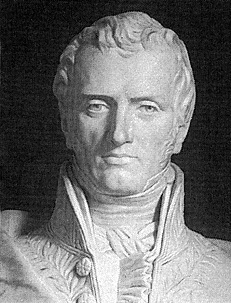
图:http://en.structurae.de/photos/index.cfm?JD=61 · Public domain · Wikimedia Commons
- 出生
- 1785 年 2 月 10 日,第戎
- 逝世
- 1836 年 8 月 21 日,巴黎
- 国籍
- 法国
- 学科
- 物理学、数学、工程与发明、博物与综合
- 职业
- 物理学家、经济学家、数学家
- 母语 / 工作语言
- 法语
- 母校
- 巴黎综合理工学院(1804 年)、巴黎高科路桥学院(1806 年)
- 工作单位
- 巴黎高科路桥学院(1819—1835)、巴黎综合理工学院(1831—1836)
研究领域
主要贡献
代表成就
师承
博士导师1
来自 Wikidata 的「博士导师」「师从」「博士生」「学生」记录,可能不全。
所获奖项(2)
- 1831法国荣誉军团骑士勋章
- —埃菲尔铁塔上所刻的72人列表
学会与院士
百科正文
生平
纳维的父亲在1793年过世,纳维的母亲让她的叔叔Emiland Gauthey来教育纳维,Emiland Gauthey是法国桥梁水域和森林兵团的工程师。1802年就读巴黎综合理工学院,在1804年继续在国立桥路学校就读,并在1806年毕业,纳维后来也继他舅舅之后,成为法国桥梁水域和森林兵团的监察长。
纳维指导了舒瓦西、阿涅尔及阿让特伊等地的桥梁兴建,并在巴黎的西岱岛建造了行人天桥。
1824年纳维进入法国科学院,1830年时担任国立桥路学校的教授,次年接续奥古斯丁·路易·柯西,在巴黎综合理工学院担任微积分及力学的教授。
贡献
纳维在1821年将弹性理论以数学公式的形式表示,使这个领域第一次可以计算有足够精确度的结果。1819年时成功的确认机械应力中的零线,修正了伽利略·伽利莱错误的结果。1826年时纳维确认弹性模量是材料的一个性质,和物体的截面二次轴矩无关。纳维是结构分析的创始者之一。
纳维主要的贡献是纳维-斯托克斯方程,也是流体力学的中心。纳维是埃菲尔铁塔上所刻的72人之一。
以上内容摘自维基百科「克洛德-路易·纳维」,按 CC BY-SA 4.0 使用,去掉了参考文献、外部链接等尾部小节,公式改写成了纯文本。全文、配图和出处见原文。
英文维基百科补充中文条目比较短,下面是英文条目「Claude-Louis Navier」的原文
Claude-Louis Navier (born Claude Louis Marie Henri Navier; French: [klod lwi maʁi ɑ̃ʁi navje]; 10 February 1785 – 21 August 1836) was a French civil engineer, affiliated with the French government, and a physicist who specialized in continuum mechanics.
The Navier–Stokes equations refer eponymously to him, with George Gabriel Stokes.
Biography
After the death of his father in 1793, Navier's mother left his education in the hands of his uncle Émiland Gauthey, an engineer with the Corps of Bridges and Roads (Corps des Ponts et Chaussées). In 1802, Navier enrolled at the École polytechnique, and in 1804 continued his studies at the École Nationale des Ponts et Chaussées, from which he graduated in 1806. He eventually succeeded his uncle as Inspecteur general at the Corps des Ponts et Chaussées.
He directed the construction of bridges at Choisy, Asnières and Argenteuil in the Department of the Seine, and built a footbridge to the Île de la Cité in Paris. His 1824 design for the Pont des Invalides failed to leave a safety margin on top of his calculations, and after cracking the bridge had to be dismantled, destroying Navier's bridge-building reputation. He was chastised by a government committee for relying too much on mathematics.
In 1824, Navier was admitted into the French Academy of Sciences. In 1830, he took up a professorship at the École Nationale des Ponts et Chaussées, and in the following year succeeded the exiled Augustin Louis Cauchy as professor of calculus and mechanics at the École polytechnique.
Contributions
Navier formulated the general theory of elasticity in a mathematically usable form (1821), making it available to the field of construction with sufficient accuracy for the first time. In 1819 he succeeded in determining the zero line of mechanical stress, finally correcting Galileo Galilei's incorrect results, and in 1826 he established the elastic modulus as a property of materials independent of the second moment of area. Navier is therefore often considered to be the founder of modern structural analysis.
His major contribution, however, remains the Navier–Stokes equations (1822), central to fluid mechanics.
His name is one of the 72 names inscribed on the Eiffel Tower.
以上内容摘自英文维基百科「Claude-Louis Navier」,按 CC BY-SA 4.0 使用,去掉了参考文献、外部链接等尾部小节,公式改写成了纯文本。全文、配图和出处见原文。
同一学科、同时代的科学家





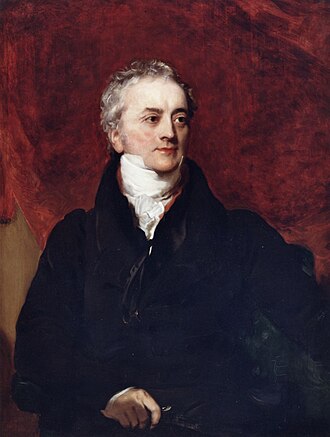

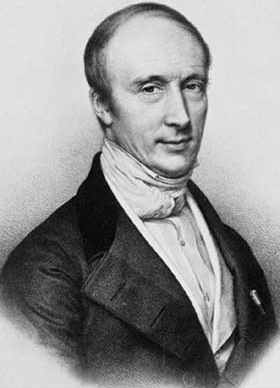
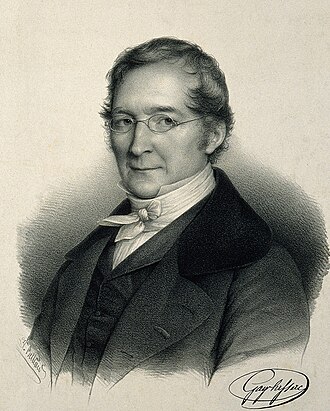
同一学科的科学家
更多 ›