格物
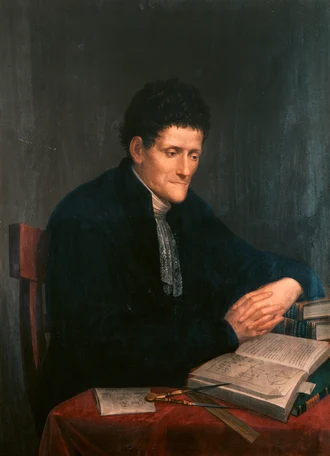
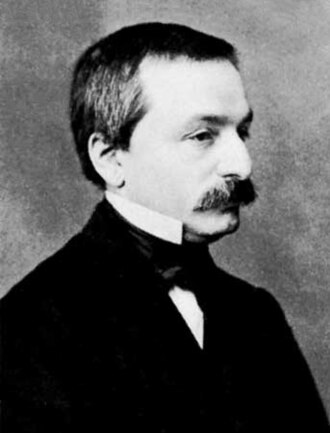
图:作者不详 · CC0 · Wikimedia Commons
- 出生
- 1765 年 9 月 22 日,瓦伦塔诺
- 逝世
- 1822 年 5 月 10 日,摩德纳
- 国籍
- 教皇国
- 学科
- 数学、医学、博物与综合
- 职业
- 数学家、医生、哲学家
- 母语 / 工作语言
- 意大利语
- 母校
- 摩德纳雷焦艾米利亚大学(1788 年)
- 工作单位
- 摩德纳雷焦艾米利亚大学(1788—1822)、摩德纳军事学院(1807—)
研究领域
主要贡献
代表成就
以他 / 她命名
学会与院士
百科正文
英文维基百科补充中文条目比较短,下面是英文条目「Paolo Ruffini」的原文
Paolo Ruffini (22 September 1765 – 10 May 1822) was an Italian mathematician and philosopher. Remembered chiefly for what is now known as the Abel–Ruffini theorem, Ruffini also made a major contribution to the theory of equations, developing the so-called theory of substitutions, the forerunner of modern group theory.
Biography
Early life and education
Paolo Ruffini was born in 1765 in Valentano in the Papal States, to a middle-class family. His father, Basilio, was a physician. When Paolo was a teenager his family moved to Reggio Emilia, near Modena. As a young boy he intended to enter Holy orders and went so far as to receive the tonsure, but he later changed his mind. He enrolled in the University of Modena, where he studied literature, medicine, mathematics, and philosophy. Among his teachers of mathematics at Modena were Luigi Fantini, Paolo Cassiani and Giovanni Battista Venturi. In 1788, he was awarded a degree in philosophy, medicine, and surgery, and in 1789, he added a mathematics degree. In 1791, he received his license to practice medicine.
Career
When only 23 years of age, Ruffini was elected Professor of Mathematics at the University of Modena. In 1780, he was elected a member of the National Academy of Sciences, the so-called "Society of the Forty". A conservative Catholic, Ruffini lost his position at the University during the French invasion of Italy because he would not take the oath of allegiance to the new government. Barred from teaching, he devoted himself to medicine and mathematical research.
In 1799, he published a revolutionary and highly controversial theory of equations claiming that quintics could not be solved by radicals, as leading mathematicians had believed at the time. Ruffini was the first to introduce the notion of the order of an element, conjugacy, the cycle decomposition of elements of permutation groups, and the notions of primitive and imprimitive.
Contributions to mathematics
Ruffini's works include notable developments in algebra. His most important accomplishment is the proof that that quintic (and higher-order) equations cannot be solved by radicals (Abel–Ruffini theorem). While his initial proof in 1799 was incomplete, it laid the foundation for the later work of Niels Henrik Abel, who provided a complete proof in 1824.
Ruffini is also well known for the Ruffini's rule, a quick method to divide polynomials by linear factors. Described by Ruffini in a paper published in 1804, this rule was a significant contribution to the field of algebra and remains a valuable tool in polynomial manipulation. In a second paper published in 1813 Ruffini applies his method to the extraction of roots of numbers and gives in full several illustrations of the process. He explains also how the process may be contracted. Thereupon he proceeds to a derivation of his method of solution by elementary processes, without the use of the differential calculus.
Ruffini also marked a major improvement for group theory, developing Joseph-Louis Lagrange's work on permutation theory (Réflexions sur la théorie algébrique des équations, 1770–1771). Lagrange's work was largely ignored until Ruffini established strong connections between permutations and the solvability of algebraic equations. Ruffini introduced notions like the order of an element, conjugacy, and cycle decomposition in permutation groups, making him a pioneer in this field.
Legacy
Ruffini's proof was initially received with skepticism by the mathematical community. Particularly strong objections against Ruffini's work were raised by Gian Francesco Malfatti and Gregorio Fontana. In a number of papers published between 1802 and 1806 Ruffini refined and completed his proof, answering the objections raised by Malfatti and Fontana and adopting some suggestions of Pietro Abbati Marescotti. In his paper Riflessione intorno alla soluzione delle equazioni algebraiche generali, published in 1813, Ruffini gave a different demonstration of his theorem that largely coincides with what is now called Wantzel's modification of the theorem of Ruffini–Abel.
Only later in Ruffini’s life his proof was recognized as fundamentally correct and built upon by mathematicians like Cauchy, Abel and Galois. Ruffini's insights into the structure of permutation groups were crucial for understanding the limitations of algebraic solutions.
以上节选摘自英文维基百科「Paolo Ruffini」,按 CC BY-SA 4.0 使用,去掉了参考文献、外部链接等尾部小节,公式改写成了纯文本。篇幅所限,较长的小节只摘了开头一部分,有的小节没有收;全文、配图和出处见原文。
同一学科、同时代的科学家

同一学科的科学家
更多 ›