格物
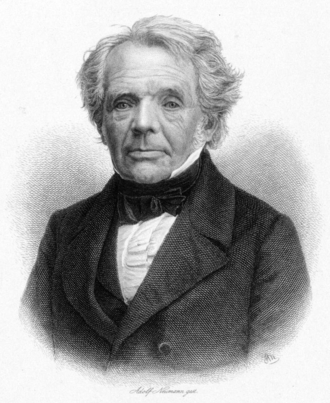
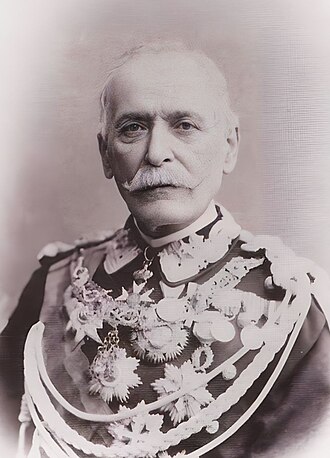
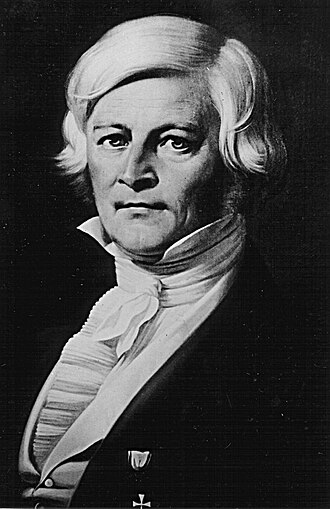
图:Adolf Neumann · Public domain · Wikimedia Commons
- 出生
- 1790 年 11 月 17 日,舒尔普福特
- 逝世
- 1868 年 9 月 26 日,莱比锡
- 国籍
- 萨克森王国
- 学科
- 数学、天文学、博物与综合
- 职业
- 数学家、天文学家、大学教师
- 母语 / 工作语言
- 德语
- 母校
- 哥廷根大学(1814 年)、莱比锡大学(1813 年)、哈雷-维滕贝格大学(1815 年)、普佛达(1809 年)
- 工作单位
- 莱比锡大学(1816—1868)
研究领域
主要贡献
代表成就
本站收录的发现与发明
以他 / 她命名
师承
博士生6
来自 Wikidata 的「博士导师」「师从」「博士生」「学生」记录,可能不全。
学会与院士
百科正文
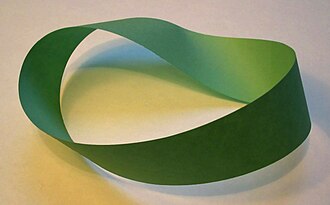
莫比乌斯最著名的成就是发现了三维欧几里得空间中的一种奇特的二维单面环状结构——后人称为莫比乌斯带。其他重要的成就包括在射影几何中引进齐次坐标系、莫比乌斯变换(Möbius transformations),数论中的莫比乌斯变换、莫比乌斯函数、莫比乌斯反演公式等等。
生平
莫比乌斯出生于德国萨克森选侯国舒尔普福特,他的母亲是宗教改革家马丁·路德的后代。莫比乌斯最初学法学,1809年转向数学,从1809年到1814年他在莱比锡大学学数学并获博士学位;1815年他获得教授资格,一年后在高斯的推荐下成为特级教授和莱比锡天文台的观测员。1846年他成为王家萨克森科学院建立成员之一,1848年他成为莱比锡天文台台长,1868年9月26日逝世于莱比锡。
家庭
莫比乌斯的父亲约翰·海因里希·莫比乌斯是南姆堡附近一个小镇上的舞蹈教师,他在莫比乌斯三岁时逝世。
他本人于1820年4月6日结婚,他的夫人多萝西娅原名罗特。两人育有一男一女。
以上内容摘自维基百科「奥古斯特·费迪南德·莫比乌斯」,按 CC BY-SA 4.0 使用,去掉了参考文献、外部链接等尾部小节,公式改写成了纯文本。全文、配图和出处见原文。
英文维基百科补充中文条目比较短,下面是英文条目「August Ferdinand Möbius」的原文
August Ferdinand Möbius (UK:, US:; German: [ˈmøːbi̯ʊs]; 17 November 1790 – 26 September 1868) was a German mathematician and theoretical astronomer.
Life and education
Möbius was born in Schulpforta, Electorate of Saxony, and was descended on his mother's side from religious reformer Martin Luther. He was home-schooled until he was 13, when he attended the college in Schulpforta in 1803, and studied there, graduating in 1809. He then enrolled at the University of Leipzig, where he studied astronomy under the mathematician and astronomer Karl Mollweide. In 1813, he began to study astronomy under mathematician Carl Friedrich Gauss at the University of Göttingen, while Gauss was the director of the Göttingen Observatory. From there, he went to study with Carl Gauss's instructor, Johann Pfaff, at the University of Halle, where he completed his doctoral thesis The occultation of fixed stars in 1815. In 1816, he was appointed as Extraordinary Professor to the "chair of astronomy and higher mechanics" at the University of Leipzig. Möbius died in Leipzig in 1868 at the age of 77.
His son Theodor was a noted philologist.
Contributions
He is best known for his discovery of the Möbius strip, a non-orientable two-dimensional surface with only one side when embedded in three-dimensional Euclidean space. It was independently discovered by Johann Benedict Listing a few months earlier. The Möbius configuration, formed by two mutually inscribed tetrahedra, is also named after him. Möbius was the first to introduce homogeneous coordinates into projective geometry. He is recognized for the introduction of the barycentric coordinate system. Before 1853 and Schläfli's discovery of the 4-polytopes, Möbius (with Cayley and Grassmann) was one of only three other people who had also conceived of the possibility of geometry in more than three dimensions.
Many mathematical concepts are named after him, including the Möbius plane, the Möbius transformations, important in projective geometry, and the Möbius transform of number theory. His interest in number theory led to the important Möbius function μ(n) and the Möbius inversion formula. In Euclidean geometry, he systematically developed the use of signed angles and line segments as a way of simplifying and unifying results.
Collected works
- Gesammelte Werke erster Band (v. 1) (Leipzig: S. Hirzel, 1885)
- Gesammelte Werke zweiter Band (v. 2) (Leipzig: S. Hirzel, 1885)
- Gesammelte Werke dritter Band (v. 3) (Leipzig: S. Hirzel, 1885)
- Gesammelte Werke vierter Band (v. 4) (Leipzig: S. Hirzel, 1885)
Die elemente der mechanik des himmels, auf neuem wege ohne hülfe höherer rechnungsarten dargestellt von August Ferdinand Möbius (Leipzig, Weidmann'sche buchhandlung, 1843)
以上内容摘自英文维基百科「August Ferdinand Möbius」,按 CC BY-SA 4.0 使用,去掉了参考文献、外部链接等尾部小节,公式改写成了纯文本。全文、配图和出处见原文。
同一学科、同时代的科学家


同一学科的科学家
更多 ›