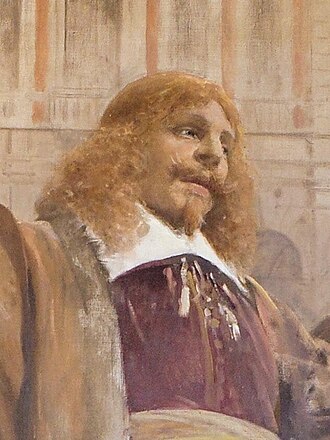
格物
图:作者不详 · Public domain · Wikimedia Commons
- 出生
- 1652 年 4 月 21 日,昂贝尔
- 逝世
- 1719 年 11 月 8 日,巴黎
- 国籍
- 法国
- 学科
- 数学、博物与综合
- 职业
- 数学家
- 母语 / 工作语言
- 法语
- 工作单位
- 卢福瓦侯爵(1683—1685)、法国科学院(1685—1719)
研究领域
主要贡献
代表成就
以他 / 她命名
师承
学生1
来自 Wikidata 的「博士导师」「师从」「博士生」「学生」记录,可能不全。
学会与院士
百科正文
以表示 x 的 n 次方根。
生平
罗尔生于下奥弗涅的昂贝尔。1675年他从昂贝尔搬往巴黎,1685年获选进法兰西皇家科学院,1699年成为科学院的Pensionnaire Géometre。那时他已经获得让-巴蒂斯特·科尔贝的津贴,因为他解了雅克·奥扎南的其中一条问题。
罗尔是微积分的早期批评者,认为它不准确,建基于不稳固的推论。他后来改变立场。
在罗尔早年,微积分还是个新兴事物,罗尔定律是他唯一让人记住他名字的一条引理。他早年认为微积分建立在某些逻辑漏洞上,早期微积分某些概念的确未曾澄清,如无穷小量的定义,牛顿和莱布尼茨两人都不曾清楚它的定义。直到十九世纪,这些概念才逐渐得以澄清。
罗尔在巴黎逝世。
以上内容摘自维基百科「米歇尔·罗尔」,按 CC BY-SA 4.0 使用,去掉了参考文献、外部链接等尾部小节,公式改写成了纯文本。全文、配图和出处见原文。
英文维基百科补充中文条目比较短,下面是英文条目「Michel Rolle」的原文
Michel Rolle (21 April 1652 – 8 November 1719) was a French mathematician. He is best known for Rolle's theorem (1691). He is also the co-inventor in Europe of Gaussian elimination (1690).
Life
Rolle was born in Ambert, Province of Auvergne. Rolle, the son of a shopkeeper, received only an elementary education. He married early and as a young man struggled to support his family on the meager wages of a transcriber for notaries and attorney. In spite of his financial problems and minimal education, Rolle studied algebra and Diophantine analysis (a branch of number theory) on his own. He moved from Ambert to Paris in 1675.
Rolle's fortune changed dramatically in 1682 when he published an elegant solution of a difficult, unsolved problem in Diophantine analysis. The public recognition of his achievement led to a patronage under minister Louvois, a job as an elementary mathematics teacher, and eventually to a short-termed administrative post in the Ministry of War. In 1685 he joined the Académie des Sciences in a very low-level position for which he received no regular salary until 1699. Rolle was promoted to a salaried position in the academy, a pensionnaire géometre. This was a distinguished post because of the 70 members of the academy, only 20 were paid. He had then already been given a pension by Jean-Baptiste Colbert after he solved one of Jacques Ozanam's problems. He remained there until he died of apoplexy in 1719.
While Rolle's forte was always Diophantine analysis, his most important work was a book on the algebra of equations, called Traité d'algèbre, published in 1690. In that book Rolle firmly established the notation for the nth root of a real number, and proved a polynomial version of the theorem that today bears his name. (Rolle's theorem was named by Giusto Bellavitis in 1846.)
Rolle was one of the most vocal early antagonists of calculus – ironically so, because Rolle's theorem is essential for basic proofs in calculus. He strove intently to demonstrate that it gave erroneous results and was based on unsound reasoning. He quarreled so vehemently on the subject that the Académie des Sciences was forced to intervene on several occasions.
Among his several achievements, Rolle helped advance the currently accepted size order for negative numbers. Descartes, for example, viewed –2 as smaller than –5.
Work
Rolle was an early critic of infinitesimal calculus, arguing that it was inaccurate, based upon unsound reasoning, and was a collection of ingenious fallacies, but later changed his opinion.
In 1690, Rolle published Traité d'Algebre. It contains the first published description in Europe of the Gaussian elimination algorithm, which Rolle called the method of substitution. Some examples of the method had previously appeared in algebra books, and Isaac Newton had previously described the method in his lecture notes, but Newton's lesson was not published until 1707. Rolle's statement of the method seems not to have been noticed insofar as the lesson for Gaussian elimination that was taught in 18th- and 19th-century algebra textbooks owes more to Newton than to Rolle.
Rolle is best known for Rolle's theorem in differential calculus. Rolle had used the result in 1690, and he proved it (by the standards of the time) in 1691. Given his animosity to infinitesimals it is fitting that the result was couched in terms of algebra rather than analysis. Only in the 18th century was the theorem interpreted as a fundamental result in differential calculus. Indeed, it is needed to prove both the mean value theorem and the existence of Taylor series. As the importance of the theorem grew, so did the interest in identifying the origin, and it was finally named Rolle's theorem in the 19th century. Barrow-Green remarks that the theorem might well have been named for someone else had not a few copies of Rolle's 1691 publication survived.
Critique of infinitesimal calculus
In a criticism of infinitesimal calculus that predated George Berkeley's, Rolle presented a series of papers at the French academy, alleging that the use of the methods of infinitesimal calculus leads to errors. Specifically, he presented an explicit algebraic curve, and alleged that some of its local minima are missed when one applies the methods of infinitesimal calculus. Pierre Varignon responded by pointing out that Rolle had misrepresented the curve, and that the alleged local minima are in fact singular points with a vertical tangent.
以上节选摘自英文维基百科「Michel Rolle」,按 CC BY-SA 4.0 使用,去掉了参考文献、外部链接等尾部小节,公式改写成了纯文本。篇幅所限,较长的小节只摘了开头一部分,有的小节没有收;全文、配图和出处见原文。
同一学科、同时代的科学家


同一学科的科学家
更多 ›