格物
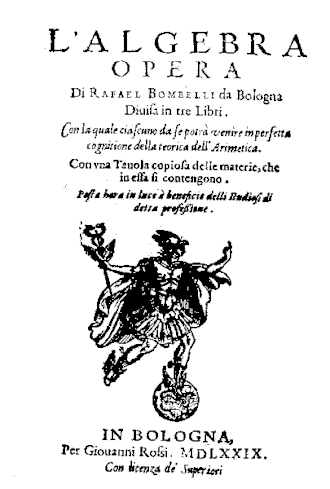
图:作者不详 · Public domain · Wikimedia Commons
- 出生
- 1526 年,博洛尼亚
- 逝世
- 1572 年,罗马
- 国籍
- 教皇国
- 学科
- 数学、工程与发明、博物与综合
- 职业
- 数学家、工程师
研究领域
百科正文
英文维基百科补充中文条目比较短,下面是英文条目「Rafael Bombelli」的原文
Rafael Bombelli (baptised on 20 January 1526; died 1572) was an Italian mathematician. Born in Bologna, he is the author of a treatise on algebra and is a central figure in the understanding of imaginary numbers.
He was the one who finally managed to address the problem with imaginary numbers. In his 1572 book, L'Algebra, Bombelli solved equations using the method of del Ferro/Tartaglia. He introduced the rhetoric that preceded the representative symbols +i and -i and described how they both worked.
Life
Rafael Bombelli was baptised on 20 January 1526 in Bologna, Papal States. He was born to Antonio Mazzoli, a wool merchant, and Diamante Scudieri, a tailor's daughter. The Mazzoli family was once quite powerful in Bologna. When Pope Julius II came to power in 1506, he exiled the ruling family, the Bentivoglios. The Bentivoglio family attempted to retake Bologna in 1508, but failed. Rafael's grandfather participated in the coup attempt and was captured and executed. Later, Antonio was able to return to Bologna, having changed his surname to Bombelli to escape the reputation of the Mazzoli family. Rafael was the oldest of six children. Rafael received no college education, but was instead taught by an engineer-architect by the name of Pier Francesco Clementi.
Bombelli felt that none of the works on algebra by the leading mathematicians of his day provided a careful and thorough exposition of the subject. Instead of another convoluted treatise that only mathematicians could comprehend, Rafael decided to write a book on algebra that could be understood by anyone.
Bombelli's Algebra
In the book that was published in 1572, entitled Algebra, Bombelli gave a comprehensive account of the algebra known at the time. He was the first European to write down the way of performing computations with negative numbers. The following is an excerpt from the text:
- "Plus times plus makes plus
- Minus times minus makes plus
- Plus times minus makes minus
- Minus times plus makes minus
- Plus 8 times plus 8 makes plus 64
- Minus 5 times minus 6 makes plus 30
- Minus 4 times plus 5 makes minus 20
- Plus 5 times minus 4 makes minus 20"
As was intended, Bombelli used simple language, as can be seen above, so that anybody could understand it. But at the same time, he was thorough.
Notation
Bombelli introduced, for the first time in a printed text (in Book II of his Algebra), a form of index notation in which the equation x³=6x+40
appeared as
1U3 a. 6U1 p. 40.
in which he wrote the U3 as a raised bowl-shape (like the curved part of the capital letter U) with the number 3 above it. Full symbolic notation was developed shortly thereafter by the French mathematician François Viète.
Reputation
Bombelli is generally regarded as the inventor of complex numbers, as no one before him had made rules for dealing with such numbers, and no one believed that working with imaginary numbers would have useful results. Upon reading Bombelli's Algebra, Leibniz praised Bombelli as an "... outstanding master of the analytical art." Crossley writes in his book, "Thus we have an engineer, Bombelli, making practical use of complex numbers perhaps because they gave him useful results, while Cardan found the square roots of negative numbers useless. Bombelli is the first to give a treatment of any complex numbers... It is remarkable how thorough he is in his presentation of the laws of calculation of complex numbers..."
In honour of his accomplishments, a Moon crater was named Bombelli in 1976.
Bombelli's method of calculating square roots
Bombelli used a method related to simple continued fraction to calculate square roots. He did not yet have the concept of a continued fraction, and below is the algorithm of a later version given by Pietro Cataldi (1613).
The method for finding √n begins with (公式略) with (公式略), from which it can be shown that (公式略). Repeated substitution of the expression on the right-hand side for r into itself yields a continued fraction (公式略)
for the root, but Bombelli is more concerned with better approximations for r. The value chosen for a is either of the whole numbers whose squares n lies between. The method gives the following convergents for (公式略) while the actual value is 3.605551275...: 32/3, 33/5, 320/33, 366/109, 3109/180, 3720/1189, ⋯
The last convergent equals 3.605550883.... Bombelli's method should be compared with formulas and results used by Heron and Archimedes. The result 265/153<√3<1351/780 used by Archimedes in his determination of the value of π can be found by using 1 and 0 for the initial values of r.
以上节选摘自英文维基百科「Rafael Bombelli」,按 CC BY-SA 4.0 使用,去掉了参考文献、外部链接等尾部小节,公式改写成了纯文本。篇幅所限,较长的小节只摘了开头一部分,有的小节没有收;全文、配图和出处见原文。
同一学科、同时代的科学家


同一学科的科学家
更多 ›