格物
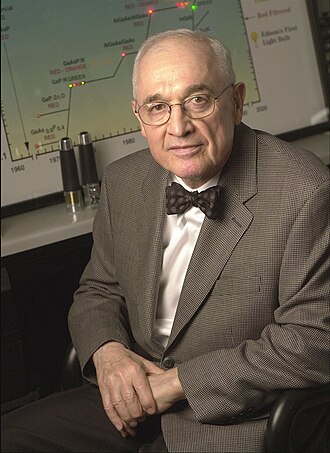
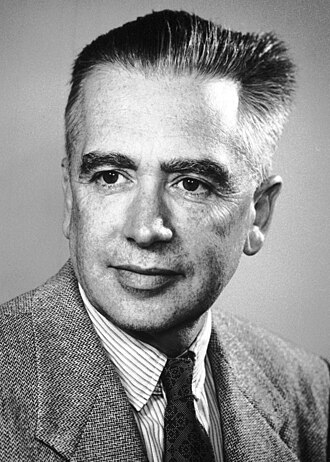
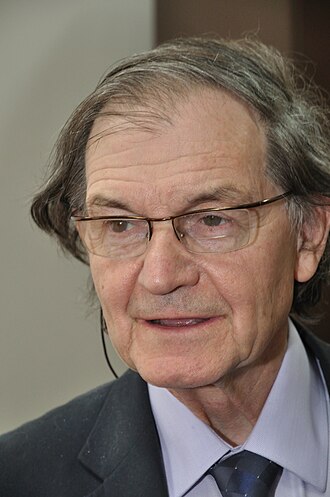
图:AnonymousUnknown author · Public domain · Wikimedia Commons
尼克·何伦亚克1928—2022
Nick Holonyak
美国物理学家
小尼克·霍洛尼亚克,美国物理学家,于1962年发明了第一台实用的可见光发光二极管,担任通用电气公司在纽约州锡拉丘兹实验室的顾问科学家。他一直在伊利诺伊大学厄巴纳-香槟分校教授电气和计算机工程、物理和电气和计算机工程。
摘自维基百科「尼克·何倫亞克」,CC BY-SA 4.0
- 出生
- 1928 年 11 月 3 日,齐格勒 (伊利诺伊州)
- 逝世
- 2022 年 9 月 20 日,厄巴纳
- 国籍
- 美国
- 学科
- 物理学、工程与发明、博物与综合
- 职业
- 物理学家、大学教师、发明家、工程师
- 母语 / 工作语言
- 英语
- 母校
- 伊利诺伊大学厄巴纳-香槟分校
- 工作单位
- 伊利诺伊大学厄巴纳-香槟分校、通用电气、贝尔实验室
研究领域
主要贡献
代表成就
师承
博士导师1
博士生1
来自 Wikidata 的「博士导师」「师从」「博士生」「学生」记录,可能不全。
所获奖项(23)
- 1973IEEE Morris N. Liebmann纪念奖
- 1975约翰·斯科特奖
- 1981IEEE Jack A. Morton Award
- 1989IEEE爱迪生奖章
- 1990美国国家科学奖章
- 1992查尔斯·汤斯奖
- 1993NAS Award for the Industrial Application of Science
- 1995日本国际奖
- 2001Frederic Ives Medal
- 2002国家技术奖章
- 2002美国科学促进会会士
- 2003IEEE 荣誉奖章
- 2003世界能源奖
- 2004勒梅尔森-麻省理工学院奖
- 2004Von Hippel Award
- 2004华盛顿奖
- 2008美国发明家名人堂
- 2015查尔斯·斯塔克·德雷珀奖
- 2017富兰克林研究所奖项
- 2021伊丽莎白女王工程奖
- —美国物理学会会士
- —摩尔杰出成就固态科学科技奖章
- —Welker Award
学会与院士
百科正文
诺贝尔奖争议
2014年诺贝尔物理学奖授予蓝色LED的发明者(赤崎勇、天野浩、中村修二),跳过了红色、绿色LED的发明者霍洛尼亚克与西泽润一,部分评论(包括霍洛尼亚克本人)认为不公平。但诺贝尔委员会(物理学奖)委员长Per Delsing(瑞典Chalmers University of Technology教授)在《读卖新闻》专访中提出反驳,他坚称“仔细研究发明的贡献度之后,有十足信心决定这3个人获奖”。
同年12月8日,天野浩在斯德哥尔摩发表的诺贝尔奖座(Lecture)中,也有介绍霍洛尼亚克的贡献。
2015年1月,霍洛尼亚克与赤崎、中村等人共获查尔斯·斯塔克·德雷珀奖。
以上内容摘自维基百科「尼克·何倫亞克」,按 CC BY-SA 4.0 使用,去掉了参考文献、外部链接等尾部小节,公式改写成了纯文本。全文、配图和出处见原文。
英文维基百科补充中文条目比较短,下面是英文条目「Nick Holonyak」的原文
Nick Holonyak Jr. (November 3, 1928 – September 18, 2022) was an American electrical engineer. He is noted particularly for his 1962 invention and first demonstration of a semiconductor laser diode that emitted visible light. This device was the forerunner of the first generation of commercial light-emitting diodes (LEDs). He was then working at a General Electric research laboratory near Syracuse, New York. He left General Electric in 1963 and returned to his alma mater, the University of Illinois Urbana-Champaign, where he later became John Bardeen Endowed Chair in Electrical and Computer Engineering and Physics.
Early life and education
Nick Holonyak Jr. was born on November 3, 1928, in Zeigler, Illinois, to Rusyn immigrants. The family moved to Glen Carbon, Illinois where his father worked in a coal mine. Holonyak was the first member of his family to receive any type of formal schooling. He once worked 30 straight hours on the Illinois Central Railroad before realizing that a life of hard labor was not what he wanted and he would prefer to go to school instead. According to a Chicago Tribune article in 2003, "The cheap and reliable semiconductor lasers critical to DVD players, bar code readers and scores of other devices owe their existence in some small way to the demanding workload thrust upon Downstate railroad crews decades ago."
Career and research
From 1957 to 1963, Holonyak was a scientist at General Electric's Advanced Semiconductor Laboratory near Syracuse, New York. Here he invented, fabricated, and demonstrated the first visible light laser diode on October 9, 1962. He grew crystals of the alloy GaAs0.60P0.40; a GaAs laser diode that worked in the infrared had recently been demonstrated by his General Electric colleague Robert N. Hall. The GaAs0.60P0.40 laser diode worked at low temperatures, but the device still functioned as a light-emitting diode at room temperature. The demonstration of red light emission from the diode inspired the article "Light of Hope – or Terror" in Reader's Digest. GaAsP was the material used for the first generation of commercial LEDs that came to market a few years later.
Inventions
In addition to introducing the III-V alloy LED, Holonyak held 41 patents. His other inventions include the red-light semiconductor laser, usually called the laser diode (used in CD and DVD players and cell phones) and the shorted emitter p-n-p-n switch (used in light dimmers and power tools).
In 2006, the American Institute of Physics decided on the five most important papers in each of its journals since it was founded 75 years ago. Two of these five papers, in the journal Applied Physics Letters, were co-authored by Holonyak. The first one, co-authored with S. F. Bevacqua in 1962, announced the creation of the first visible-light laser diode. The second, co-authored primarily with Milton Feng in 2005, announced the creation of a transistor laser that can operate at room temperatures.
Personal life
Holonyak and his wife, Katherine, were married for over 60 years. He died on September 18, 2022, in Urbana, Illinois, at the age of 93.
Recognition
Awards
Many colleagues expressed their belief that Holonyak deserved the Nobel Prize for his invention of the GaAsP laser and LED. On this subject, he said: "It's ridiculous to think that somebody owes you something. We're lucky to be alive, when it comes down to it." In October 2014, Holonyak reversed his stance by stating "I find this one insulting" in reaction to news that the inventors of the blue LED were awarded the 2014 Nobel Prize in Physics, instead of his fellow LED researchers.
Commemoration
1997: The Optical Society of America (now Optica) created the Nick Holonyak, Jr. Award in his honor.
2005: Inducted as a Laureate of The Lincoln Academy of Illinois and awarded the Order of Lincoln (the State's highest honor) by the Governor of Illinois in the area of Science.
June 2006: Two of Holonyak's papers were chosen by the editors of Applied Physics Letters as among the five most important published since the journal's founding in 1962.
November 9, 2007: Historical marker installed on the University of Illinois campus recognizing his development of the quantum-well laser. It is located on the Bardeen Engineering Quadrangle near where the old Electrical Engineering Research Laboratory used to stand.
以上节选摘自英文维基百科「Nick Holonyak」,按 CC BY-SA 4.0 使用,去掉了参考文献、外部链接等尾部小节,公式改写成了纯文本。篇幅所限,较长的小节只摘了开头一部分,有的小节没有收;全文、配图和出处见原文。
同年获同一奖项
同一学科、同时代的科学家


同一学科的科学家
更多 ›