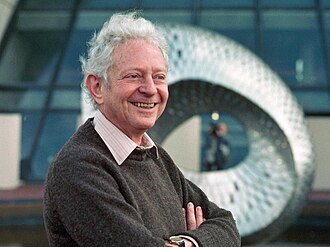
格物
戴维·奥利弗1937—2012
David Olive
British physicist (1937-2012)
大卫·伊恩·奥利夫 CBE FRS FLSW,英国理论物理学家,对弦理论和对偶理论做出了基础性的贡献。
摘自维基百科「大衛·奧利夫」,CC BY-SA 4.0
- 出生
- 1937 年 4 月 16 日,伦敦
- 逝世
- 2012 年 11 月 7 日,剑桥
- 国籍
- 英国
- 学科
- 物理学、博物与综合
- 职业
- 物理学家、理论物理学家、大学教师
- 母语 / 工作语言
- 英语
- 母校
- 剑桥大学圣约翰学院、剑桥大学、皇家高中
- 工作单位
- 伦敦帝国学院、斯旺西大学、乌得勒支大学
师承
博士导师1
博士生4
来自 Wikidata 的「博士导师」「师从」「博士生」「学生」记录,可能不全。
所获奖项(3)
- 1997狄拉克奖章(ICTP)
- 2010Fellow of the Learned Society of Wales
- —大英帝国司令勋章
学会与院士
百科正文
他是伦敦帝国学院物理学教授(1984年至1992年)。1992年,他帮助斯旺西大学去建立一个新的理论物理学会。
1997年,他被授予了狄拉克奖和国际理论物理中心勋章。他是威尔士学社创始院士。
1987年,当选皇家学会成员,并于2002年获颁英帝国司令勋章。
以上内容摘自维基百科「大衛·奧利夫」,按 CC BY-SA 4.0 使用,去掉了参考文献、外部链接等尾部小节,公式改写成了纯文本。全文、配图和出处见原文。
英文维基百科补充中文条目比较短,下面是英文条目「David Olive」的原文
David Ian Olive ( ; 16 April 1937 – 7 November 2012) was a British theoretical physicist. Olive made fundamental contributions to string theory and duality theory, he is particularly known for his work on the GSO projection and Montonen–Olive duality.
He was professor of physics at Imperial College, London, from 1984 to 1992. In 1992 he moved to Swansea University to help set up the new theoretical physics group.
He was awarded the Dirac Prize and Medal of the International Centre for Theoretical Physics in 1997. He was a Founding Fellow of the Learned Society of Wales. He was elected as a fellow of the Royal Society in 1987, and appointed CBE in 2002.
Biography
Early life and education
David Olive was born in Middlesex in 1937 and educated at the Royal High School, Edinburgh and Edinburgh University. He then moved to St John's College, Cambridge, obtaining his PhD under the supervision of John Taylor in 1963.
He married Jenny in 1963; they had 2 daughters and a granddaughter.
Career
After a short postdoctoral appointment at the Carnegie Institute in Pittsburgh, Olive returned to Cambridge as a Fellow of Churchill College, becoming a lecturer in the Department of Applied Mathematics and Theoretical Physics (DAMTP) in 1965. Here he made key contributions to the approach to particle physics known as S-matrix theory. His 1966 book The Analytic S-matrix co-authored with Richard Eden, Peter Landshoff and John Polkinghorne, remains a definitive text on the subject and is known as ELOP.
In 1971, Olive made what he has described as a "momentous personal decision" to sacrifice his tenured position in Cambridge and move to the Theory Division, CERN as a fixed-term staff member. He was part of a team assembled by Daniele Amati to work on the theory originally known as the dual resonance model but shortly to be recognised as string theory. In CERN, Olive began the collaborations with the circle of string theorists many of whom feature in his memoir From Dual Fermion to Superstring. His work at CERN, in part in collaboration with Lars Brink and Ed Corrigan, initially focused on the consistent formulation of dual fermion amplitudes, generalising the existing bosonic models. This period saw several of Olive's major contributions to string theory, including the Gliozzi-Scherk-Olive (GSO) projection which elucidated the role of spacetime supersymmetry in ensuring consistency of the dual fermion model and was to prove an essential step in establishing 10-dimensional superstring theory. He was one of the first to become convinced of the conceptual revolution whereby string theory is viewed as a unified theory of all particle interactions, including gravity, rather than simply as a model of hadrons. This was the subject of his plenary talk at the 1974 Rochester conference in London.
In 1977, Olive returned to the UK to take up a lectureship at Imperial College, becoming Professor in 1984 and Head of the Theoretical Physics Group in 1988. He had by now begun collaboration with Peter Goddard and together they produced a series of papers on the mathematical foundations of string theory, notably on Virasoro and Kac-Moody algebras and their representations and relation to vertex operators. One outcome of their work on algebras and lattices was the identification of the special role played by the two Lie groups SO(32) and E8 x E8, which would shortly be shown by Michael Green and John Schwarz to exhibit anomaly cancellation that led to the renaissance of string theory in 1984.
This body of work from 1973 to 1983 was recognised with the award of the prestigious Dirac Medal in 1997 to Goddard and Olive "in recognition of their far-sighted and highly influential contributions to theoretical physics. They have contributed many crucial insights that shaped our emerging understanding of string theory and have also had a far-reaching impact on our understanding of 4-dimensional field theory.”
The Dirac Medal also recognised a second major line of research pioneered by Olive, on duality symmetries in gauge field theories, this work was to play a key role in later developments of M-theory. While still at CERN, Olive had begun to study the magnetic monopoles which 't Hooft and Polyakov had shown existed in non-abelian gauge theories, publishing a paper with Peter Goddard and Jean Nuyts. In 1977, together with Claus Montonen, he made the remarkable conjecture that there should exist an electromagnetic dual theory in which the roles of monopoles and gauge bosons are interchanged.
以上节选摘自英文维基百科「David Olive」,按 CC BY-SA 4.0 使用,去掉了参考文献、外部链接等尾部小节,公式改写成了纯文本。篇幅所限,较长的小节只摘了开头一部分,有的小节没有收;全文、配图和出处见原文。
同年获同一奖项
同一学科、同时代的科学家

同一学科的科学家
更多 ›