格物
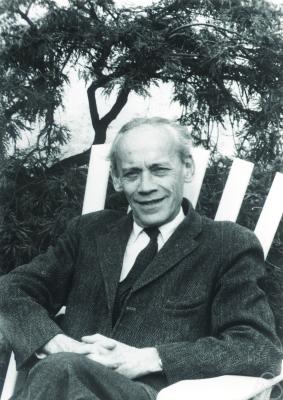
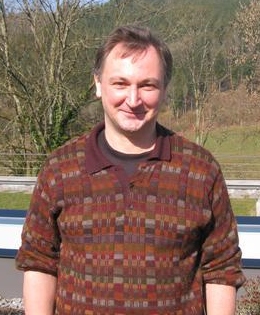
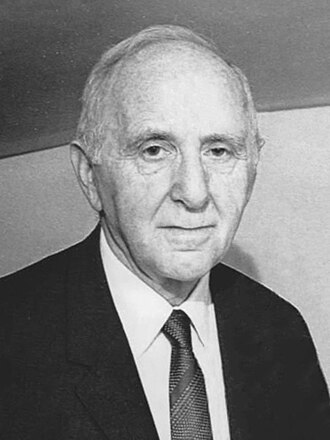
图:Konrad Jacobs, Erlangen · CC BY-SA 2.0 de · Wikimedia Commons
- 出生
- 1898 年 3 月 3 日,维也纳
- 逝世
- 1962 年 12 月 20 日,汉堡
- 国籍
- 德国、美国、奥匈帝国、奥地利
- 学科
- 数学、博物与综合
- 职业
- 数学家、大学教师
- 母语 / 工作语言
- 德语、英语
- 母校
- 维也纳大学(1917 年)、莱比锡大学(博士,1921 年)、哥廷根大学(1922 年)
- 工作单位
- 普林斯顿大学(1946—1958)、汉堡大学(1922—1937)、汉堡大学(1958—1962)、圣母大学(1937—1938)、印第安纳大学(1938—1946)、帝国军(1917—1918)
研究领域
主要贡献
代表成就
本站收录的发现与发明
以他 / 她命名
师承
博士生34
学生2
来自 Wikidata 的「博士导师」「师从」「博士生」「学生」记录,可能不全。
所获奖项(3)
- 1932阿克曼-托伊布纳纪念奖
- 1962honorary doctorate of the Université de Clermont-Ferrand
- —美国文理科学院院士
学会与院士
百科正文
1937年至1938年任教于圣母大学。1938年至1946年任教于印第安纳大学,1946年至1958年在普林斯顿大学。其学生包括塞尔日·兰、约翰·泰特及王湘浩。
他是有领导地位的代数学家。他贡献主要在代数数论,特别是类体论。他建立了L函数的其中一个构作方法。他对环、群和域等基本概念的整理亦有所建树。他发展了代数拓扑的分枝辫理论。
他对伽罗瓦理论和同调群亦十分了解。
他留于后世有两大猜想。两者均未证,分别关于:
伽罗瓦群的阿廷L函数的线性表示
给定整数a,求a是不同质数p模的原根的频率。
以上内容摘自维基百科「埃米爾·阿廷」,按 CC BY-SA 4.0 使用,去掉了参考文献、外部链接等尾部小节,公式改写成了纯文本。全文、配图和出处见原文。
英文维基百科补充中文条目比较短,下面是英文条目「Emil Artin」的原文
Emil Artin (German: [ˈaʁtiːn]; March 3, 1898 – December 20, 1962) was an Austrian mathematician of Armenian descent.
Artin was one of the leading mathematicians of the twentieth century. He is best known for his work on algebraic number theory, contributing largely to class field theory and a new construction of L-functions. He also contributed to the pure theories of rings, groups and fields.
Along with Emmy Noether, he is considered the founder of modern abstract algebra.
Early life and education
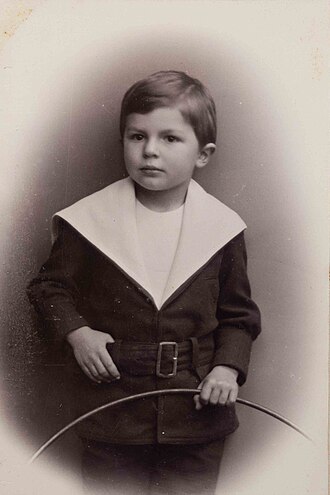
Parents
Emil Artin was born in Vienna to parents Emma Maria, née Laura (stage name Clarus), a soubrette on the operetta stages of Austria and Germany, and Emil Hadochadus Maria Artin, Austrian-born of mixed Austrian and Armenian descent. His Armenian last name was Artinian which was shortened to Artin. Several documents, including Emil's birth certificate, list the father's occupation as "opera singer" though others list it as "art dealer." It seems at least plausible that he and Emma had met as colleagues in the theater. They were married in St. Stephen's Parish on July 24, 1895.
Early education
Artin entered school in September 1904, presumably in Vienna.
Career
Professorship at Hamburg
Courant arranged for Artin to receive a stipend for the summer of 1922 in Göttingen, which occasioned his declining a position offered him at the University of Kiel. The following October, however, he accepted an equivalent position at Hamburg, where in 1923, he completed the Habilitation thesis (required of aspirants to a professorship in Germany), and on July 24 advanced to the rank of Privatdozent.
On April 1, 1925, Artin was promoted to Associate Professor (außerordentlicher Professor). In this year also, Artin applied for and was granted German citizenship. He was promoted to full Professor (ordentlicher Professor) on October 15, 1926.
Return to Hamburg and personal life
The following year, Artin took a leave of absence to return to Germany for the first time since emigration, nearly twenty years earlier. He spent the fall semester at Göttingen, and the next at Hamburg. For the Christmas holidays, he travelled to his birthplace, Vienna, to visit his mother, Vienna being a city he had not seen in decades. In a letter home he described the experience of his return in a single, oddly laconic sentence: "It is kind of amusing to walk through Vienna again." In 1957, an honorary doctorate was conferred on Artin by the University of Freiburg. That fall, he returned to Princeton for what would be his final academic year at that institution.
Influence and work
Artin was one of the leading algebraists of the century, with an influence larger than might be guessed from the one volume of his Collected Papers edited by Serge Lang and John Tate. He worked in algebraic number theory, contributing largely to class field theory and a new construction of L-functions. He also contributed to the pure theories of rings, groups and fields. The influential treatment of abstract algebra by van der Waerden is said to derive in part from Artin's ideas, as well as those of Emmy Noether. Artin solved Hilbert's seventeenth problem in 1927. He also developed the theory of braids as a branch of algebraic topology.
Conjectures
He left two conjectures, both known as Artin's conjecture. The first concerns Artin L-functions for a linear representation of a Galois group; and the second the frequency with which a given integer a is a primitive root modulo primes p, when a is fixed and p varies. These are unproven; in 1967, Hooley published a conditional proof for the second conjecture, assuming certain cases of the generalized Riemann hypothesis.
Supervision of research
Artin advised over thirty doctoral students, including Bernard Dwork, Serge Lang, K. G. Ramanathan, John Tate, Harold N. Shapiro, Hans Zassenhaus and Max Zorn. A more complete list of his students can be found at the Mathematics Genealogy Project website (see "External links," below).
Family
In 1932 he married Natascha Jasny, born in Russia to mixed parentage (her mother was Christian, her father, Jewish). Artin was not himself Jewish, but, on account of his wife's racial status in Nazi Germany, was dismissed from his university position in 1937. They had three children, one of whom is Michael Artin, an American algebraic geometer and professor emeritus at the Massachusetts Institute of Technology. His daughter, Karin Artin, was the first wife of John Tate.
以上节选摘自英文维基百科「Emil Artin」,按 CC BY-SA 4.0 使用,去掉了参考文献、外部链接等尾部小节,公式改写成了纯文本。篇幅所限,较长的小节只摘了开头一部分,有的小节没有收;全文、配图和出处见原文。
同一学科、同时代的科学家


同一学科的科学家
更多 ›