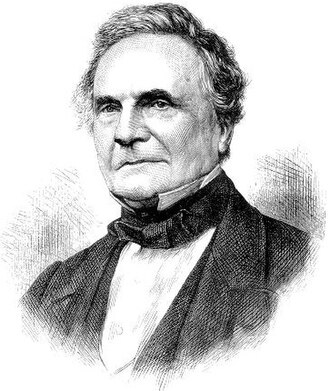
格物
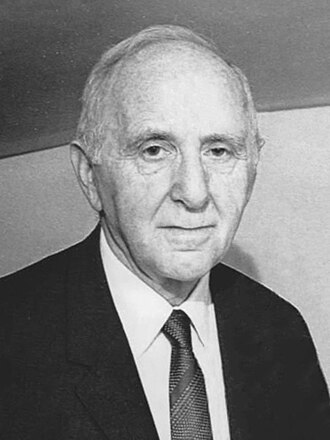
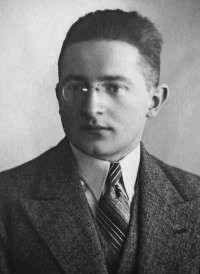
阿尔伯托·考尔德伦1920—1998
Alberto Calderón
Argentine mathematician (1920–1998)
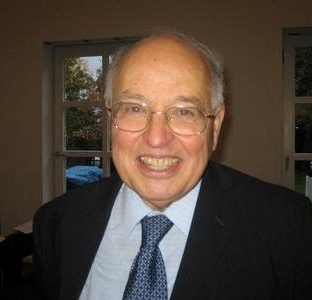
Alberto Pedro Calderón was an Argentine-American mathematician. His name is associated with the University of Buenos Aires, but first and foremost with the University of Chicago, where Calderón and his mentor, the analyst Antoni Zygmund, developed the theory of singular integral operators. This created the "Chicago School of (hard) Analysis".
摘自英文维基百科「Alberto Calderón」(英文维基百科,暂无中文条目),CC BY-SA 4.0
- 出生
- 1920 年 9 月 14 日,门多萨
- 逝世
- 1998 年 4 月 16 日,西北纪念医院
- 国籍
- 阿根廷
- 学科
- 数学、博物与综合
- 职业
- 数学家、大学教师
- 母语 / 工作语言
- 西班牙语、英语
- 母校
- 布宜诺斯艾利斯大学(1947 年)、芝加哥大学(1950 年)、Institut Montana Zugerberg(1934 年)
- 工作单位
- 麻省理工学院(1955—1959)、芝加哥大学(1959—1972)、YPF公司(1947—1948)、俄亥俄州立大学(1950—1953)、普林斯顿高等研究院(1953—1955)、麻省理工学院(1972—1975)、芝加哥大学(1975—1985)、芝加哥大学(1989—1992)
研究领域
主要贡献
代表成就
师承
博士生27
来自 Wikidata 的「博士导师」「师从」「博士生」「学生」记录,可能不全。
所获奖项(5)
- 1979博修奖
- 1989沃尔夫数学奖
- 1989勒罗伊·P·斯蒂尔奖
- 1991美国国家科学奖章
- 1997honorary doctorate of the Autonomous University of Madrid
学会与院士
百科正文
本条目暂无中文维基百科条目,下面是英文维基百科原文。
Calderón's work ranged over a wide variety of topics: from singular integral operators to partial differential equations, from interpolation theory to Cauchy integrals on Lipschitz curves, from ergodic theory to inverse problems in electrical prospection. Calderón's work has also had a powerful impact on practical applications including signal processing, geophysics, and tomography.
Early life and education
Alberto Pedro Calderón was born on September 14, 1920, in Mendoza, Argentina, to Don Pedro Calderón, a physician (urologist), and Haydée. He had several siblings, including a younger brother, Calixto Pedro Calderón, also a mathematician. His father encouraged his mathematical studies. After his mother's unexpected death when he was twelve, he spent two years at the Montana Knabeninstitut, a boys' boarding school near Zürich in Switzerland, where he was mentored by Save Bercovici, who interested him in mathematics. He then completed his high school studies in Mendoza.
Persuaded by his father that he could not make a living as a mathematician, he entered the University of Buenos Aires, where he studied engineering. After graduating in civil engineering in 1947, he got a job in the research laboratory of the geophysical division of the state-owned oil company, the YPF (Yacimientos Petrolíferos Fiscales).
Research
While still working at YPF, Calderón became acquainted with the mathematicians at the University of Buenos Aires: Julio Rey Pastor, the first professor in the Institute of Mathematics, his assistant Alberto González Domínguez (who became his mentor and friend), Luis Santaló and Manuel Balanzat. At the YPF Lab Calderón studied the possibility of determining the conductivity of a body by making electrical measurements at the boundary; he did not publish his results until 1980, in his short Brazilian paper. see also On an inverse boundary value problem and the Commentary by Gunther Uhlmann. It pioneered a new area of mathematical research in inverse problems.
Calderón then took up a post at the University of Buenos Aires. Antoni Zygmund of the University of Chicago, arrived there in 1948 at the invitation of Alberto González Domínguez and Calderón was assigned as his assistant. Zygmund invited Calderón to work with him, and in 1949 Calderón arrived in Chicago with a Rockefeller Fellowship. He was encouraged by Marshall Stone to obtain a doctorate, and with three recently published papers as dissertation, Calderón obtained his PhD in mathematics under Zygmund's supervision in 1950.
The collaboration reached fruition in the Calderón-Zygmund theory of singular integrals, and lasted more than three decades.
Career
In his academic career, Calderón taught at many different universities, but primarily at the University of Chicago and the University of Buenos Aires. Calderón together with his mentor and collaborator Zygmund, maintained close ties with Argentina and Spain, and through their doctoral students and their visits, strongly influenced the development of mathematics in these countries.
- 1947 - 1950 Rockefeller Foundation Fellow, University of Chicago
- 1950 - 1953 Visiting Associate Professor, Ohio State University, Columbus, Ohio
- 1953 - 1955 Member, Institute for Advanced Study, Princeton, New Jersey
- 1955 - 1959 Associate Professor, Massachusetts Institute of Technology
- 1959 - 1968 Professor, University of Chicago
- 1968 - 1972, Louis Block Professor of Mathematics, University of Chicago
- 1972 - 1975 Professor, Massachusetts Institute of Technology
- 1975 - 1985, University Professor of Mathematics, University of Chicago
- 1975 - death, Honorary Professor, University of Buenos Aires
He was also visiting professor at universities including the University of Buenos Aires, Cornell University, Stanford University, National University of Bogotá, Colombia, Collège de France, Paris, University of Paris (Sorbonne), Autónoma and Complutense Universities, Madrid, University of Rome and Göttingen University.
Awards and honors
Calderón was recognized internationally for his outstanding contributions to Mathematics as attested to by his numerous prizes and membership in various academies. He gave many invited addresses to universities and learned societies. In particular he addressed the International Congress of Mathematicians: a) as invited lecturer in Moscow in 1966 and b) as plenary lecturer in Helsinki in 1978. The Instituto Argentino de Matemática (I.A.M.), based in Buenos Aires, a prime research center of the National Research Council of Argentina (CONICET), now honors Alberto Calderón by bearing his name: Instituto Argentino de Matemática Alberto Calderón. In 2007, the Inverse Problems International Association (IPIA) instituted the Calderón Prize, named in honor of Alberto P. Calderón, and awarded to a "researcher who has made distinguished contributions to the field of inverse problems broadly defined".
Academies
1958 Member, American Academy of Arts and Sciences, Boston, Massachusetts
1959 Correspondent Member, National Academy of Exact, Physical and Natural Sciences, Buenos Aires, Argentina
1968 Member, National Academy of Sciences of the U.S.A.
1970 Correspondent Member, Royal Academy of Sciences, Madrid, Spain
1983 Member, Latin American Academy of Sciences, Caracas, Venezuela
Selected papers
Calderón, A. P.; Zygmund, A. (1952), "On the existence of certain singular integrals", Acta Mathematica, 88 (1): 85–139, doi:10.1007/BF02392130, ISSN 0001-5962, MR 0052553, Zbl 0047.10201. This is one of the key papers on singular integral operators.
Calderón, A. P. (1958). "Uniqueness in the Cauchy Problem for Partial Differential Equations". American Journal of Mathematics. 80 (1): 16–36. doi:10.2307/2372819. JSTOR 2372819. S2CID 123717719.
Calderón, A. P. (1963): "Boundary value problems for elliptic equations", Outlines for the Joint Soviet - American Symposium on Partial Differential Equations, Novosibirsk, pp. 303–304.
Calderón, A. P. (1977). "Cauchy integrals on Lipschitz curves and related operators". Proceedings of the National Academy of Sciences of the United States of America. 74 (4): 1324–1327. Bibcode:1977PNAS...74.1324C. doi:10.1073/pnas.74.4.1324. PMC 430741. PMID 16578748.
Calderón, A. P. (1980): "Commutators, Singular Integrals on Lipschitz curves and Applications", Proc. Internat. Congress of Math. 1978, Helsinki, pp. 85–96.
Calderón, A. P. (1964). "Intermediate spaces and interpolation, the complex Method" (PDF). Studia Mathematica. 24 (2): 113–190. doi:10.4064/sm-24-2-113-190.
以上节选摘自英文维基百科「Alberto Calderón」,按 CC BY-SA 4.0 使用,去掉了参考文献、外部链接等尾部小节,公式改写成了纯文本。篇幅所限,较长的小节只摘了开头一部分,有的小节没有收;全文、配图和出处见原文。
同年获同一奖项
同一学科、同时代的科学家




同一学科的科学家
更多 ›