格物
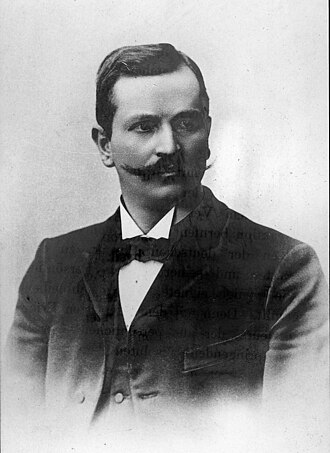
图:Public domain · Wikimedia Commons
- 出生
- 1863 年 7 月 12 日,不伦瑞克
- 逝世
- 1906 年 7 月 5 日,柏林
- 国籍
- 不伦瑞克公国
- 学科
- 物理学、博物与综合
- 职业
- 物理学家、大学教师
- 母语 / 工作语言
- 德语
- 母校
- 哥廷根大学
- 工作单位
- 莱比锡大学、吉森大学、柏林洪堡大学
研究领域
师承
博士导师1
博士生4
来自 Wikidata 的「博士导师」「师从」「博士生」「学生」记录,可能不全。
所获奖项(1)
- 1901honorary member of the Physics Association (Frankfurt am Main, Germany)
学会与院士
百科正文
生平
保罗·德鲁德出生于布伦瑞克,父亲是一位医生,德鲁德一开始在哥廷根大学主修数学,但后来却主修物理。他的论文涵盖了光的反射和衍射晶体中完成于1887年,根据福格特。
1894年,德鲁德在莱比锡大学成为extraordinarius教授,在同一年,他和Emilie Regelsberger在哥廷根当律师的女儿结婚。他们生了四个孩子。 1900年,他成为在那个时候科学期刊《物理学年鉴》的编辑,那是在当时风靡的物理杂志。1901-1905,他是吉森大学物理学的讲座教授。 1905年他成为德国柏林大学物理研究所主任。 1906年,在他的职业生涯的高峰,他成为普鲁士科学院院士的成员。在他就职典礼演讲后的几天,不明的原因,他自杀了。德鲁德留下他的妻子和四个孩子。
德鲁德毕业时,海因里希·赫兹开始出版在他实验室研究的詹姆斯·克拉克·麦克斯韦的电磁理论。因此德鲁德开始他的职业生涯,当时麦克斯韦的理论被引入到德国。
他的第一个实验是测定各种固体的光学常数,测量精度达到空前的水平。然后,他推导出光学和电学常数和物质之间物理结构的关系。 1894年他引出 “C”为光速在一个完好真空中的符号。
此后他皆在莱比锡任职,德鲁德接受应邀写了一本光学的教科书。该书名为《光学教程》("Lehrbuch der Optik"),发表于1900年,汇集了以前不同的科目,电力和光学,这是引用德鲁德为“划时代进展的自然科学”。
1900年,他开发了一个强大的模型来解释热学,电学,光学性质的问题。德鲁德模型将进一步在1933年由阿诺德·索末菲和汉斯·贝特改进。
连结
Brief biography
以上内容摘自维基百科「保罗·德鲁德」,按 CC BY-SA 4.0 使用,去掉了参考文献、外部链接等尾部小节,公式改写成了纯文本。全文、配图和出处见原文。
英文维基百科补充中文条目比较短,下面是英文条目「Paul Drude」的原文
Paul Karl Ludwig Drude ( drood; German: [ˈdʁuːdə]; 12 July 1863 – 5 July 1906) was a German physicist specializing in optics. He is known for the Drude model.
Biography
Education
Paul Karl Ludwig Drude was born on 12 July 1863 in Braunschweig. He began his studies in mathematics at the University of Göttingen, but later changed his major to physics. In 1887, he received his Ph.D. under Woldemar Voigt with a thesis on the reflection and diffraction of light in crystals.
Drude graduated the year Heinrich Hertz began publishing his findings from his experiments on the electromagnetic theories of James Clerk Maxwell, thus Drude began his career at the time Maxwell's theories were being introduced into Germany.
Career and research
In 1894, Drude became professor extraordinarius at the University of Leipzig. The same year, he married Emilie Regelsberger, with whom he had 4 children.
His first experiments were the determination of the optical constants of various solids, measured to unprecedented levels of accuracy. He then worked to derive relationships between the optical and electrical constants and the physical structure of substances. In 1894, he was responsible for introducing the symbol c for the speed of light in a perfect vacuum.
Toward the end of his tenure at Leipzig, Drude was invited to write a textbook on optics, which he accepted. The book, Lehrbuch der Optik, published in 1900, brought together the formerly distinct subjects of electricity and optics, which was cited by Drude as an "epoch-making advance in natural science".
In 1900, Drude became the editor of Annalen der Physik, the most respected physics journal at that time. The same year, he developed a powerful model to explain the thermal, electrical, and optical properties of matter; this is known as the Drude model. In 1901, he was appointed Professor Ordinarius of Physics at the University of Giessen.
In 1905, Drude became Director of the Physics Institute at the University of Berlin. In 1906, at the height of his career, he became a Member of the Prussian Academy of Sciences. A few days after his inauguration lecture, for inexplicable reasons, he committed suicide. He was survived by his wife and children.
Honors
Drude crater on the Moon is named after him.
The Paul Drude Institute, in Berlin, was established in his honor.
以上内容摘自英文维基百科「Paul Drude」,按 CC BY-SA 4.0 使用,去掉了参考文献、外部链接等尾部小节,公式改写成了纯文本。全文、配图和出处见原文。
同一学科、同时代的科学家

同一学科的科学家
更多 ›