格物
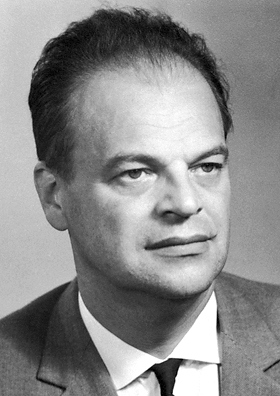
图:Nobel foundation · Public domain · Wikimedia Commons
尼古拉·巴索夫1922—2001
Nikolay Basov
苏维埃俄国物理学家
诺贝尔物理学奖 1964罗蒙诺索夫金质奖章 1990罗蒙诺索夫金质奖章
尼古拉·根纳季耶维奇·巴索夫,苏联物理学家、教育家,因在量子光学领域的重要贡献,1964年与查尔斯·汤斯和亚历山大·普罗霍罗夫同获诺贝尔物理学奖。
摘自维基百科「尼古拉·巴索夫」,CC BY-SA 4.0
- 出生
- 1922 年 12 月 14 日,乌斯曼
- 逝世
- 2001 年 7 月 1 日,莫斯科
- 国籍
- 苏维埃俄国、苏联、俄罗斯
- 学科
- 物理学、工程与发明、博物与综合
- 职业
- 物理学家、发明家、大学教师、政治人物
- 母语 / 工作语言
- 俄语
- 母校
- 国家核子研究大学(1950 年)
- 工作单位
- 列别捷夫物理研究所(1948—)、国家核子研究大学
研究领域
师承
博士生2
来自 Wikidata 的「博士导师」「师从」「博士生」「学生」记录,可能不全。
所获奖项(23)
- 1959列宁奖
- 1964诺贝尔物理学奖
- 1967列宁勋章
- 1969社会主义劳动英雄
- 1969列宁勋章
- 1969镰刀与槌子奖章
- 1972列宁勋章
- 1975列宁勋章
- 1982列宁勋章
- 1982社会主义劳动英雄
- 1982镰刀与槌子奖章
- 1985Order of the Patriotic War, 2nd class
- 1985honorary doctorate of the University Polytechnic of Madrid
- 1986卡林加奖
- 1989苏联国家奖
- 1990罗蒙诺索夫金质奖章
- 1991爱德华泰勒奖
- 1997Order "For Merit to the Fatherland", 2nd class
- 1998美国物理学会会士
- —Russian President's Prize in the field of education
- —波兰共和国功绩勋章
- —Order of Cyril and Methodius
- —罗蒙诺索夫金质奖章
学会与院士
百科正文
荣誉
- 列宁奖(1959年)
- 诺贝尔物理学奖(1964年)
- 两次获得社会主义劳动英雄荣誉称号(1969年,1982年)
- 五次获得列宁勋章
- 二级卫国战争勋章(1985年)
- 罗蒙诺索夫金质奖章(1989年)
- 苏联国家奖(1989年)
- 二级祖国功勋勋章(1997年12月13日)
以上内容摘自维基百科「尼古拉·巴索夫」,按 CC BY-SA 4.0 使用,去掉了参考文献、外部链接等尾部小节,公式改写成了纯文本。全文、配图和出处见原文。
英文维基百科补充中文条目比较短,下面是英文条目「Nikolay Basov」的原文
Nikolay Gennadiyevich Basov (Russian: Николай Геннадиевич Басов; 14 December 1922 – 1 July 2001) was a Soviet physicist and educator. For his fundamental work in the field of quantum electronics that led to the development of laser and maser, Basov shared the 1964 Nobel Prize in Physics with Alexander Prokhorov and Charles Hard Townes.
Early life and education
Nikolay Gennadiyevich Basov was born on 14 December 1922 in Usman, Russia, the son of Gennady Fedorovich Basov and Zinaida Andreevna Molchanova. Basov finished high school in 1941 in Voronezh, and was later called for military service at the Kuibyshev Military Medical Academy. In 1943, he left the academy and served in the Red Army participating in the Second World War with the 1st Ukrainian Front.
In 1945, Basov entered the Moscow Engineering Physics Institute (MEPhI). In 1950, he began his postgraduate studies at the MEPhI, although he worked on his Candidate of Sciences thesis at the Lebedev Physical Institute (LPI)—under the supervision of Mikhail Leontovich and Alexander Prokhorov—receiving his degree in 1953. Basov defended his Doctor of Sciences thesis, A Molecular Oscillator, in 1956.
In 1950, Basov married Ksenia Tikhonovna, who was also a physicist. They had two sons, Gennady (born 1954) and Dmitry (born 1963).
Career and research
Basov was Director of the LPI from 1973 to 1988. He was elected a corresponding member of the USSR Academy of Sciences (Russian Academy of Sciences since 1991) in 1962 and Full Member of the Academy in 1966. In 1967, he was elected a Member of the Presidium of the Academy (1967—1990), and since 1990 he was the councillor of the Presidium of the USSR Academy of Sciences. In 1971 he was elected a Member of the German Academy of Sciences Leopoldina. He was Honorary President and Member of the International Academy of Science, Munich. He was the head of the laboratory of quantum radiophysics at the LPI until his death in 2001.
In the early 1950s Basov and Prokhorov developed theoretical grounds for creation of a molecular oscillator and constructed such an oscillator based on ammonia. Later this oscillator became known as maser. They also proposed a method for the production of population inversion using inhomogeneous electric and magnetic fields. Their results were presented at a national conference in 1952 and published in 1954. Basov then proceeded to the development of laser, an analogous generator of coherent light. In 1955 he designed a three-level laser, and in 1959 suggested constructing a semiconductor laser, which he built with collaborators in 1963. Basov with co-workers proposed Disk laser in 1966 and realized experimentally the thin disk active mirror semiconductor lasers.
He developed with colleaguaes the first nonlinear theory of coherent addition of laser sets.
N.G.Basov encouraged the researchers in nonlinear optics in Lebedev Institute who discovered the optical phase conjugation.
Together with Lebedev Institute researchers he realized the robust method of the phase-locking of laser arrays via optical phase conjugation in Stimulated Brillouin scattering.
Basov's contributions to the development of the laser and maser, which won him the Nobel Prize in 1964, also led to new missile defense initiatives.
Basov died on 1 July 2001 in Moscow at the age of 78, and was buried in Novodevichy Cemetery.
Politics
He entered politics in 1951 and became a member of parliament (the Soviet of the Union of the Supreme Soviet) in 1974. Following U.S. President Ronald Reagan's speech on SDI in 1983, Basov signed a letter along with other Soviet scientists condemning the initiative, which was published in the New York Times. In 1985 he declared the Soviet Union was capable of matching SDI proposals made by the U.S.
以上内容摘自英文维基百科「Nikolay Basov」,按 CC BY-SA 4.0 使用,去掉了参考文献、外部链接等尾部小节,公式改写成了纯文本。全文、配图和出处见原文。
同年获同一奖项
同一学科、同时代的科学家




同一学科的科学家
更多 ›