格物
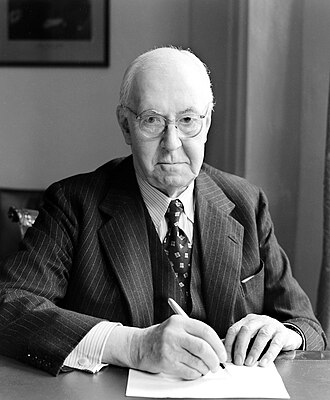
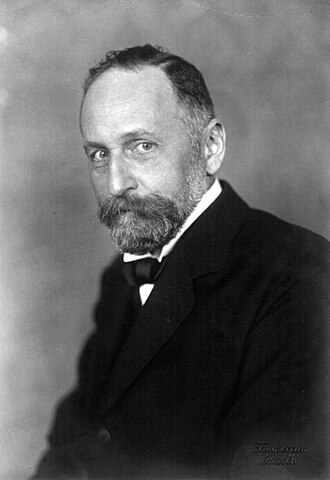
图:Michieli · CC BY 4.0 · Wikimedia Commons
亨利·哈利特·戴尔1875—1968
Henry Hallett Dale
医生, 英国
亨利·哈利特·戴尔爵士,OM,GBE,FRS,英国神经科学家。他研究乙酰胆碱,发现神经冲动的化学传递,与奥托·勒维一起获得1936年的诺贝尔生理学或医学奖。
摘自维基百科「亨利·哈利特·戴尔」,CC BY-SA 4.0
- 出生
- 1875 年 6 月 9 日,伊斯灵顿
- 逝世
- 1968 年 7 月 23 日,剑桥
- 国籍
- 英国
- 学科
- 化学、生物学、医学
- 职业
- 医生、神经学家、生物化学家、生理学家
- 母语 / 工作语言
- 英语
- 母校
- 剑桥大学三一学院、Tollington School、莱士中学、圣巴多罗买医院、伦敦大学学院
- 工作单位
- 伦敦大学学院
师承
来自 Wikidata 的「博士导师」「师从」「博士生」「学生」记录,可能不全。
所获奖项(24)
- 1914英国皇家学会院士
- 1919克鲁内演讲
- 1919大英帝国司令勋章
- 1921贝利奖章
- 1924皇家奖章
- 1932下级勋位爵士
- 1935Harveian Oration
- 1936诺贝尔生理学或医学奖
- 1937科普利奖章
- 1943大英帝国爵级大十字勋章
- 1944功绩勋章
- 1945Honorary Fellow of the Royal College of Surgeons
- 1945doctor honoris causa from the University of Paris
- 1949Grand Cross of the Order of the Crown
- 1952Honorary Fellow of the Royal Society Te Apārangi
- 1954Banting Medal
- 1955蓝马克斯勋章
- 1956阿尔伯特奖章
- 1962Schmiedeberg Plaque
- —Pour le Mérite for Sciences and Arts order
- —维也纳大学荣誉博士
- —honorary doctorate of the University of Graz
- —Cameron Prize of the University of Edinburgh
- —Fellow of the Royal College of Physicians of London
学会与院士
百科正文
研究
在伦敦大学学院工作期间,他结识了Otto Loewi,并成为了朋友。戴尔于1914年成为伦敦国立医学研究所生物化学与药理学系主任。他于1942年成为皇家机构的富勒化学教授。二战期间,他担任内阁科学顾问。
尽管戴尔和他的同事在1914年首次将乙酰胆碱鉴定为一种可能的神经递质,但洛维显示了它在神经系统中的重要作用。两人分享了1936年诺贝尔医学奖。
在1940年代,戴尔被卷入了关于突触信号性质的科学辩论中。 Dale等人认为突触的信号是化学信号,而John Carew Eccles等人则认为突触是电信号。后来发现,大多数突触信号是化学的,但是有些突触是电信号。
戴尔还提出了根据神经元释放的神经递质区分神经元的方案。同一神经元可以释放大量神经递质的这一发现被称为“共存原理”。这种现象最受瑞典神经解剖学家和神经药理学家Tomas Hökfelt的欢迎,他被认为是“共存原理之父”。
个人生活
1904年,戴尔与表妹埃伦·哈里特·哈雷特结婚,育有二女一子。 他们的女儿之一艾莉森·萨拉·戴尔与亚历山大·R·托德结婚,后者也获得了诺贝尔奖,并于1940年至1945年担任皇家学会主席。
以上内容摘自维基百科「亨利·哈利特·戴尔」,按 CC BY-SA 4.0 使用,去掉了参考文献、外部链接等尾部小节,公式改写成了纯文本。全文、配图和出处见原文。
英文维基百科补充中文条目比较短,下面是英文条目「Henry Hallett Dale」的原文
Sir Henry Hallett Dale (9 June 1875 – 23 July 1968) was an English pharmacologist and physiologist. For his study of acetylcholine as agent in the chemical transmission of nerve pulses (neurotransmission) he shared the 1936 Nobel Prize in Physiology or Medicine with Otto Loewi.
Early life and education
Henry Hallett Dale was born in Islington, London, to Charles James Dale, a pottery manufacturer from Staffordshire, and his wife, Frances Anne Hallett, daughter of a furniture manufacturer, from South Devon. Henry was the third of seven children, one of whom (his younger brother, Benjamin Dale) became an accomplished composer and warden of the Royal Academy of Music. Henry was educated at the local Tollington Park College and then The Leys School Cambridge (one of the school's houses is named after him) and in 1894 entered Trinity College, Cambridge, working under the physiologist John Langley. For a few months in 1903 he also studied under Paul Ehrlich in Frankfurt, Germany. Also in 1903, Dale assisted Ernest Starling and William Bayliss in the vivisection of a dog, by removing the dog's pancreas and then killing the dog with a knife, which ultimately led to the events of the Brown Dog affair. Dale received his Doctor of Medicine degree from Cambridge in 1909.
Career and research
While working at the University College London, he met and became friends with Otto Loewi. Dale became the director of the Department of Biochemistry and Pharmacology at the National Institute for Medical Research in London in 1914. He became a Fullerian Professor of Chemistry at the Royal Institution in 1942. During World War II he served on the scientific advisory panel to the Cabinet.
Although Dale and his colleagues first identified acetylcholine in 1914 as a possible neurotransmitter, Loewi showed its importance in the nervous system. The two men shared the 1936 Nobel Prize for Medicine.
During the 1940s Dale was embroiled in the scientific debate over the nature of signaling at the synapse. Dale and others believed that signaling at the synapse was chemical, while John Carew Eccles and others believed that the synapse was electrical. It was later found that most synaptic signalling is chemical, but there are some synapses that are electrical.
Dale also originated the scheme used to differentiate neurons according to the neurotransmitters they release. Thus, neurons releasing noradrenaline (known in the United States as norepinephrine) are called noradrenergic, neurons releasing GABA are GABAergic, and so on. This is called Dale's principle (sometimes erroneously referred to as Dale's Law), one interpretation of which holds that each neuron releases only one type of neurotransmitter. This particular interpretation of Dale's principle has been shown to be false, as many neurons release neuropeptides and amino acids in addition to classical neurotransmitters such as acetylcholine or biogenic amines (see cotransmission) (Bear, et al. 2001). This finding, that numerous neurotransmitters can be released by the same neuron, is referred to as the "coexistence principle." This phenomenon was most popularized by the Swedish neuroanatomist and neuropharmacologist Tomas Hökfelt, who is considered to be the "Father of the Coexistence Principle."
Between 1938 and 1960 Dale served as chairman of the Wellcome Trust. In honour of his work with both the Wellcome Trust and the MRC, on his retirement a small boat equipped with medical facilities was built and named The Lady Dale, and served on the River Gambia to provide medical care for the next thirty years.
Awards and honours
Dale was elected a Fellow of the Royal Society (FRS) in 1914. In 1926, he was awarded the Cameron Prize for Therapeutics of the University of Edinburgh. He was elected to the American Academy of Arts and Sciences in 1927, the American Philosophical Society in 1939, and the United States National Academy of Sciences in 1940.
Personal life
In 1904, Dale had married his first cousin Ellen Harriett Hallett and had a son and two daughters. One of their daughters, Alison Sarah Dale, married Alexander R. Todd, who won the 1957 Nobel Prize in Chemistry and served as President of the Royal Society from 1975 to 1980. The Dales lived at Mount Vernon House from 1919 to 1942.
Sir Henry was made Master of the Worshipful Company of Salters in 1952. The Dales's residency at the house is marked by a Greater London Council blue plaque erected in 1981 on the garden wall of the house.
以上节选摘自英文维基百科「Henry Hallett Dale」,按 CC BY-SA 4.0 使用,去掉了参考文献、外部链接等尾部小节,公式改写成了纯文本。篇幅所限,较长的小节只摘了开头一部分,有的小节没有收;全文、配图和出处见原文。
同年获同一奖项
同一学科、同时代的科学家

同一学科的科学家
更多 ›