格物
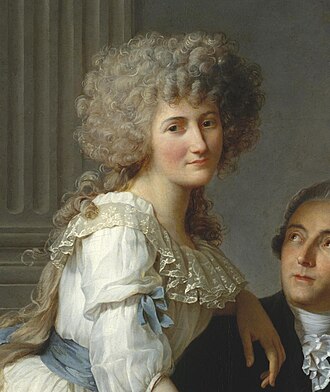
图:Jacques-Louis David · Public domain · Wikimedia Commons
- 出生
- 1758 年 1 月 20 日,蒙布里松
- 逝世
- 1836 年 2 月 10 日,巴黎
- 国籍
- 法国
- 学科
- 化学、博物与综合
- 职业
- 化学家、插画家、译者、自然科学家
- 母语 / 工作语言
- 法语、英语、拉丁语、意大利语
百科正文
英文维基百科补充中文条目比较短,下面是英文条目「Marie-Anne Paulze Lavoisier」的原文
Marie-Anne Pierrette Paulze Lavoisier, later Countess of Rumford, (20 January 1758 – 10 February 1836) was a French chemist and noblewoman. Madame Lavoisier's first husband was the chemist and nobleman Antoine Lavoisier. She acted as his laboratory companion, using her linguistic skills to write up his work and bring it to an international audience. She also played a pivotal role in the translation of several scientific works and was instrumental to the standardization of the scientific method.
Biography
Her father, Jacques Paulze, worked primarily as a parliamentary lawyer and financier. Most of his income came from running the Ferme Générale (the General Farm) which was a private consortium of financiers who paid the French monarchy for the privilege of collecting certain taxes. Her mother, Claudine Thoynet Paulze, died in 1761, leaving behind Marie-Anne, then aged 3, and two sons. After her mother's death Paulze was placed in a convent where she received her formal education. She was for a time a pupil of the artist Jacques-Louis David.
At the age of thirteen, Paulze received a marriage proposal from the 50-year-old Count d'Amerval. Jacques Paulze tried to object to the union, but received threats about losing his job with the Ferme Générale. To indirectly thwart the marriage, Jacques Paulze made an offer to one of his colleagues to ask for his daughter's hand instead. This colleague was Antoine Lavoisier, a French nobleman and scientist. Lavoisier accepted the proposition, and he and Marie-Anne were married on 16 December 1771. Lavoisier was about 28, while Marie-Anne was about 13.
Lavoisier continued to work for the Ferme-Générale but in 1775 was appointed gunpowder administrator, leading the couple to settle down at the Arsenal in Paris. Here, Lavoisier's interest in chemistry blossomed after having previously trained at the chemical laboratory of Guillaume François Rouelle, and, with the financial security provided by both his and Paulze's family, as well as his various titles and other business ventures, he was able to construct a state-of-the-art chemistry laboratory.
Contributions to chemistry
Paulze assisted Lavoisier in the lab during the day, making entries in lab notebooks and sketching diagrams of his experimental designs. The training she had received from the painter Jacques-Louis David allowed her to accurately and precisely draw experimental apparatuses, which ultimately helped many of Lavoisier's contemporaries understand his methods and results. She served as editor of his reports and worked with him to develop the metric system of measurement. Together, the Lavoisiers rebuilt the field of chemistry, which had its roots in alchemy and at the time was a convoluted science dominated by George Stahl’s theory of phlogiston.
In the eighteenth century, the idea of phlogiston (a fire-like element which is gained or released during a material's combustion) was used to describe the apparent property changes that substances exhibited when burned. Paulze, being a master in English, Latin, and French, was able to translate various works about phlogiston into French for her husband to read. Perhaps her most important translation was that of Richard Kirwan's 'Essay on Phlogiston and the Constitution of Acids', which she both translated and critiqued, adding footnotes as she went along and pointing out errors in the chemistry throughout the paper. Despite her contributions, she was not attributed as a translator in the original work, but in later editions. She also translated works by Joseph Priestley, Henry Cavendish, and others for Lavoisier's personal use. This was an invaluable service to Lavoisier, who relied on Paulze's translation of foreign works to keep abreast of current developments in chemistry.
Artistic training and contributions
Paulze began receiving artistic instruction from the painter Jacques-Louis David in late 1785 or early 1786. Not long after, probably sometime in 1787, David painted a full-length double portrait of Paulze and her husband, foregrounding the former. Paulze's artistic training enabled her not only to document and illustrate her husband's experiments and publications (she even depicted herself as a participant in two drawings of her husband's experiments) but also to paint a portrait of Benjamin Franklin, one of the many scientific thinkers she hosted in her salons. Later, Paulze's ties with David were severed due to the radical politics of the latter in the context of the French Revolution.
以上节选摘自英文维基百科「Marie-Anne Paulze Lavoisier」,按 CC BY-SA 4.0 使用,去掉了参考文献、外部链接等尾部小节,公式改写成了纯文本。篇幅所限,较长的小节只摘了开头一部分,有的小节没有收;全文、配图和出处见原文。
同一学科、同时代的科学家