格物

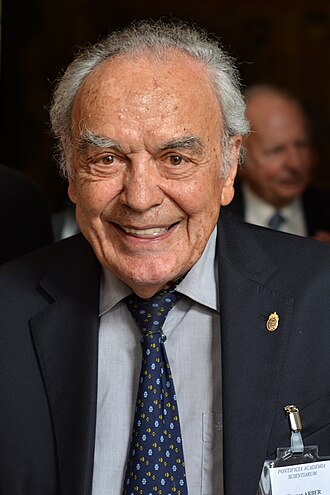
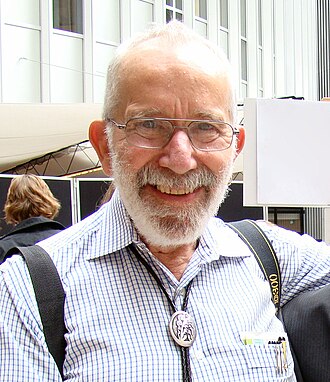
图:Otha deWayne Howse · CC BY-SA 3.0 · Wikimedia Commons
斯坦利·诺曼·科恩1935—
Stanley Norman Cohen
American geneticist
斯坦利·诺曼·科恩,美国遗传学家。
摘自维基百科「斯坦利·诺曼·科恩」,CC BY-SA 4.0
- 出生
- 1935 年 2 月 17 日,珀斯安博伊
- 国籍
- 美国
- 学科
- 生物学、医学、博物与综合
- 职业
- 遗传学家、大学教师、医生、学者
- 母校
- 医学佩雷尔曼学院宾夕法尼亚大学、罗格斯大学
- 工作单位
- 斯坦福大学
研究领域
师承
博士生2
来自 Wikidata 的「博士导师」「师从」「博士生」「学生」记录,可能不全。
所获奖项(9)
- 1980拉斯克基础医学研究奖
- 1981沃尔夫医学奖
- 1988美国国家科学奖章
- 1989国家技术奖章
- 1996勒梅尔森-麻省理工学院奖
- 2001美国发明家名人堂
- 2004奥尔巴尼医疗中心奖
- 2004邵逸夫生命科学与医学奖
- 2016Biotechnology Heritage Award
学会与院士
百科正文
生平
科恩就读于罗格斯大学,1956年获得学士学位。然后在宾夕法尼亚大学学习医学,1960年获硕士学位。1968年成为斯坦福医学院助理教授,1975年成为医学正教授,1977年成为遗传学教授。1978年和1986年间,他曾担任遗传学系主任。自1993年以来,他一直是医学院纪念李国鼎教授。
科恩最早对细菌染色体外的遗传物质——质粒感兴趣,他想方设法要将质粒移植到其他细菌。1973年,他与赫伯特·博耶成功将质粒导入其他细菌,以获得遗传效果,后来证明这种方法能适用于高等动物。这为基因工程奠定了基础。科恩后来还研究过抗生素抗性的发展和传播。1980年科恩获拉斯克基础医学研究奖,1981年获沃尔夫医学奖,1988年获国家科学奖章,1989年获国家技术奖章,2004年获阿尔巴尼医学中心奖、邵逸夫生命科学及医学奖。
以上内容摘自维基百科「斯坦利·诺曼·科恩」,按 CC BY-SA 4.0 使用,去掉了参考文献、外部链接等尾部小节,公式改写成了纯文本。全文、配图和出处见原文。
英文维基百科补充中文条目比较短,下面是英文条目「Stanley Norman Cohen」的原文
Stanley Norman Cohen (born February 17, 1935) is an American geneticist and the Kwoh-Ting Li Professor in the Stanford University School of Medicine. Stanley Cohen and Herbert Boyer were the first scientists to transplant genes from one living organism to another, a fundamental discovery for genetical engineering. Thousands of products have been developed on the basis of their work, including human growth hormone and hepatitis B vaccine. According to immunologist Hugh McDevitt, "Cohen's DNA cloning technology has helped biologists in virtually every field". Without it, "the face of biomedicine and biotechnology would look totally different." Boyer cofounded Genentech in 1976 based on their work together, but Cohen was a consultant for Cetus Corporation and declined to join.
Early life
Cohen was born in Perth Amboy, New Jersey. He graduated from Rutgers University with a B.S. in 1956, and received his M.D. from the University of Pennsylvania School of Medicine in 1960. Cohen then held internships and fellowships at various institutions, including Mount Sinai Hospital in New York City, University Hospital in Ann Arbor, Michigan, and Duke University Hospital in Durham, North Carolina. During a residency at the National Institute for Arthritis and Metabolic Diseases, he decided to combine basic research with a clinical practice. In 1967 he was a postdoctoral researcher at the Albert Einstein College of Medicine.
Career
Cohen joined the faculty of Stanford University in 1968. He was appointed as a Professor of Medicine in 1975, and as a Professor of Genetics in 1977. In 1993, he became the Kwoh-Ting Li Professor in the School of Medicine.
At Stanford he began to explore the field of bacterial plasmids, seeking to understand how the genes of plasmids could make bacteria resistant to antibiotics. At a conference on plasmids in 1972, he met Herbert W. Boyer and discovered that their interests and research were complementary. Plasmids were sent back and forth between Stanley Cohen, Annie C. Y. Chang, and others at Stanford, and Herbert Boyer and Robert B. Helling at the University of California, San Francisco. The Stanford researchers isolated the plasmids, and sent them to the San Francisco team, who cut them using the restriction enzyme EcoRI. The fragments were analyzed and sent back to Stanford, where Cohen's team joined them and introduced them into Escherichia coli. Both laboratories then isolated and analyzed the newly created recombinant plasmids.
This collaboration, in particular the 1973 publication of "Construction of biologically functional bacterial plasmids in vitro" by Cohen, Chang, Boyer and Helling, is considered a landmark in the development of methods to combine and transplant genes. Not only were different plasmids from E. coli successfully joined and inserted back into E. coli cells, but those cells replicated and carried forward the new genetic information. Subsequent experiments that transferred Staphylococcus plasmid genes into E. coli demonstrated that genes could be transplanted between species. These discoveries signaled the birth of genetic engineering, and earned Cohen a number of significant awards, beginning with the Albert Lasker Award for Basic Medical Research in 1980 for "his imaginative and persevering studies of bacterial plasmids, for discovering new opportunities for manipulating and investigating the genetics of cells, and for establishing the biological promise of recombinant DNA methodology."
In 1976, Cohen co-authored a proposal for uniform nomenclature for bacterial plasmids (with Royston C. Clowes, Roy Curtiss III, Naomi Datta, Stanley Falkow and Richard Novick). From 1978 to 1986, Cohen served as chair of the Department of Genetics at Stanford.
During the 1970s and 1980s, Cohen was an active proponent of the potential benefits of DNA technology.
Awards
- 1979 elected to the National Academy of Sciences
- 1980 Albert Lasker Award for Basic Medical Research
- 1981 Wolf Prize in Medicine
- 1988 National Medal of Science from President Reagan
- 1989 National Medal of Technology (shared with Herbert Boyer) from President Bush
- 1996 Lemelson–MIT Prize
- 2001 National Inventors Hall of Fame
- 2004 Albany Medical Center Prize (shared with Herbert Boyer)
- 2004 Shaw Prize in Life Science and Medicine (shared with Herbert Boyer)
- 2006 elected to the American Philosophical Society
- 2009 Double Helix Medal
2016 Biotechnology Heritage Award, from the Biotechnology Industry Organization (BIO) and the Chemical Heritage Foundation
以上节选摘自英文维基百科「Stanley Norman Cohen」,按 CC BY-SA 4.0 使用,去掉了参考文献、外部链接等尾部小节,公式改写成了纯文本。篇幅所限,较长的小节只摘了开头一部分,有的小节没有收;全文、配图和出处见原文。
同年获同一奖项
同一学科、同时代的科学家





同一学科的科学家
更多 ›