格物
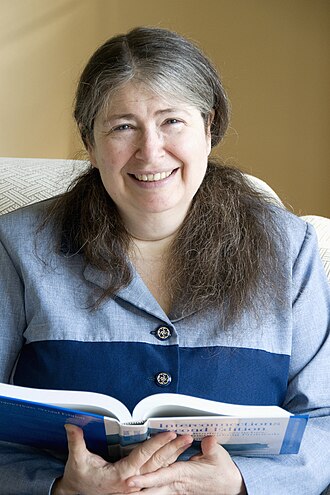
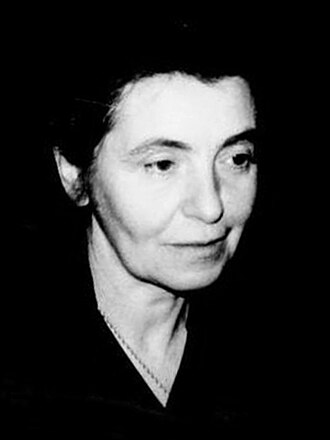
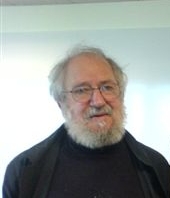
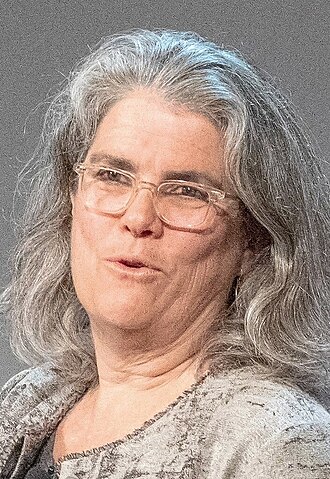
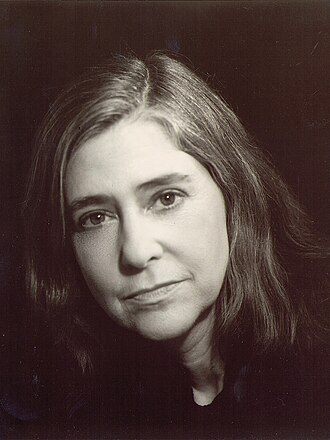
图:Scientist-100 at English Wikipedia · Public domain · Wikimedia Commons
Radia Perlman1951—
American software designer and network engineer (born 1951)
Radia Joy Perlman is an American computer programmer and network engineer. She is a major figure in assembling the networks and technology to enable what we now know as the Internet. She is most famous for her invention of the Spanning Tree Protocol (STP), which is fundamental to the operation of network bridges, while working for Digital Equipment Corporation. Her innovations have made a huge impact on how networks self-organize and move data. She also made large contributions to many other areas of network design and standardization – for example, enabling today's link-state routing protocols to be more robust, scalable, and easy to manage.
摘自英文维基百科「Radia Perlman」(英文维基百科,暂无中文条目),CC BY-SA 4.0
- 出生
- 1951 年 12 月 18 日,朴次茅斯
- 国籍
- 美国
- 学科
- 数学、计算机科学、工程与发明、博物与综合
- 职业
- 计算机科学家、通信工程师、数学家、软件开发者
- 母语 / 工作语言
- 英语
- 母校
- 麻省理工学院(哲学博士,1988 年)、麻省理工学院(理学硕士)
- 工作单位
- 麻省理工学院、BBN科技、太阳微系统、EMC
研究领域
主要贡献
代表成就
本站收录的发现与发明
师承
博士导师1
来自 Wikidata 的「博士导师」「师从」「博士生」「学生」记录,可能不全。
所获奖项(7)
- 2000honorary doctor of Royal Institute of Technology
- 2005Anita Borg Institute Women of Vision Awards
- 2010SIGCOMM Award
- 2014互联网名人堂
- 2016美国发明家名人堂
- 2016ACM会士
- 2023IEEE埃里克·E·萨姆纳奖
学会与院士
百科正文
本条目暂无中文维基百科条目,下面是英文维基百科原文。
Perlman was elected a member of the National Academy of Engineering in 2019 for contributions to Internet routing and bridging protocols. She holds over 100 issued patents. She was elected to the Internet Hall of Fame in 2014, and to the National Inventors Hall of Fame in 2016. She received lifetime achievement awards from USENIX in 2006 and from the Association for Computing Machinery’s SIGCOMM in 2010.
More recently, she has invented the TRILL protocol to correct some of the shortcomings of spanning trees, allowing Ethernet to make optimal use of bandwidth. As of 2022, she was a Fellow at Dell Technologies.
Early life
Perlman was born in 1951, Portsmouth, Virginia. She grew up in Loch Arbour, New Jersey. She is Jewish. Both of her parents worked as engineers for the US government. Her father worked on radar and her mother was a mathematician by training, who worked as a computer programmer. During her school years, Perlman found math and science to be “effortless and fascinating”, but had no problem achieving top grades in other subjects as well as she was a perfectionist. She enjoyed playing the piano and French horn. While her mother helped her with her math homework, they mainly talked about literature and music. But she did not feel as though she fit the stereotype of an "engineer", as she did not disassemble or reassemble computer components.
Despite being the best science and math student in her school, it was only when Perlman took a programming class in high school that she started to consider a career that involved computers. She was the only woman in the class, and later reflected "I was not a hands-on type person. It never occurred to me to take anything apart. I assumed I'd either get electrocuted, or I'd break something". She graduated from Ocean Township High School in 1969.
Education
As an undergraduate at MIT, Perlman learned programming for a physics class. She was given her first paid job in 1971 as part-time programmer for the LOGO Lab at the (then) MIT Artificial Intelligence Laboratory, programming system software such as debuggers.
Working under the supervision of Seymour Papert, she developed a child-friendly version of the educational robotics language LOGO, called TORTIS ("Toddler's Own Recursive Turtle Interpreter System"). During research performed in 1974-76, young children – the youngest aged 3½ years – programmed a LOGO educational robot called a Turtle. Perlman has been described as a pioneer of teaching young children computer programming. Afterwards, she was inspired to make a new programming language that would teach much younger children similar to Logo, but using special "keyboards" and input devices. This project was abandoned because "being the only woman around, I wanted to be taken seriously as a 'scientist' and was a little embarrassed that my project involved cute little kids". An MIT Media project later tracked her down, and told her that others had started a new field called tangible user interface from the leftovers of her abandoned project.
As a math grad at MIT, she needed to find an adviser for her thesis, and joined the MIT group at BBN Technologies. There she first got involved with designing network protocols. Perlman obtained a SB and MS in Mathematics, and later a PhD in Computer Science from MIT in 1988. Her doctoral thesis on routing in environments where malicious network failures are present serves as the basis for much of the work that now exists in this area.
When studying at MIT in the late 60s, she was one among the 50 or so women students in an entering class of about 1,000 undergraduates.
Career
After graduation, she accepted a position with Bolt, Beranek, and Newman (BBN), a government contractor that developed software for network equipment. While working for BBN, Perlman made an impression on a manager for Digital Equipment Corporation (DEC) and was offered a job, joining the firm in 1980. During her time working at Digital, she quickly produced a solution that did exactly what the team wanted it to: the Spanning Tree Protocol. It allows a network to deliver data reliably by making it possible to design the network with redundant links. This setup provides automatic backup paths if an active link fails, and disables the links that are not part of the tree. This leaves a single, active path between any pair of network nodes. She is most famous for STP, which is fundamental to the operation of network bridges in many smaller networks. Perlman is the author of a textbook on networking called “Interconnections: Bridges, Routers, Switches, and Internetworking Protocols” and coauthor of another on network security called “Network Security: Private Communication in a Public World”, which is a now popular college textbook. Her contributions to network security include trust models for Public Key Infrastructure, data expiration, and distributed algorithms resilient despite malicious participants.
She left Digital in 1993 and joined Novell. Then, in 1997 she left Novell and joined Sun Microsystems. Over the course of her career, she has earned over 200 patents, 40 of them while working for Sun Microsystems, where she held the title of Sun Fellow. She has taught courses at the University of Washington, Harvard University, MIT, and Texas A&M, and has been the keynote speaker at events all over the world.
Awards
- Fellow of the Association for Computing Machinery, class of 2016
- National Inventors Hall of Fame induction (2016)
- Internet Hall of Fame induction (2014)
- SIGCOMM Award (2010)
- IEEE Fellow in 2008 for contributions to network routing and security protocols
- USENIX Lifetime Achievement Award (2006)
- Recipient of the first Anita Borg Institute Women of Vision Award for Innovation in 2005
- Silicon Valley Intellectual Property Law Association Inventor of the year (2003)
- Honorary Doctorate, Royal Institute of Technology (June 28, 2000)
Twice named as one of the 20 most influential people in the industry by Data Communications magazine: in the 20th anniversary issue (January 15, 1992) and the 25th anniversary issue (January 15, 1997). Perlman is the only person to be named in both issues.
以上节选摘自英文维基百科「Radia Perlman」,按 CC BY-SA 4.0 使用,去掉了参考文献、外部链接等尾部小节,公式改写成了纯文本。篇幅所限,较长的小节只摘了开头一部分,有的小节没有收;全文、配图和出处见原文。
同一学科、同时代的科学家




同一学科的科学家
更多 ›