格物
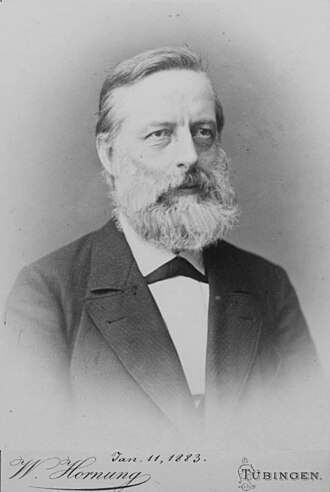
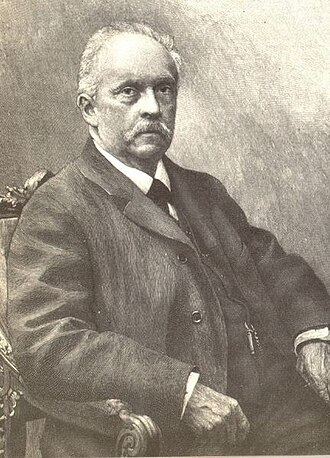
图:Wilhelm Hornung · Public domain · Wikimedia Commons
- 出生
- 1830 年 8 月 19 日,法雷尔
- 逝世
- 1895 年 4 月 11 日,蒂宾根
- 国籍
- 奥尔登堡大公国
- 学科
- 物理学、化学、博物与综合
- 职业
- 化学家、大学教师、哲学家、物理学家
- 母语 / 工作语言
- 德语
- 母校
- 维尔茨堡大学(1854 年)、海德堡大学(1856 年)、苏黎世大学(1853 年)
- 工作单位
- 弗罗茨瓦夫大学(1859—1866)、Eberswalde University for Sustainable Development(1866—1868)、Polytechnikum Karlsruhe(1868—1876)、蒂宾根大学(1876—1895)
研究领域
主要贡献
代表成就
师承
博士导师1
博士生3
来自 Wikidata 的「博士导师」「师从」「博士生」「学生」记录,可能不全。
所获奖项(2)
- 1882戴维奖章
- 1886honorary member of the Physics Association (Frankfurt am Main, Germany)
学会与院士
百科正文
1868年编制出的元素周期表与门捷列夫1869年发表的元素周期表有很多相似之处,但直到1870年他才发表自己的研究成果。
生平
1830年出生于今下萨克森法勒尔,
1851年时进入苏黎世大学攻读医学,
两年后转至维尔茨堡大学就读,鲁道夫·菲尔绍是其病理学导师。
1854年毕业后,至海德堡追随本生学习,
1859年起在布雷斯劳大学担任私讲师教授物理学跟化学,
1866年转至卡尔斯鲁厄大学担任教授,普法战争期间,该大学一度作为医院,迈尔亦担任医生负责治疗受伤的士兵。
1876年赴蒂宾根大学任教并在当地逝世。
以上内容摘自维基百科「尤利乌斯·洛塔尔·迈尔」,按 CC BY-SA 4.0 使用,去掉了参考文献、外部链接等尾部小节,公式改写成了纯文本。全文、配图和出处见原文。
英文维基百科补充中文条目比较短,下面是英文条目「Lothar Meyer」的原文
Julius Lothar Meyer (19 August 1830 – 11 April 1895) was a German chemist. He was one of the pioneers in developing the earliest versions of the periodic table of the chemical elements. The Russian chemist Dmitri Mendeleev (his chief rival) and he both had worked with Robert Bunsen. Meyer never used his first given name and was simply known as Lothar Meyer throughout his life.
Career
Meyer was born in Varel, Germany (then part of the Duchy of Oldenburg). He was the son of Friedrich August Meyer, a physician, and Anna Biermann. After attending the Altes Gymnasium in Oldenburg, he studied medicine at the University of Zurich in 1851. Two years later, he studied pathology at the University of Würzburg as a student of Rudolf Virchow. At Zurich, he had studied under Carl Ludwig, which had prompted him to devote his attention to physiological chemistry. After graduating as a Doctor of Medicine from Würzburg in 1854, he went to Heidelberg University, where Robert Bunsen held the chair of chemistry. In 1858, he received a Ph.D. in chemistry from the University of Breslau with a thesis on the effects of carbon monoxide on the blood. With this interest in the physiology of respiration, he had recognized that oxygen combines with the hemoglobin in blood.
Influenced by the mathematical teaching of Gustav Kirchhoff, he took up the study of mathematical physics at the University of Königsberg under Franz Ernst Neumann and in 1859, after having received his habilitation (certification for university teaching), became Privatdozent in physics and chemistry at the University of Breslau. In 1866, Meyer accepted a post at the Eberswalde Forestry Academy at Neustadt-Eberswalde but two years later was appointed to a professorship at the Karlsruhe Polytechnic.
Periodic table
Meyer is best known for his part in the periodic classification of the elements. He noted, as John A. R. Newlands did in England, that if the elements were arranged in the order of their atomic weights, they fell into groups of similar chemical and physical properties repeated at periodic intervals. According to him, if the atomic weights were plotted as ordinates and the atomic volumes as abscissae—the curve obtained a series of maxima and minima—the most electro-positive elements appearing at the peaks of the curve in the order of their atomic weights.
His book, Die modernen Theorien der Chemie, which he began writing in Breslau in 1862 and published two years later, contained an early version of the periodic table. It contained 28 elements, grouping them for the first time into six families by their valence. Works on organizing the elements by atomic weight, until then had been stymied by the widespread use of equivalent weights for the elements, rather than atomic weights.
He published articles about classification table of the elements in horizontal form (1864) and vertical form (1870), in which the series of periods are properly ended by an element of the alkaline earth metal group.
Table of Meyer, 1870
In 1869, Dmitri Mendeleev published a periodic table of all elements known at that time (he later predicted several new elements to complete the table, and corrected some atomic weights). A few months later, Meyer published a paper that included a revised version of his 1864 table that now included virtually all of the known elements, which was similar to the table published by Mendeleev:
Meyer had developed his fuller periodic table independently, but he acknowledged Mendeleev's priority. Included in Meyer's paper was a line chart of atomic volumes as a function of atomic weights, showing graphically the periodicity of the elements. Like Mendeleev, he also included predictions of future elements, but unlike Mendeleev did not emphasize these predictions nor suggest details of the physical and chemical properties of the future elements.
In 1882, both Meyer and Mendeleev received the Davy Medal from the Royal Society in recognition of their work on the Periodic Law.
The mineral lotharmeyerite, CaZn2(AsO4)2 · 2H2O, was discovered in 1983 and named in recognition of Meyer's work on the Periodic Law. The type locality is the Ojuela mine, Mapimí, Durango, Mexico. Four closely related minerals have been described since 1983: ferrilotharmeyerite (1992); cobaltlotharmeyerite (1997); nickellotharmeyerite (1999); and manganlotharmeyerite (2002).
Personal life
Meyer married Johanna Volkmann in 1866.
Tribute
On 19 August 2020, Google celebrated his 190th birthday with a Google Doodle.
以上节选摘自英文维基百科「Lothar Meyer」,按 CC BY-SA 4.0 使用,去掉了参考文献、外部链接等尾部小节,公式改写成了纯文本。篇幅所限,较长的小节只摘了开头一部分,有的小节没有收;全文、配图和出处见原文。
同年获同一奖项
同一学科、同时代的科学家



同一学科的科学家
更多 ›