格物
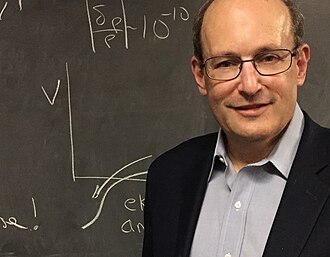
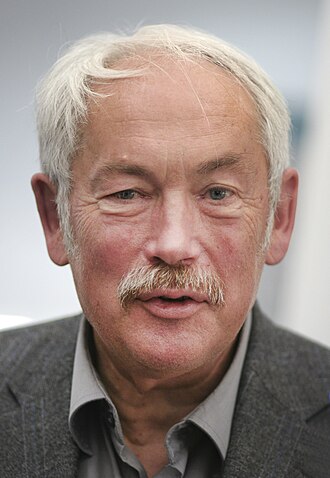
图:Sleepy Geek · CC BY-SA 4.0 · Wikimedia Commons
保罗·斯泰恩哈特1952—
Paul Steinhardt
American cosmologist
保罗·斯泰恩哈特,美国宇宙学家,普林斯顿大学教授。他和他的学生独立地修正了古斯的暴胀模型。在2002年时,由于对宇宙暴胀理论的贡献而荣获国际理论物理研究中心颁发的狄拉克奖章。此外,他也因预测“准晶体”这种假设性的新状态物质而闻名。
摘自维基百科「保罗·斯泰恩哈特」,CC BY-SA 4.0
- 出生
- 1952 年 12 月 25 日,华盛顿哥伦比亚特区
- 国籍
- 美国
- 学科
- 物理学、天文学、博物与综合
- 职业
- 物理学家、非虚构文学作家、大学教师、天文学家
- 母语 / 工作语言
- 英语
- 母校
- 哈佛大学、珊瑚墙高级中学
- 工作单位
- 普林斯顿大学、宾夕法尼亚大学
研究领域
主要贡献
本站收录的发现与发明
师承
博士导师1
博士生5
来自 Wikidata 的「博士导师」「师从」「博士生」「学生」记录,可能不全。
所获奖项(6)
- 2002狄拉克奖章(ICTP)
- 2006汤森路透引文桂冠奖
- 2010奥利弗·巴克利奖
- 2012约翰·斯科特奖
- —古根海姆学者奖
- —美国物理学会会士
学会与院士
百科正文
英文维基百科补充中文条目比较短,下面是英文条目「Paul Steinhardt」的原文
Paul Joseph Steinhardt (born December 25, 1952) is an American theoretical physicist whose principal research is in cosmology and condensed matter physics. He is currently the Albert Einstein Professor in Science at Princeton University, where he is on the faculty of both the Departments of Physics and of Astrophysical Sciences.
Steinhardt is best known for his development of new theories of the origin, evolution and future of the universe. He is also well known for his exploration of a new form of matter, known as quasicrystals, which were thought to exist only as man-made materials until he co-discovered the first known natural quasicrystal in a museum sample. He subsequently led a separate team that followed up that discovery with several more examples of natural quasicrystals recovered from the wilds of the Kamchatka Peninsula in far eastern Russia. Several years later, he and collaborators reported the accidental synthesis of a previously unknown type of quasicrystal in the remnants of the first atomic bomb test on July 16, 1945, at Alamagordo, New Mexico.
He has written two popular books on these topics. Endless Universe: Beyond the Big Bang (2007), co-authored with Neil Turok, describes the early struggles in challenging the widely accepted big bang theory and the subsequent development of the bouncing or cyclic theories of the universe, which are currently being explored and tested. The Second Kind of Impossible: The Extraordinary Quest for a New Form of Matter (2019) recounts the story of quasicrystals from his invention of the concept with his then-student Dov Levine, to his expedition to far eastern Russia to recover meteorite fragments containing natural quasicrystal grains formed billions of years ago.
Education and career
Born in 1952 to Helen and Charles Steinhardt, Paul Steinhardt is the second oldest of four children. He grew up in Miami, Florida, where he attended Coral Gables Senior High School while attending classes at a local university. Steinhardt received his Bachelor of Science in physics at Caltech in 1974, and his Ph.D. in physics at Harvard University in 1978 where his advisor was Sidney Coleman. He was a Junior Fellow in the Harvard Society of Fellows from 1978 to 1981. He rose from junior faculty to Mary Amanda Wood Professor at the University of Pennsylvania between 1981 and 1998, during which he maintained a long-term association with the Thomas J. Watson Research Center, and has been on the faculty at Princeton University since the Fall of 1998. He co-founded the Princeton Center for Theoretical Science and served as its Director from 2007 to 2019.
Research
Inflationary cosmology
Beginning in the early 1980s, Steinhardt co-authored seminal papers that helped to lay the foundations of inflationary cosmology.
Slow-roll inflation and generation of the seeds for galaxies
In 1982, Steinhardt and Andreas Albrecht (and, independently, Andrei Linde) constructed the first inflationary models that could speed up the expansion of the universe enough to explain the observed smoothness and flatness of the universe and then "gracefully exit" to the more modest expansion observed today. The Albrecht-Steinhardt paper was the first to note the effect of Hubble friction in sustaining inflation for a sufficiently long period (the "slow-roll" effect), setting the prototype for most subsequent inflationary models.
Hubble friction played a critical role in the 1983 paper by James Bardeen, Steinhardt and Michael S.
Honors and awards
In 1986, Steinhardt was elected as a Fellow in the American Physical Society in recognition of his contributions to cosmology and to the theoretical understanding of quasicrystals.
In 1994, he was named a Guggenheim Fellow.
In 1998, he was elected to the United States National Academy of Sciences.
In 2002, Steinhardt was honored for his work on the inflationary model of the universe with the P.A.M. Dirac Medal from the International Centre for Theoretical Physics. He shared the award with Alan Guth of MIT and Andrei Linde of Stanford.
In 2010, Steinhardt received the Oliver E. Buckley Condensed Matter Prize of the American Physical Society for his pioneering contributions to the theory of quasicrystals.
In 2012, he received the John Scott Award for his work on quasicrystals.
In 2012, Steinhardt was named Simons Fellow in Theoretical Physics and Radcliffe Fellow at the Radcliffe Institute for Advanced Study at Harvard.
以上节选摘自英文维基百科「Paul Steinhardt」,按 CC BY-SA 4.0 使用,去掉了参考文献、外部链接等尾部小节,公式改写成了纯文本。篇幅所限,较长的小节只摘了开头一部分,有的小节没有收;全文、配图和出处见原文。
同年获同一奖项
同一学科、同时代的科学家






同一学科的科学家
更多 ›