格物
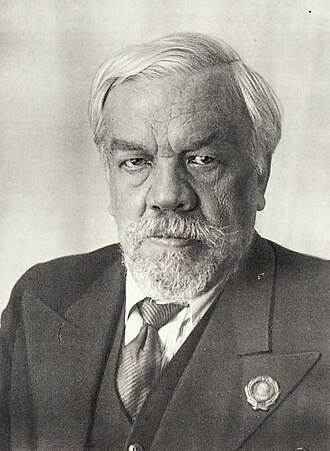
图:作者不详 · Public domain · Wikimedia Commons
- 出生
- 1869 年 4 月 5 日,恰普雷金
- 逝世
- 1942 年 10 月 8 日,新西伯利亚
- 国籍
- 俄罗斯帝国、苏联
- 学科
- 物理学、数学、工程与发明、博物与综合
- 职业
- 数学家、物理学家、工程师、大学教师
- 母语 / 工作语言
- 俄语
- 母校
- 莫斯科帝国大学物理与数学系(硕士,1893 年)、莫斯科国立大学(博士,1902 年)
- 工作单位
- 中央流体力学研究所(1918—1942)、Imperial Moscow Engineering School(1896—1906)、帝国莫斯科大学(1894—1918)
研究领域
主要贡献
代表成就
以他 / 她命名
师承
博士生4
来自 Wikidata 的「博士导师」「师从」「博士生」「学生」记录,可能不全。
所获奖项(9)
- 1925Zhukovsky Prize
- 1927红旗劳动勋章
- 1929俄罗斯苏维埃联邦社会主义共和国功勋科学工作者
- 1933列宁勋章
- 1941社会主义劳动英雄
- —Order of Saint Stanislaus, 2nd class
- —圣弗拉基米尔勋章
- —Order of Saint Anna, 2nd class
- —Order of Saint Anna, 3rd class
学会与院士
百科正文
简介
1869年4月5日,他出生于利佩茨克州恰普雷金。1877年就读于沃罗涅日第二高中,1890年,毕业于莫斯科国立大学,后来成为了一名教授。1901年曾在莫斯科女子高等讲习所教授机械工程,1903年又在莫斯科高等技术学校教授应用数学。苏联著名物理学家"列昂尼德·伊凡诺维奇·谢多夫"(Leonid I. Sedov)就是他的学生之一。1942年10月8日,他在新西伯利亚州新西伯利亚市去世。
恰普雷金的理论曾受到中央空气流体动力学研究院创始人尼古拉·叶戈罗维奇·茹科夫斯基的极大启发。他早期的研究主要在流体力学领域,在1948年发表了他的四卷《全集》。数学上的恰普雷金方程和宇宙学中所假设的物质-"恰普雷金气体"就是以他的名字命名的。
荣誉和纪念
- 社会主义劳动英雄(1941年2月1日);
- 被二次授予列宁勋章(1941年2月1日和1933年12月22日);
- 被二次授予劳动红旗勋章(1927年7月10日和?);
茹科夫斯基奖(1925年)。
1924年入选为俄罗斯科学院(1925年-1991年的苏联科学院)院士,月球上的恰普雷金环形山就是以他的名字命名的。
另请参阅
- 查普雷金宇宙模型
- 恰普雷金方程
- 恰普雷金雪橇
- 恰普雷金顶点
以上内容摘自维基百科「谢尔盖·恰普雷金」,按 CC BY-SA 4.0 使用,去掉了参考文献、外部链接等尾部小节,公式改写成了纯文本。全文、配图和出处见原文。
英文维基百科补充中文条目比较短,下面是英文条目「Sergey Chaplygin」的原文
Sergey Alexeyevich Chaplygin (Russian: Серге́й Алексе́евич Чаплы́гин; 5 April 1869 – 8 October 1942) was a Russian and Soviet physicist, mathematician, and mechanical engineer. He is known for mathematical formulas such as Chaplygin's equation and for a hypothetical substance in cosmology called Chaplygin gas, named after him.
He graduated in 1890 from Moscow University, and later became a professor. He taught mechanical engineering at Moscow Higher Courses for Women in 1901, and of applied mathematics at Moscow School of Technology, 1903. He was appointed Director of the courses in 1905. Leonid I. Sedov was one of his students.
Chaplygin's theories were greatly inspired by N. Ye. Zhukovsky, who founded the Central Institute of Aerodynamics. His early research focused on hydromechanics. His "Collected Works", consisting of 4 volumes, were published in 1948.
Biography
Early life
Chaplygin was born to Aleksei Timofeevich Chaplygin, a shop assistant, and Anna Petrovna in Ranenburg (present day Chaplygin), Russia. After his father died when he was 2 years old, his mother remarried a tradesman and they moved to Voronezh. There, he attended the Voronezh Gymnasium, which he graduated in 1886.
Soon after, he attended the Moscow University, specializing in Physics and Mathematics, which he graduated from in 1890. There he met and was strongly influenced by Nikolai Egorovich Zhukovsky. In 1893, he published his first work, On certain cases of the motion of a solid body in a fluid, for which he received the N. D. Brashman Award.
After graduating from the university, he went on to become a professor there. In 1897, he published On the motion of a heavy body of revolution in a horizontal plane, which was the first to present the general equation of motion of a nonholonomic system. This equation is a generalisation of Lagrange's equation. In 1899, he was awarded the Gold Medal of the St. Petersburg Academy of Sciences.
Death
Chaplygin died of a brain haemorrhage in October 1942.
Honours and awards
- Hero of Socialist Labour (1 February 1941)
- Two Orders of Lenin (1 February 1941 and 22 December 1933)
- Order of the Red Banner of Labour, twice (10 July 1927 and ?)
- Zhukovsky Prize (1925)
- N. D. Brashman Prize (1897)
Chaplygin was elected to the Russian Academy of Sciences (the Academy of Sciences of the USSR in 1925-1991) in 1924.
The lunar crater Chaplygin and town Chaplygin are named in his honour.
以上内容摘自英文维基百科「Sergey Chaplygin」,按 CC BY-SA 4.0 使用,去掉了参考文献、外部链接等尾部小节,公式改写成了纯文本。全文、配图和出处见原文。
同一学科、同时代的科学家

同一学科的科学家
更多 ›