格物

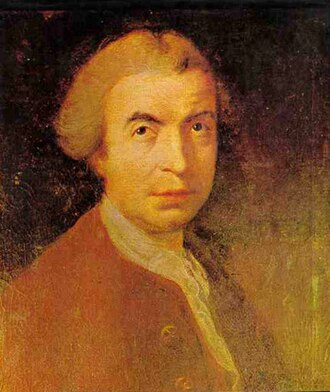
图:After Maurice Quentin de La Tour · Public domain · Wikimedia Commons
- 出生
- 1717 年 11 月 16 日,巴黎
- 逝世
- 1783 年 10 月 29 日,巴黎
- 国籍
- 法兰西王国
- 学科
- 物理学、数学、天文学、工程与发明、博物与综合
- 职业
- 哲学家、数学家、物理学家、音乐学家
- 母语 / 工作语言
- 法语
- 母校
- 巴黎大学(1738 年)、四族学院(1735 年)
研究领域
主要贡献
代表成就
本站收录的发现与发明
以他 / 她命名
师承
博士导师1
来自 Wikidata 的「博士导师」「师从」「博士生」「学生」记录,可能不全。
所获奖项(2)
- 1781美国文理科学院院士
- —英国皇家学会院士
学会与院士
百科正文
身世
达朗贝尔的身世多舛,出生后即被遗弃在巴黎的一座教堂圣让勒朗(Saint Jean-le-Rond)附近,所以以教堂的名字命名。后被一位玻璃匠收养长大。
以上内容摘自维基百科「让·勒朗·达朗贝尔」,按 CC BY-SA 4.0 使用,去掉了参考文献、外部链接等尾部小节,公式改写成了纯文本。全文、配图和出处见原文。
英文维基百科补充中文条目比较短,下面是英文条目「Jean Le Rond d'Alembert」的原文
Jean Le Rond d'Alembert ( DAL-əm-BAIR; French: [ʒɑ̃ lə ʁɔ̃ dalɑ̃bɛʁ]; 16 November 1717 – 29 October 1783) was a French mathematician, physicist, philosopher, and music theorist. Until 1759 he was, together with Denis Diderot, a co-editor of the Encyclopédie.
His most famous achievements include the wave equation, also known as d'Alembert's equation, and D'Alembert's formula for solving said equation. In French, the fundamental theorem of algebra is named in his honour.
Early years
Born in Paris, d'Alembert was the natural son of the writer Claudine Guérin de Tencin and the chevalier Louis-Camus Destouches, an artillery officer. Destouches was abroad at the time of d'Alembert's birth. Days after birth his mother left him on the steps of the Saint-Jean-le-Rond de Paris church. According to custom, he was named after the patron saint of the church.
Studies and adult life
D'Alembert first attended a private school. The chevalier Destouches left d'Alembert an annuity of 1,200 livres on his death in 1726. Under the influence of the Destouches family, at the age of 12 d'Alembert entered the Jansenist Collège des Quatre-Nations (the institution was also known under the name "Collège Mazarin"). Here he studied philosophy, law, and the arts, graduating as baccalauréat en arts in 1735.
Career
In July 1739 he made his first contribution to the field of mathematics, pointing out the errors he had detected in Analyse démontrée (published 1708 by Charles-René Reynaud) in a communication addressed to the Académie des Sciences. At the time L'analyse démontrée was a standard work, which d'Alembert himself had used to study the foundations of mathematics.
Music theories
D'Alembert's first exposure to music theory was in 1749 when he was called upon to review a Mémoire submitted to the Académie by Jean-Philippe Rameau. This article, written in conjunction with Diderot, would later form the basis of Rameau's 1750 treatise Démonstration du principe de l'harmonie. D'Alembert wrote a glowing review praising the author's deductive character as an ideal scientific model.
Personal life
D'Alembert was a participant in several Parisian salons, particularly those of Marie Thérèse Rodet Geoffrin, of the marquise du Deffand and of Julie de Lespinasse. D'Alembert became infatuated with Julie de Lespinasse, and eventually took up residence with her.
Death
He suffered bad health for many years and his death was as the result of a urinary bladder illness. As a known unbeliever, D'Alembert was buried in a common unmarked grave.
Legacy
In France, the fundamental theorem of algebra is known as the d'Alembert–Gauss theorem, as an error in d'Alembert's proof was caught by Carl Friedrich Gauss.
He also created his ratio test to determine if a series converges.
The d'Alembert operator, which first arose in d'Alembert's analysis of vibrating strings, plays an important role in modern theoretical physics.
Fictional portrayal
Diderot portrayed d'Alembert in Le rêve de D'Alembert (D'Alembert's Dream), written after the two men had become estranged. It depicts d'Alembert ill in bed, conducting a debate on materialist philosophy in his sleep.
D'Alembert's Principle, a 1996 novel by Andrew Crumey, takes its title from D'Alembert's principle in physics. Its first part describes d'Alembert's life and his infatuation with Julie de Lespinasse.
List of works
D'Alembert, Jean Le Rond (1743). Traité de dynamique (2nd ed.). Gabay (1990 reprint).
D'Alembert, Jean Le Rond (1747a). "Recherches sur la courbe que forme une corde tenduë mise en vibration (Researches on the curve that a tense cord forms [when] set into vibration)". Histoire de l'académie royale des sciences et belles lettres de Berlin. Vol. 3. pp. 214–219.
以上节选摘自英文维基百科「Jean Le Rond d'Alembert」,按 CC BY-SA 4.0 使用,去掉了参考文献、外部链接等尾部小节,公式改写成了纯文本。篇幅所限,较长的小节只摘了开头一部分,有的小节没有收;全文、配图和出处见原文。
同一学科、同时代的科学家





同一学科的科学家
更多 ›