格物
- 类型
- 方程
- 命名来源
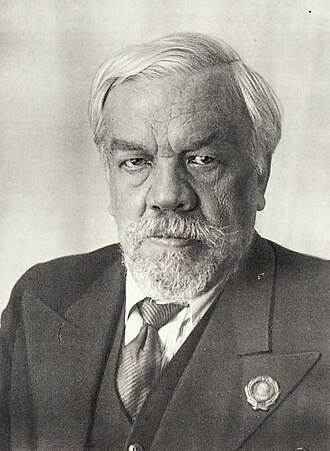
- 谢尔盖·阿列克谢耶维奇·恰普雷金
- 学科
- 物理学
相关科学家
百科正文
解析解: u(x,t)=_(C)1+_(C)2*(_(C)3+C[1]*x+_(C)4*t)
u(x,t)=_(C)1+((1/2)*π -_(C)3-C[1]*x-_(C)4*t)*_(C)2
- (公式略)
- (公式略)
- (公式略)
- (公式略)
以上内容摘自维基百科「查普里金方程」,按 CC BY-SA 4.0 使用,去掉了参考文献、外部链接等尾部小节,公式改写成了纯文本。全文、配图和出处见原文。
英文维基百科补充中文条目比较短,下面是英文条目「Chaplygin's equation」的原文
In gas dynamics, Chaplygin's equation, named after Sergei Alekseevich Chaplygin (1902), is a partial differential equation useful in the study of transonic flow. It is (公式略)
Here, c=c(v) is the speed of sound, determined by the equation of state of the fluid and conservation of energy. For polytropic gases, we have c²/(γ -1)=h₀-v²/2, where γ is the specific heat ratio and h₀ is the stagnation enthalpy, in which case the Chaplygin's equation reduces to (公式略)
The Bernoulli equation (see the derivation below) states that maximum velocity occurs when specific enthalpy is at the smallest value possible; one can take the specific enthalpy to be zero corresponding to absolute zero temperature as the reference value, in which case 2h₀ is the maximum attainable velocity. The particular integrals of above equation can be expressed in terms of hypergeometric functions.
Derivation
For two-dimensional potential flow, the continuity equation and the Euler equations (in fact, the compressible Bernoulli's equation due to irrotationality) in Cartesian coordinates (x,y) involving the variables fluid velocity (vₓ,v_(y)), specific enthalpy h and density ρ are (公式略)
with the equation of state ρ =ρ (s,h) acting as third equation. Here hₒ is the stagnation enthalpy, v²=vₓ²+v_(y)² is the magnitude of the velocity vector and s is the entropy. For isentropic flow, density can be expressed as a function only of enthalpy ρ =ρ (h), which in turn using Bernoulli's equation can be written as ρ =ρ (v).
Since the flow is irrotational, a velocity potential φ exists and its differential is simply dφ =vₓdx+v_(y)dy. Instead of treating vₓ=vₓ(x,y) and v_(y)=v_(y)(x,y) as dependent variables, we use a coordinate transform such that x=x(vₓ,v_(y)) and y=y(vₓ,v_(y)) become new dependent variables. Similarly the velocity potential is replaced by a new function (Legendre transformation) Φ =xvₓ+yv_(y)-φ
such then its differential is dΦ =xdvₓ+ydv_(y), therefore (公式略)
Introducing another coordinate transformation for the independent variables from (vₓ,v_(y)) (v,θ) according to the relation vₓ=vcos θ and v_(y)=vsin θ, where v is the magnitude of the velocity vector and θ is the angle that the velocity vector makes with the vₓ -axis, the dependent variables become (公式略)
The continuity equation in the new coordinates become (公式略)
For isentropic flow, dh=ρ ⁻¹c²dρ, where c is the speed of sound. Using the Bernoulli's equation we find (公式略)
where c=c(v). Hence, we have (公式略)
以上内容摘自英文维基百科「Chaplygin's equation」,按 CC BY-SA 4.0 使用,去掉了参考文献、外部链接等尾部小节,公式改写成了纯文本。全文、配图和出处见原文。