 格物
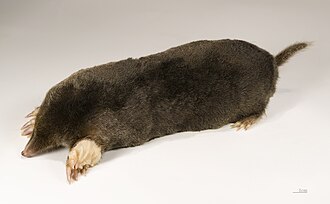
图:Didier Descouens · CC BY-SA 4.0 · Wikimedia Commons
- 学名
- Talpidae
- 分类等级
- 科
- 上级类群
- 真盲缺目
- 大类
- 哺乳动物
- 命名
- 戈特黑尔夫·菲舍尔·冯·瓦尔德海姆,1814 年
- 主要食物
- 蠕虫、chrysalis、毛虫
- 用途
- 生物虫害防治
- 数据库
- NCBI 分类 · GBIF
下级类群(2)
百科正文
分类
- 鼹科动物可以分为3个亚科、7个族及17个属:
- 美洲鼹亚科 Scalopinae
- 星鼻鼹族 Condylurini
- 星鼻鼹属 Condylura
- 美洲鼹族 Scalopini
- 毛尾鼹属 Parascalops
- 美洲鼹属 Scalopus
- 甘肃鼹属 Scapanulus
- 西鼹属 Scapanus
- 鼹亚科 Talpinae
- 俄罗斯麝鼹族 Desmanini
- 俄罗斯麝鼹属 Desmana
- 鼬鼹属 Galemys
- 北美鼩鼹族 Neurotrichini
- 北美鼩鼹属 Neurotrichus
- 长尾鼩鼹族 Scaptonychini
- 长尾鼩鼹属 Scaptonyx
- 鼹族 Talpini
- 东方鼹属 Euroscaptor
- 缺齿鼹属 Mogera
- 毛尾鼹属 Parascalops
- 麝鼹属 Scaptochirus
- 鼹属 Talpa
- 日本鼩鼹族 Urotrichini
- 毛吻鼩鼹属 Dymecodon
- 日本鼩鼹属 Urotrichus
- 鼩鼹亚科 Uropsilinae
- 鼩鼹属 Uropsilus
以上内容摘自维基百科「鼴科」,按 CC BY-SA 4.0 使用,去掉了参考文献、外部链接等尾部小节,公式改写成了纯文本。全文、配图和出处见原文。
英文维基百科补充中文条目比较短,下面是英文条目「Talpidae」的原文
The family Talpidae includes the true moles (as well as the shrew moles and desmans), who are small insectivorous mammals of the order Eulipotyphla. Talpids are all digging animals to various degrees: moles are completely subterranean animals; shrew moles and shrew-like moles somewhat less so; and desmans, while basically aquatic, excavate dry sleeping chambers; whilst the quite unique star-nosed mole is equally adept in the water and underground. Talpids are found across the Northern Hemisphere of Eurasia and North America (although none are found in Ireland nor in the Americas south of northern Mexico), and range as far south as the montane regions of tropical Southeast Asia.
The first talpids evolved from shrew-like animals which adapted to digging late in the Eocene in Europe. Eotalpa anglica is the oldest known mole, discovered in the Late Eocene deposits of Hampshire Basin, UK. The most primitive living talpids are believed to be the shrew-like moles, with other species having adapted further into the subterranean, and, in some cases, aquatic lifestyles.
Characteristics
Talpids are small, dark-furred animals with cylindrical bodies and hairless, tubular snouts. They range in size from the tiny shrew moles of North America, as small as 10 cm in length and weighing under 12 grams, to the Russian desman, with a body length of 18–22 cm, and a weight of about 550 grams. The fur varies between species, but is always dense and short; desmans have waterproof undercoats and oily guard hairs, while the subterranean moles have short, velvety fur lacking any guard hairs. The forelimbs of moles are highly adapted for digging, with powerful claws, and the paws turned permanently outwards to aid in shovelling dirt away from the front of the body. By contrast, desmans have webbed paws with a fringe of stiff fur to aid in swimming. Moles generally have short tails, but those of desmans are elongated and flattened.
All species have small eyes and poor eyesight, but only a few are truly blind. The external ears are very small or absent. Talpids rely primarily on their sense of touch, having sensory vibrissae on their faces, legs, and tails. Their flexible snouts are particularly sensitive. Desmans are able to close both their nostrils and ears while diving. Unusually, the penis of talpids points backwards, and they have no scrotum.
Females have six or eight teats. Both sexes have claws on all five fingers and on all five toes. The paw has an additional bone called the os falciforme. In burrowing moles, the clavicle and the humeral head are connected. The tibia and the fibula are partially fused in all talpids.
Classification
The family is divided into three subfamilies, 19 genera and 59 species.
- Family Talpidae
- Subfamily Uropsilinae - Asian shrew-like moles (Chinese shrew moles)
- Genus Uropsilus - eight species in China, Bhutan, and Myanmar
- Equivalent-teeth shrew mole, U. aequodonenia
- Anderson's shrew mole, U. andersoni
- Black-backed shrew mole, U. atronates
- Dabie Mountains shrew mole, U. dabieshanensis
- Gracile shrew mole, U. gracilis
- Inquisitive shrew mole, U. investigator
- Snow Mountain shrew mole, U. nivatus
- Chinese shrew mole, U. soricipes
- Subfamily Scalopinae - New World moles
- Tribe Condylurini - condylurine moles
- Genus Condylura - one species in eastern North America
- Star-nosed mole, C. cristata
- Tribe Scalopini - scalopine moles
- Genus Alpiscaptulus - one species in China
- Medog mole, A. medogensis
- Genus Parascalops - one species in northeastern North America
- Hairy-tailed mole, P. breweri
- Genus Scalopus - one species in eastern North America
- Eastern mole, S. aquaticus
- Genus Scapanulus - one species in China
- Gansu mole, S. oweni
- Genus Scapanus - five species in western North America
- Mexican mole, S. anthonyi
- Northern broad-footed mole, S. latimanus
- Southern broad-footed mole, S. occultus
- Coast mole, S. orarius
- Townsend's mole, S. townsendii
- Subfamily Talpinae - Old World moles, desmans, and shrew moles
- Tribe Talpini - talpine moles
- Genus Euroscaptor - ten species in East, South, and Southeast Asia
- Greater Chinese mole, E. grandis
- Kloss's mole, E. klossi
- Kuznetsov's mole, E. kuznetsovi
- Long-nosed mole, E. longirostris
- Malaysian mole, E. malayanus
- Himalayan mole, E. micrurus
- Ngoc Linh mole, E. ngoclinhensis
- Orlov's mole, E. orlovi
Relationship with humans
All species in the family Talpidae are classed as "prohibited new organisms" under New Zealand's Hazardous Substances and New Organisms Act 1996, preventing them from being imported into the country.
以上节选摘自英文维基百科「Talpidae」,按 CC BY-SA 4.0 使用,去掉了参考文献、外部链接等尾部小节,公式改写成了纯文本。篇幅所限,较长的小节只摘了开头一部分,有的小节没有收;全文、配图和出处见原文。