 格物
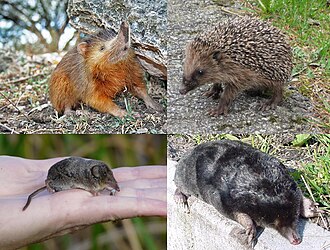
图:derivative work: user:The Explaner · CC BY-SA 4.0 · Wikimedia Commons
生命之树 › 真核生物 › 动物界 › 真后生动物亚界 › 两侧对称动物 › 后口动物总门 › 脊索动物门 › 脊椎动物亚门 › 有颌下门 › 肉鳍鱼总纲 › 四足形类 › 希望螈目 › 四足总纲 › 哺乳动物 › 兽型类 › 全兽类 › 兽亚纲 › 有胎盘类 › 北方真兽高目 › 劳亚兽总目
真盲缺目目
Eulipotyphla
真盲缺目 又名劳亚食虫目,是哺乳动物的一目。原本,本目的物种被归于现已不再使用的食虫目中,但因种系发生的研究确定食虫目是多系群,而被重新分类成“盲缺目”(Lipotyphla)指没有盲肠的动物;随后,又移除了马岛猬及金毛鼹等非洲猬目动物,成为现在的“真盲缺目”(或称“劳亚食虫目”)。
摘自维基百科「真盲缺目」,CC BY-SA 4.0
- 学名
- Eulipotyphla
- 分类等级
- 目
- 上级类群
- 劳亚兽总目
- 大类
- 哺乳动物
- 命名
- Peter J. Waddell、Norihiro Okada、Masami Hasegawa,1999 年
- 数据库
- NCBI 分类
下级类群(5)
百科正文
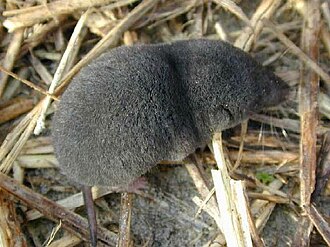
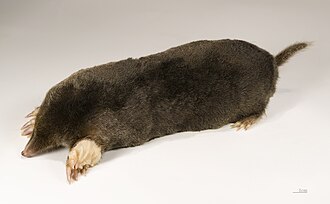
本目包含刺猬、鼠猬、沟齿鼩、鼹鼠、鼩鼹、鼩鼱等动物。
分类
- 真盲缺目 Eulipotyphla
- 猬科 Erinaceidae
- 刺猬亚科 Erinaceinae
- 鼠猬亚科 Galericinae
- 鼩鼱科 Soricidae
- 麝鼩亚科 Crocidurinae
- 鼩鼱亚科 Soricinae
- 非洲白齿鼩亚科 Myosoricinae
- 鼹科 Talpidae
- 鼹亚科 Talpinae
- 美洲鼹亚科 Scalopinae
- 鼩鼹亚科 Uropsilinae
- 沟齿鼩科 Solenodontidae
- † 岛鼯科 Nesophontidae
- † 半猴猬科 Amphilemuridae
依据Roca et al.与Brace et al.的研究,既存本目动物间的关系如下:
上面种系发生树的上下两个分支被分子钟推定约于7,200万至7,400万年前分开演化,岛鼯科与沟齿鼩科约于5,700万年前分开演化,鼹科与最下面的两科约于6,900万年前分开演化,鼩鼱科与猬科则约于6,400万年前分开演化。
以上内容摘自维基百科「真盲缺目」,按 CC BY-SA 4.0 使用,去掉了参考文献、外部链接等尾部小节,公式改写成了纯文本。全文、配图和出处见原文。
英文维基百科补充中文条目比较短,下面是英文条目「Eulipotyphla」的原文
Eulipotyphla (, from eu- "true" + Lipotyphla "lacking blind gut"; sometimes called true insectivores) is an order of mammals comprising the families Erinaceidae (hedgehogs and gymnures), Solenodontidae (solenodons), Talpidae (moles, shrew-like moles and desmans), and Soricidae (true shrews).
Taxonomic history
Historically, these animals were grouped with others such as treeshrews, elephant shrews, and colugos, under the broader category Insectivora, comprising all small insect-eating placental mammals. Wilhelm Peters identified two sub-groups of Insectivora, distinguished by the presence or absence of a cecum in the large intestine. In his 1866 Generelle morphologie der organismen, Ernst Haeckel named these groups Menotyphla and Lipotyphla, respectively from μένω ("remain")/λείπω ("lack" or "leave behind") + τυφλὸν literally "blind", as in τυφλὸν ἔντερον ("blind intestine", from which the Latin intestinum caecum derives as a calque).
Since the late 1990s, molecular studies have produced evidence that the Lipotyphla are not a monophyletic group. This led to tenrecs, otter shrews, and golden moles being placed in a new order (Afrosoricida, in the superorder Afrotheria), with the remaining members of Lipotyphla being reclassified as Eulipotyphla.
A 2023 study suggested that the order began to diversify prior to the K-Pg extinction, based on molecular clock estimates.
Classification
- Order Eulipotyphla (= 'Lipotyphla' - Afrosoricida = 'Erinaceomorpha' + 'Soricomorpha')
- Family Erinaceidae
- Subfamily Erinaceinae: hedgehogs
- Subfamily Galericinae: gymnures or moonrats
- Family Soricidae
- Subfamily Crocidurinae: white-toothed shrews
- Subfamily Soricinae: red-toothed shrews
- Subfamily Myosoricinae: African white-toothed shrews
- Family Talpidae
- Subfamily Talpinae: Old World moles and desmans
- Subfamily Scalopinae: New World moles
- Subfamily Uropsilinae: shrew-like moles
- Family Solenodontidae: solenodons
- † Family Nesophontidae: extinct West Indian shrews
- † Family Amphilemuridae
- † Family Nyctitheriidae
- † Family Plesiosoricidae
Family-level cladogram of modern eulipotyphlan relationships, following Roca et al. and Brace et al.:
The upper and lower basal subclades within the tree are the suborders Solenodonota and Erinaceota, respectively. These two branches are estimated to have split ~72–74 million years (Ma) ago. The Nesophontidae and Solenodontidae are thought to have separated roughly 57 Ma ago. Split times for talpids vs. soricids plus erinaceids, and for soricids vs. erinaceids, have been estimated at 69 Ma and 64 Ma ago, respectively.
以上内容摘自英文维基百科「Eulipotyphla」,按 CC BY-SA 4.0 使用,去掉了参考文献、外部链接等尾部小节,公式改写成了纯文本。全文、配图和出处见原文。