 格物
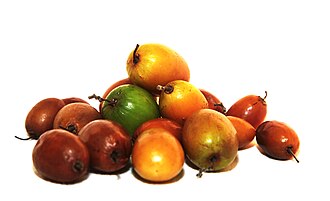
图:Rémi Tournebize · CC BY-SA 3.0 · Wikimedia Commons
- 学名
- Ziziphus jujuba
- 分类等级
- 种
- 上级类群
- 枣属
- 大类
- 被子植物
- 命名
- 菲利普·米勒,1768 年
- 中文别名
- 枣、大枣、枣叶、酸枣仁、枣核
- 保护状况(IUCN)
- 无危物种
- 异名
- Ziziphus zizyphus (L.) H.Karst. (1882)、Paliurus mairei、Rhamnus zizyphus
- 用途
- 药用植物、食物、蜜源植物
- 数据库
- NCBI 分类 · GBIF · IUCN 红色名录
百科正文
栽培作物
枣的品种繁多,大小不一,比较出名的有河北沧县和山东乐陵的“金丝小枣”,新疆和田枣、哈密大枣,宁夏灵武长枣、中宁黄河滩枣,江苏泗洪的泗洪大枣,无核,含糖量高,掰断可拉出丝;河北黄骅的“冬枣”,甜脆适合鲜食,在冬春上市;山西的“大枣”,果大。干制的枣可制成“脆枣”;浙江的“义乌大枣”等。冬枣是山东沾化的特产,在秋末冬初成熟,果大脆甜,但不易储存。
在中国大陆,枣还可以被用来制作红枣酒。有时候,中国人以白酒喷洒枣的表面,可变成酒枣子。
枣比较抗旱,需水不多,适合生长在贫瘠的土壤,树生长慢,所以木材坚硬细致,不易变形,因此用枣木制成的擀面杖品质非常好。另外,枣木还适合制作雕刻品。
加工食品
枣除了直接食用外,还可以加工成为各种食品。比如枣糕、枣露(枣果汁)、枣花蜜等。
以上内容摘自维基百科「枣」,按 CC BY-SA 4.0 使用,去掉了参考文献、外部链接等尾部小节,公式改写成了纯文本。全文、配图和出处见原文。
英文维基百科补充中文条目比较短,下面是英文条目「Jujube」的原文
Jujube (UK; US or; scientific name Ziziphus jujuba), jujuba, Chinese jujube, red date or Chinese date is a species in the genus Ziziphus in the buckthorn family Rhamnaceae. It is often confused with the closely related Indian jujube, Z. mauritiana. The jujube tolerates a diverse range of climates, from temperate to tropical. Its origin is thought to be in eastern Asia, but it has been widely dispersed through cultivation, and is today cultivated in gardens as a shrub as well as in agriculture as a food crop. Its fruit is eaten freshly harvested as well as dried and candied.
Names
The name jujuba is directly Latin while jujube through a Romance language (likely French jujube), both derive from Classical zizyphum (used for the fruit) and zizyphus (the tree) from Ancient Greek ζίζυφον zízyphon. The name jujube is not connected to botanically unrelated jojoba (Simmondsia chinensis) hispanicized from native Oʼodham hohohwi.
Jujube fruits are also known as "red dates" or "Chinese dates" by resemblance to date fruits of the Phoenix dactylifera palm.
Description
It is a small deciduous tree or shrub reaching a height of 5–10 metres (16–33 feet), usually with thorny branches. The leaves are shiny-green, ovate-acute, 2–7 centimetres (3⁄4–2+3⁄4 inches) long and 1–3 cm (3⁄8–1+1⁄8 in) wide, with three conspicuous veins at the base, and a finely toothed margin. Leaves of trees grown in the climate region in Turkey measure average between 3.8–4.28 cm in length and 1.79–1.98 cm in width.
Taxonomy
The binomial name has a complex history, due to a combination of botanical naming regulations, and variations in spelling. It was first named in the binomial system by Carl Linnaeus as Rhamnus zizyphus, in Species Plantarum (1753).
Distribution and habitat
Its precise natural distribution is uncertain due to extensive cultivation. However, its origin is thought to be in eastern Asia, in southern and central China, India, Korea, and Japan, and possibly also southwestern Asia between Lebanon, and southeastern Europe, though more likely introduced there.
The Chinese jujube enjoys a diverse range of climates from temperate to tropical (whereas the Indian jujube is restricted to warmer subtropical and tropical climates).
Cultivation
Asia
Chinese jujubes have been grown in parts of Asia for thousands of years. Wild jujube kernels have been found in three sites on the Qi River basin of northern China dating to the Neolithic period. It may have originated in Syria, but was distributed across the Mediterranean region at least 3,000 years ago. Today, it is most widely grown in China. The tree is tolerant of droughts and flooding, and can be cultivated on a large scale.
Pests
Witch's broom, prevalent in China and Korea, is the main disease affecting jujubes, though plantings in North America currently are not affected by any pests or diseases. In Europe, the last several years have seen some 80%–90% of the jujube crop eaten by insect larvae, including those of the false codling moth (Thaumatotibia leucotreta).
Uses
Culinary
Freshly harvested and candied dried fruit are often eaten as a snack or with coffee. Smoked jujubes are consumed in Vietnam and are referred to as black jujubes. A drink can be made by crushing the pulp in water.
In Vietnam and Taiwan, fully mature, nearly ripe fruit is harvested and sold on the local markets and also exported to Southeast Asian countries.
Culture
In Arabic-speaking regions the jujube and alternatively the species Z. lotus are closely related to the lote-trees (sing. سدرة sidrah, pl. سدر sidr) which are mentioned in the Quran, while in Palestine the species Z. spina-christi is called sidr.
An ancient jujube tree in the city Al-Qurnah, Iraq, is claimed by locals as the Tree of Knowledge mentioned in the Bible.
以上节选摘自英文维基百科「Jujube」,按 CC BY-SA 4.0 使用,去掉了参考文献、外部链接等尾部小节,公式改写成了纯文本。篇幅所限,较长的小节只摘了开头一部分,有的小节没有收;全文、配图和出处见原文。