 格物
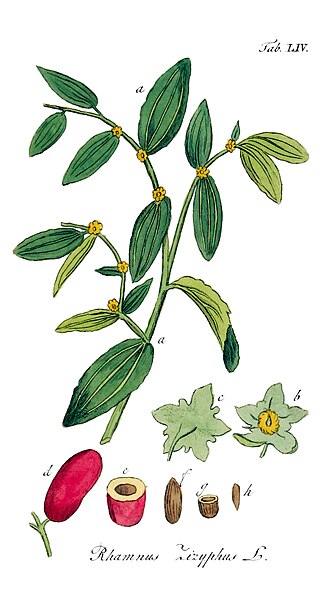
图:Adolphus Ypey · Public domain · Wikimedia Commons
- 学名
- Ziziphus
- 分类等级
- 属
- 上级类群
- 鼠李科
- 大类
- 被子植物
- 命名
- 菲利普·米勒,1754 年
- 数据库
- NCBI 分类 · GBIF
下级类群(6)
百科正文
物种
- 毛果枣 Z. atropensis
- 褐果枣 Z. fungii
- 枣 Z. jujuba
- 球枣 Z. laui
- 大果枣 Z. mairei
- 滇刺枣 Z. mauritiana
- 山枣 Z. montana
- 小果枣 Z. oenopolia
- 毛脉枣 Z. pubinervis
- 皱枣 Z. rugosa
- 蜀枣 Z. xiangchengensis
以上内容摘自维基百科「枣属」,按 CC BY-SA 4.0 使用,去掉了参考文献、外部链接等尾部小节,公式改写成了纯文本。全文、配图和出处见原文。
英文维基百科补充中文条目比较短,下面是英文条目「Ziziphus」的原文
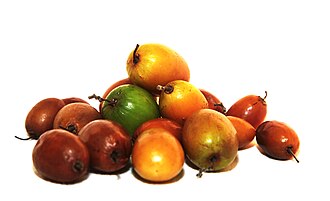
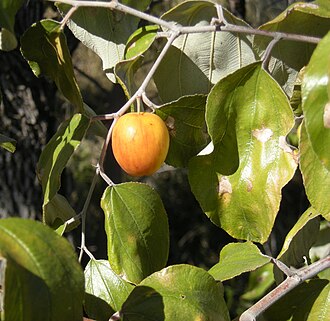
Ziziphus is a genus of spiny shrubs and small trees in the buckthorn family, Rhamnaceae. It includes 68 species native to tropical and subtropical parts of Africa, Eurasia, Australia and South America. The leaves are alternate, entire, with three prominent basal veins, and often aromatic. The flowers are small, inconspicuous yellow-green. The fruit is an edible drupe, often very sweet and sugary, reminiscent of a date in texture and flavour.
Well known, commonly cultivated species i.e. jujubes include the Chinese jujube (Ziziphus jujuba) of China and Indian jujube (Ziziphus mauritiana) spread from western Africa to India; other species like Ziziphus spina-christi from southwestern Asia and Ziziphus lotus from the Mediterranean region are significant to local cultures within their habitats.
Etymology
This genus was made in 1754 by Philip Miller after he separated some species from the Rhamnus genus that Carl Linnaeus placed in his book Species Plantarum. Its name is Latin and derived from Greek ζίζυφον zízyphon which is identified with Ziziphus vulgaris, where it is presumed to have been borrowed from another language, perhaps from zizfum or zizafun, the Persian word for Z. lotus.
Ecology
Ziziphus species are used as food plants by the larvae of some Lepidoptera species including Bucculatrix zizyphella, which feeds exclusively on the genus, and Endoclita malabaricus.
Species are distributed throughout the world in tropical and warm temperate areas, from rain forests to deserts. Some species are evergreen, others are winter or drought deciduous.
Species adapted to dry climates are smaller and have oleifera cells that produce a fragrant aroma.
Uses
The temperate Ziziphus jujuba (Chinese jujube) and the tropical Ziziphus mauritiana (Indian Jujube) are economically important fruit trees.
In traditional Chinese medicine (TCM), suan zao ren (Ziziphus jujuba) is considered to be sweet and sour in taste, and neutral in action. It is believed to nourish the heart yin, augment the liver blood, and calm the spirit (TCM medical terms). It is used to treat irritability, insomnia and heart palpitations.
Mythology
The mythological lotus tree which occurs in Homer's Odyssey is often equated with Z. lotus.
Species
68 species are accepted.
Formerly placed here
Condaliopsis obtusifolia (Hook. ex Torr. & A.Gray) Suess. – Lotebush (as Ziziphus obtusifolia (Hook. ex Torr. & A.Gray) A.Gray)
- Pseudoziziphus celata (Judd & D.W.Hall) Hauenschild (as Ziziphus celata Judd & Hall)
- Pseudoziziphus parryi (Torr.) Hauenschild – Parry's Jujube (as Ziziphus parryi Torr.)
- Sarcomphalus mistol (Griseb.) Hauenschild (as Ziziphus mistol Griseb.)
- Ziziphus lloydi A.Gray
Fossil species
- † Ziziphus hyperboreus Heer (Greenland, Eocene fossil)
- † Ziziphus wyomingianis Berry (Tipperary, Wind River Basin Wyoming, USA, Eocene fossil)
- † = Extinct
以上内容摘自英文维基百科「Ziziphus」,按 CC BY-SA 4.0 使用,去掉了参考文献、外部链接等尾部小节,公式改写成了纯文本。全文、配图和出处见原文。