 格物
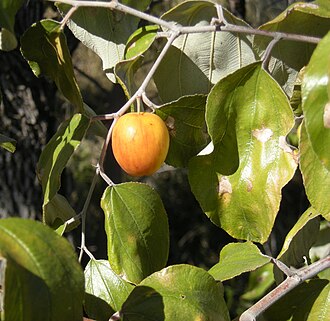
图:Ethel Aardvark · CC BY 3.0 · Wikimedia Commons
- 学名
- Ziziphus mauritiana
- 分类等级
- 种
- 上级类群
- 枣属
- 大类
- 被子植物
- 命名
- 让-巴蒂斯特·拉马克
- 中文别名
- 印度枣、酸枣、缅枣、理枣皮、滇刺枣(滇酸枣)
- 保护状况(IUCN)
- 无危物种
- 异名
- Rhamnus jujuba、Ziziphus orthacantha、Ziziphus rotundata、Sarcomphalus mauritianus、Paliurus mairei
- 用途
- 药用植物、食物、饲料、木材
- 数据库
- NCBI 分类 · GBIF · IUCN 红色名录
百科正文
蜜枣
台湾于1944年引进滇刺枣,之后在台湾培育出如“蜜枣”等品种,又称为“台湾青苹果”、“青枣”。
蜜枣生长季节从12月开始,直到隔年3月都是产季,蜜枣每100g约有45 ~70mg的维生素C,另含膳食纤维、铁、钾等营养。
以上内容摘自维基百科「印度棗」,按 CC BY-SA 4.0 使用,去掉了参考文献、外部链接等尾部小节,公式改写成了纯文本。全文、配图和出处见原文。
英文维基百科补充中文条目比较短,下面是英文条目「Ziziphus mauritiana」的原文
Ziziphus mauritiana, also known as Indian jujube, Indian plum, Chinese apple, ber (Hindi: बेर) and dunks, is a tropical, spiny, evergreen shrub or small tree in the buckthorn family Rhamnaceae. It is often confused with the closely related Chinese jujube (Z. jujuba): Z. mauritiana is common in tropical and subtropical climates, while Z. jujuba prefers temperate climates.
The plant grows vigorously up to 12 metres (39 ft) high, with a trunk 30 centimetres (12 in) or more in diameter. It has a spreading crown with stipular spines and drooping branches. The fruit is oval, obovate, oblong or round, and can be 2.5–6 centimetres (0.98–2.36 in) long depending on the variety, having smooth, light green skin when unripe, turning yellow and then reddish brown as it ripens.
Origin and distribution
The species is believed to be native to South Asia, southern China, Southeast Asia, and Central and West Africa. It has been introduced to the tropical regions of the Americas, and is now widely naturalised throughout the Old World tropics from Southern Africa through the Middle East to South Asia and China, into Australasia and the Pacific Islands. While the Rhamnaceae family contains many nitrogen-fixing species, Z.
Morphology
Ziziphus mauritiana has a rapidly developing taproot, a necessary adaptation to drought conditions. The species varies widely in height, from a bushy shrub 1.5–2 metres (4.9–6.6 ft) tall, to a tree 10–12 metres (33–39 ft) tall with a trunk diameter of about 30 centimetres (12 in). Z. mauritiana may be erect or wide-spreading, with gracefully drooping thorny branches and zigzag branchlets, with short, sharp straight or hooked thorns; some varieties are thornless.
Ecology
This hardy tree can withstand extreme temperatures and thrives in rather dry or water-logged conditions with an annual rainfall of 125–2,225 millimetres (4.9–87.6 in). In Fiji, naturalised trees grow along roadsides and on agricultural land, usually near sea level but occasionally up to an elevation of 600 metres (2,000 ft). It also grows well on laterite soils with good drainage, or sandy, gravelly, alluvial soil of dry riverbeds.
Propagation
Propagation is best done by seed, grafting or cuttings. The seeds are spread by birds, livestock, feral pigs, humans and other mammals. Seeds may remain viable for over two years, but the germination rate decreases with age. Cross-incompatibility occurs, and cultivars have to be matched for good fruit set; some cultivars produce good crops parthenocarpically.
In India, there are 90 or more cultivars varying in growth habit, leaf shape, fruiting season, and fruit form, size, colour, flavour and storage quality.
Cultivation and uses
Ziziphus mauritiana is widely grown in both its native and introduced ranges, mainly for its fruit. The main producing regions of Z. mauritiana fruit are the arid and semi arid areas of India. The crop is also grown in Pakistan, Bangladesh, Vietnam, the Caribbean and parts of Africa. From 1984 to 1995, with improved cultivars, 0.9 million tonnes of fruit were produced on a land area of 88,000 hectares (220,000 acres).
Season and harvesting
Plants are capable of seed production once they reach a height of about 1 metre (3.3 ft). Wild-growing plants in northern Australia may take eight years to reach this size. A tree can produce 5,000–10,000 fruits a year if grown directly from seed, or up to 30,000 fruits if grafted.
In India, certain cultivars ripen as early as October, while others mature from mid-February to mid-March, in March, or from mid-March through April.
Pests and diseases
Fruit flies are the biggest threat to Z. mauritiana fruits. Some cultivars are more susceptible than others—the flies prefer the largest, sweetest fruits, while a nearby tree bearing smaller, less-sweet fruits suffers little damage. Full-grown larvae exit the fruit by making holes in the skin, and then drop to the ground to form pupae. Control is possible by destroying the pupae with irrigation during summer or subjecting the soil to heat by burning grass, as well as regular application of insecticide.
以上节选摘自英文维基百科「Ziziphus mauritiana」,按 CC BY-SA 4.0 使用,去掉了参考文献、外部链接等尾部小节,公式改写成了纯文本。篇幅所限,较长的小节只摘了开头一部分,有的小节没有收;全文、配图和出处见原文。