 格物
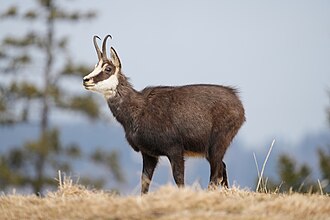
图:Giles Laurent · CC BY-SA 4.0 · Wikimedia Commons
生命之树 › 真核生物 › 动物界 › 真后生动物亚界 › 两侧对称动物 › 后口动物总门 › 脊索动物门 › 脊椎动物亚门 › 有颌下门 › 肉鳍鱼总纲 › 四足形类 › 希望螈目 › 四足总纲 › 哺乳动物 › 兽型类 › 全兽类 › 兽亚纲 › 有胎盘类 › 北方真兽高目 › 劳亚兽总目 › 偶蹄目 › 牛科 › 羊亚科 › 臆羚属
臆羚种
Rupicapra rupicapra
臆羚,又称欧洲山羚,是一种粗壮像山羊的动物,生活于欧洲的阿尔卑斯山脉和喀尔巴阡山脉。在1907年,臆羚被成功地引进了新西兰的南岛,但它却破坏了当地的生态系统。臆羚属于牛科羊亚科,是臆羚属唯二的成员之一,另一个成员是比利牛斯臆羚。
摘自维基百科「臆羚」,CC BY-SA 4.0
- 学名
- Rupicapra rupicapra
- 分类等级
- 种
- 英文名
- chamois
- 上级类群
- 臆羚属
- 大类
- 哺乳动物
- 命名
- 卡尔·林奈,1758 年
- 保护状况(IUCN)
- 无危物种
- 栖息地
- 山
- 数据库
- NCBI 分类 · GBIF · IUCN 红色名录
百科正文
身为一种山区动物,臆羚卓越的适应了多岩石的山区。它们的爬山能力仅次于羱羊。成年臆羚的肩高为75厘米(2.5英尺),体重为50千克(110磅)。雌性及雄性都有一对稍微向后弯的短角。在夏天,臆羚的臆羚的毛色为棕色,臆羚的毛在冬天变成浅灰色。其最明显的差别是有一条明显的黑色斑纹在眼睛下面,背部有一条黑脊纹。臆羚的寿命为20年。
母羚和小羚住在3-10只的小群中;而大多数情况下公羚是独居动物。在交配季节时(从11月下旬到12月上旬),公羚找到母羚并与其他公羚交战,胜者与母羚交配。在20星期的妊娠期之后,小羚就出生了。在3年后小羚便成年了。有些人说在放牧地区中,有些臆羚会与家山羊交配并产出不能生育的杂种,但这讲法还没有被科学证明。
由于臆羚肉很好吃,许多人都去捕猎这种动物;其颈部的毛用来做称为“gamsbart”(其实是臆羚须),是阿尔卑斯山区的居民的帽子装饰品。
臆羚皮是用来生产一种皮垫,用来擦车;今天,这种皮垫可以用许多动物皮去做。臆羚皮也同样用来制造自行车短裤,其好处是不容易脏。但在今天,大多数自行车短裤是用其他动物的皮来制造的。臆羚皮也经常用来做吸汗带。臆羚皮有时也用来做燃料过滤器。
臆羚的德语名是Gämse (或Gemsbock);在英语中的Gemsbock则是南非直角长角羚的意思。
以上内容摘自维基百科「臆羚」,按 CC BY-SA 4.0 使用,去掉了参考文献、外部链接等尾部小节,公式改写成了纯文本。全文、配图和出处见原文。
英文维基百科补充中文条目比较短,下面是英文条目「Chamois」的原文
The chamois (; French: [ʃamwa]; Rupicapra rupicapra), or Alpine chamois, is a species of goat-antelope native to mountainous parts of Europe and Western Asia, from the Pyrenees and the Cantabrian Mountain Range, the Alps, the Apennines, the Dinarides, the Tatra to the Carpathian Mountains, the Balkan Mountains, the Rila–Rhodope massif, Pindus, the northeastern mountains of Turkey, and the Caucasus. It has also been introduced to the South Island of New Zealand. Some subspecies of chamois are strictly protected in the EU under the European Habitats Directive.
Description
The chamois is a very small bovid. A fully grown chamois reaches a height of 70–80 cm (28–31 in) and measures 107–137 cm (42–54 in). Males, which weigh 30–60 kg (66–132 lb), are slightly larger than females, which weigh 25–45 kg (55–99 lb). Both males and females have short, straightish horns which are hooked backwards near the tip, the horn of the male being thicker. In summer, the fur has a rich brown colour which turns to a light grey in winter. Distinct characteristics are white contrasting marks on the sides of the head with pronounced black stripes below the eyes, a white rump and a black stripe along the back.
Biology and behaviour
Female chamois and their young live in herds of up to 15 to 30 individuals; adult males tend to live solitarily for most of the year.
During the rut (late November/early December in Europe, May in New Zealand), males engage in fierce battles for the attention of unmated females. An impregnated female undergoes a gestation period of 170 days, after which a single kid is usually born in May or early June. On rare occasions, twins may be born. If a mother is killed, other females in the herd may try to raise the young.
Kids are weaned at six months of age and are fully grown by one year of age, but do not reach sexual maturity until they are three to four years old, although some females may mate at as early two years old. At sexual maturity, young males are forced out of their mother's herds by dominant males (who sometimes kill them), to wander somewhat nomadically until they can establish themselves as mature breeding specimens at eight to nine years of age.
Chamois eat various types of vegetation, including highland grasses and herbs during the summer and conifers, barks and needles from trees in winter.
Distribution and habitat
The chamois is native to the Alps, the mountains of south and central Europe, Turkey, and the Caucasus. It lives in precipitous, rugged, rocky terrain at moderately high elevations of up to at least 3,600 m (11,800 ft). In Europe, the chamois spends the summer months in alpine meadows above the tree line, but moves to elevations of around 800 m (2,600 ft) to spend the winter in pine-dominated forests.
In New Zealand
Alpine chamois arrived in New Zealand in 1907 as a gift from the Austrian Emperor, Franz Joseph I in exchange for specimens of living ferns, rare birds and lizards. Albert E. L. Bertling, formerly head keeper of the Zoological Society's Gardens, Regent's Park, London, accepted an invitation from the New Zealand Government to deliver a consignment of chamois (two bucks and six does) to the colony. They arrived in Wellington, New Zealand, on 23 January 1907, on board SS Turakina. From Wellington the chamois were transhipped to the Manaroa and conveyed to Lyttelton, then by rail to Fairlie in South Canterbury and a four-day horse trek to Mount Cook.
Hunting
Chamois are popular game animals, sought for their meat. Chamois have two traits that are exploited by hunters: the first is that they are most active in the morning and evening when they feed; the second is that they tend to look for danger originating from below, which means that a hunter stalking chamois from above is less likely to be observed and more likely to be successful.
The tuft of hair from the back of the neck, the gamsbart (chamois "beard"), is traditionally worn as a decoration on hats throughout the alpine countries.
Chamois leather
Chamois leather, traditionally made from the hide of the chamois, is very smooth and absorbent and is favoured in cleaning, buffing, and polishing because it produces no scratching. Modern chamois leather may still be made from chamois hides, but hides of deer or domestic goats or sheep are much more commonly used.
Chamois fabric
An artificial fabric known as "chamois" is made variously from cotton flannel, PVA, viscose, and other materials with similar qualities. It is napped to produce a plush surface similar to moleskin or chamois leather.
以上节选摘自英文维基百科「Chamois」,按 CC BY-SA 4.0 使用,去掉了参考文献、外部链接等尾部小节,公式改写成了纯文本。篇幅所限,较长的小节只摘了开头一部分,有的小节没有收;全文、配图和出处见原文。