 格物
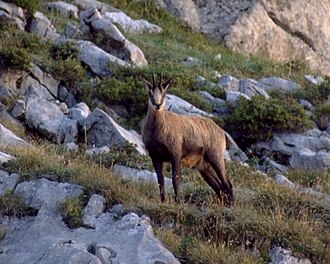
图:Andreas Tille · CC BY-SA 4.0 · Wikimedia Commons
- 学名
- Rupicapra
- 分类等级
- 属
- 上级类群
- 羊亚科
- 大类
- 哺乳动物
- 命名
- 亨利·马里·迪克罗泰·德·布兰维尔,1816 年
- 主要食物
- 禾本科、叶、嫩枝、真菌界
- 数据库
- NCBI 分类 · GBIF
下级类群(2)

百科正文
英文维基百科补充中文条目比较短,下面是英文条目「Rupicapra」的原文
Rupicapra is a genus of two species of goat-antelope called chamois. They belong to the bovine family of hoofed mammals, the Bovidae.
Taxonomy
Two extant species are accepted.
Description
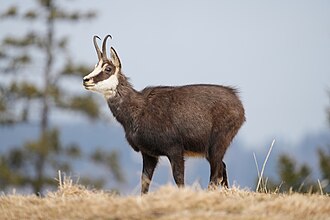
Both male and female have hook-shaped horns that slightly curl backwards and grow little by little each year, never falling off. Their coats are light brown and short-haired in the summer, and darker and longer-haired in the winter; the head has two pale creamy-white patches, from the nose to between the horns, and from the chin round the cheeks and behind the eyes to just below the ears; the pale patches are separated by dark stripes from the mouth up through the eye to the back of the head. There are also two darker bands on their flanks.
Behaviour
In the summer, the Apennine chamois prefers rock faces and pasture lands at heights above 1,700 m (5,600 ft) for its habitat, and in the winter it prefers to retreat to the woods below. The diet consists of grasses, leaves, buds, shoots and fungi. Adult males prefer a solitary life, only approaching females during the mating season. Groups consist only of females, young males, and "kids". Females give birth to only one kid after a gestation period of 23 to 24 weeks.
Conservation
A 2014 study by Durham University discovered that these goats are shrinking in size due to global warming and climatic changes.
以上内容摘自英文维基百科「Rupicapra」,按 CC BY-SA 4.0 使用,去掉了参考文献、外部链接等尾部小节,公式改写成了纯文本。全文、配图和出处见原文。