格物
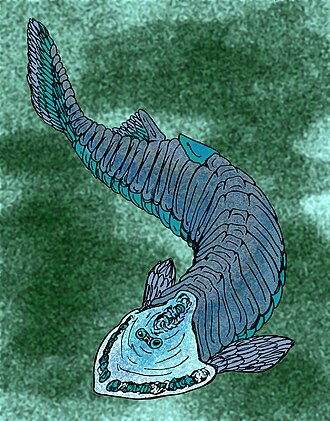
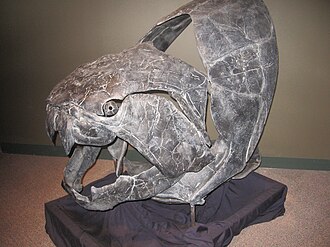
图:User:Apokryltaros · CC BY 2.5 · Wikimedia Commons
- 学名
- Osteostraci
- 分类等级
- 纲
- 上级类群
- 脊椎动物亚门
- 大类
- 其他动物
- 命名
- 雷·兰克斯特,1868 年
百科正文
英文维基百科补充中文条目比较短,下面是英文条目「Osteostraci」的原文
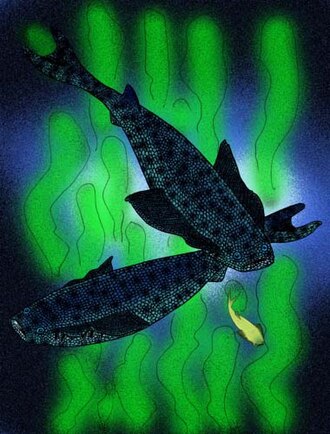
The class Osteostraci (meaning "bony shells") is an extinct taxon of bony-armored jawless fish, one of several groups termed "ostracoderms", that lived in what is now North America, Europe and Russia (largely around the former landmass of Euramerica/Laurussia) from the Middle Silurian to Late Devonian.
Description
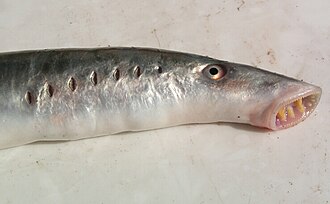
Osteostracans (along with possibly Pituriaspida) are the closest known relatives of jawed fish (gnathostomes) among jawless fish, sharing with jawed fish the development of several anatomical characters, including: paired pectoral fins, opercular flaps, sclerotic ossicles, a dermal skeleton with three layers (a basal layer of isopedin, a middle layer of spongy bone, and a superficial layer of dentin), bony (ossified) sclera, and perichondral bone. The osteostracans were more similar to lampreys than to jawed vertebrates in possessing two pairs of semicircular canals in the inner ear, as opposed to the three pairs found in the inner ears of jawed vertebrates.
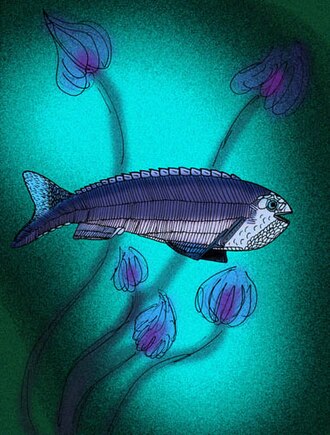
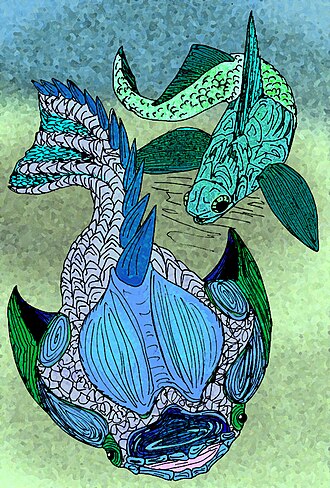
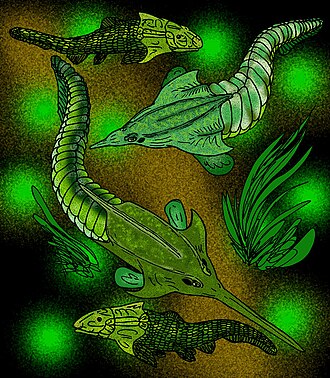
Most osteostracans had a massive cephalothoracic shield, but all Middle and Late Devonian species appear to have had a reduced, thinner, and often micromeric dermal skeleton. This reduction may have occurred at least three times independently because the pattern of reduction is different in each taxon. The inner endoskeletal headshield was primarily composed of cartilage, which was then lined with a thin outermost layer of bone. This was then in turn covered by a bony exoskeletal headshield. The headshield is most often horseshoe-shaped, though some osteostracans strongly deviated from this, such as many members of Benneviaspidida, whose headshields developed pointed projections.
Ecology
Osteostracans are generally interpreted as benthic fish that spent much of their time close to the bottom of water bodies, though the diversity of headshield shapes and their hydrodynamic properties suggests that osteostracans varied on how closely they swam to the seafloor, with some exhibiting headshields that were more efficient swimming close to the sediment surface, while others more efficient when swimming in the open water column. Most were inhabitants of shallow marine environments, though some likely lived in freshwater. Osteostracans are suggested to have been deposit feeders, feeding on detritus in sediment. They probably had the ability to sense electric fields (electroreception).
Evolutionary history
Osteostracans likely originated in central Euramerica/Laurussia, first appearing during the Wenlock stage of the mid-Silurian, though it is estimated they may have originated somewhat earlier, perhaps as early as the late Ordovician. The Zenaspidida subgroup was widely distributed over Euramerica, while Thyestiida was largely confined to Baltica (though with some fossils from Britain and Spitsbergen), while Benneviaspidida is almost entirely confined to Spitsbergen. Osteostracans were largely confined to Euramerica/Laurussia throughout their evolutionary history, never reaching Gondwana, though they did disperse to some isolated terranes that now form part of modern southern Siberia. Osteostracans reached an apex of species and morphological diversity during the Lochkovian and Pragian stages of the Early Devonian, before declining thereafter, becoming extinct by the end of the Frasnian. This time period corresponds with the rise of jawed vertebrates, though the differences in ecology between ostracoderms like osteostracans and jawed vertebrates suggests that direct competition was an unlikely cause of their extinction, with a reduction in suitable habitat as a result of major sea level changes during the period also being proposed cause of the extinction.
Classification
Phylogeny
Below is a cladogram showing the phylogenetic relationships of osteostracans from Sansom (2009) with modifications recovered by Scott & Wilson (2014) and El Fassi El Fehri et al. (2026):
Taxonomy
Cephalaspis was the first osteostracan (as well as the first "ostracoderm" generally) to be scientifically described, by Louis Agassiz in 1835, based on remains found in Britain. He originally compared Cephalaspis to sturgeons and catfish, but later by 1844 noted fundamental anatomical differences. The class Osteostraci was erected by Ray Lankester in 1870. For a long time after its description, Cephalaspis was used as a wastebasket taxon for osteostracans sharing generic anatomical features common to many members of the class. Subsequent classification work has resulted in many former Cephalaspis species placed into new genera by later researchers.
以上节选摘自英文维基百科「Osteostraci」,按 CC BY-SA 4.0 使用,去掉了参考文献、外部链接等尾部小节,公式改写成了纯文本。篇幅所限,较长的小节只摘了开头一部分,有的小节没有收;全文、配图和出处见原文。