格物
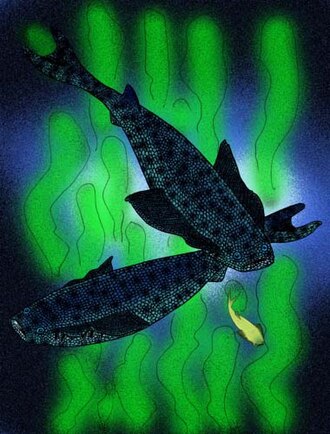
图:Apokryltaros · CC BY-SA 4.0 · Wikimedia Commons
- 学名
- Thelodonti
- 分类等级
- 纲
- 上级类群
- 脊椎动物亚门
- 大类
- 其他动物
- 命名
- 劳伦斯·赖博,1915 年
百科正文
下属分类
- 本科包括以下属:
- Dasylepis Pander, 1856
- Dictyolepis Pander, 1856
- Melittomalepis Pander, 1856
- Pachylepis Pander, 1856
- Prionacanthus Pander, 1856
- Schediosteus Pander, 1856
- Spirodus Kade, 1858
以上内容摘自维基百科「花鳞鱼纲」,按 CC BY-SA 4.0 使用,去掉了参考文献、外部链接等尾部小节,公式改写成了纯文本。全文、配图和出处见原文。
英文维基百科补充中文条目比较短,下面是英文条目「Thelodonti」的原文
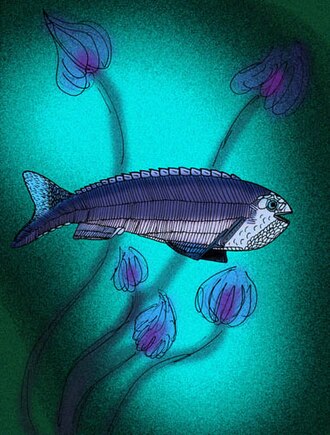
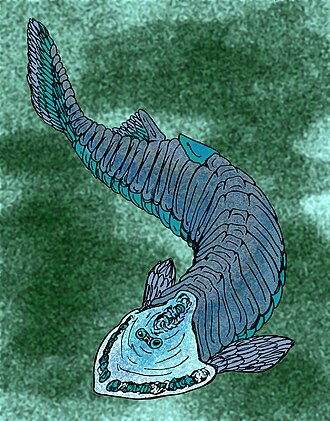
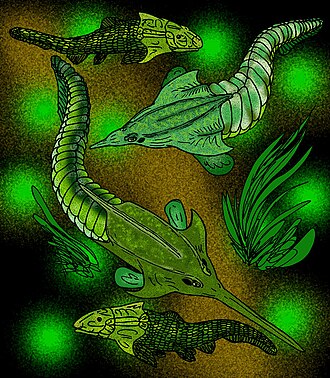
Thelodonti (from Greek: "nipple teeth") is a class of extinct Palaeozoic jawless fishes with distinctive scales instead of large plates of armor. These fish lived in both freshwater and marine environments, first appearing during the Late Ordovician, and perishing shortly after the Frasnian–Famennian extinction event in the Late Devonian.
There is much debate over whether the group represents a monophyletic grouping, or disparate stem groups to the major lines of jawless and jawed fish.
Thelodonts are united in possession of "thelodont scales". This defining character is not necessarily a result of shared ancestry, as it may have been evolved independently by different groups. Thus the thelodonts are sometimes thought to represent a polyphyletic group, although there is no firm agreement on this point. On the basis that they are monophyletic, they are reconstructed as being ancestrally marine and invading freshwater on multiple occasions.
"Thelodonts" were morphologically very similar, and probably closely related, to fish of the classes Heterostraci and Anaspida, differing mainly in their covering of distinctive, small, spiny scales. These scales were easily dispersed after death; their small size and resilience makes them the most common vertebrate fossil of their time.
Traditionally thelodonts were considered predominantly deposit-feeding bottom dwellers, but more recent studies have shown they occupied various ecological roles in various parts of the water column, much like modern bony fishes and sharks. In particular, a large variety of species preferred reef ecosystems, and it has been suggested that this preference was the reason for the development of their unique scales, protecting against abrasion and allowing for the development of more flexible bodies than other jawless fish, which had inflexible armors and were restricted to open habitats.
Description
Very few complete thelodont specimens are known; fewer still are preserved in three dimensions. This is due in part to the lack of an internal ossified (i.e. bony) skeleton; it does not help that the scales are poorly, if at all, attached to one another, and that they readily detach from their owners upon death.
The exoskeleton is composed of many tooth-like scales, usually around 0.5–1.5mm in size.
Taxonomy
Due to the small number of intact fossils, the taxonomy of thelodonts is based primarily on scale morphology. In fact, some thelodont families are only recognised based on their scale fossils.
A recent assessment of thelodont taxonomy by Wilson and Märss in 2009 merges the orders Loganelliiformes, Katoporiida and Shieliiformes into Thelodontiformes, places families Lanarkiidae and Nikoliviidae into Furcacaudiformes on the basis of scale morphology, and establishes Archipelepidiformes as the basal-most order.
Ecology
Thelodonts displayed similar squamation patterns as modern sharks, so functionally they served a similar role. This allows for a clearer observation of their ecological niches. In particular, protection against abrasion seems to have been the original role for these scales.
Most thelodonts were considered deposit feeders, but more recent studies have shown that several species were active swimmers and thus more pelagic. A large variety of species in particular preferred reef ecosystems.
Utility as biostratigraphic markers
Thelodont scales are globally widespread during the Silurian and Early Devonian times, becoming restricted in range to Gondwana, until their extinction in the Late Devonian (Frasnian). The morphology of some species diversified rapidly enough for the scales to rival the conodonts in utility as biostratigraphic markers, allowing precise correlation of widely spaced sediments.
Evolutionary patterns
The first major pattern or group of jawless fish with exoskeletons or plated armour, was the Laurentian group, which existed during the Cambrian-Ordovician time. However, the thelodonts (as well as the conodonts, placoderms, acanthodians, and chondrichthyans) are the second major group which are believed to have emerged in the middle Ordovician and lasted near the Late Devonian period. Due to their similar characteristics and chronological time frame of existence, many believe the thelodonts have Laurentian origins.
以上节选摘自英文维基百科「Thelodonti」,按 CC BY-SA 4.0 使用,去掉了参考文献、外部链接等尾部小节,公式改写成了纯文本。篇幅所限,较长的小节只摘了开头一部分,有的小节没有收;全文、配图和出处见原文。