格物
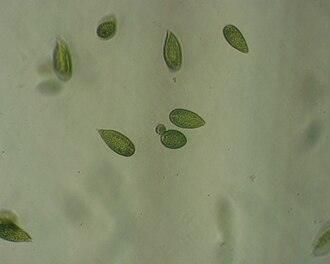
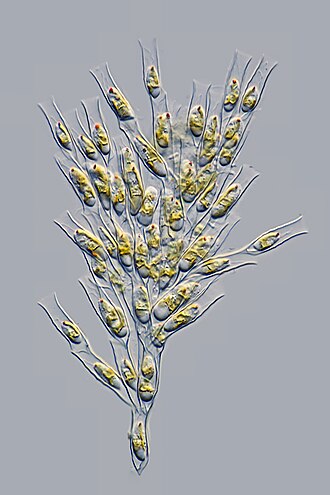
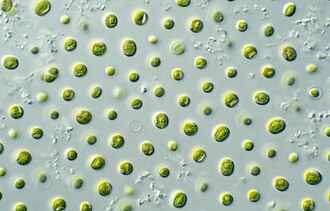
图:Krengefors · CC BY-SA 3.0 · Wikimedia Commons
- 学名
- Raphidophyceae
- 分类等级
- 纲
- 英文名
- Raphidophyte
- 上级类群
- AH/SAR 总类群
- 大类
- 其他真核生物
- 中文别名
- 针鞭毛藻纲
- 数据库
- NCBI 分类 · GBIF
百科正文
下级分类
- 本纲包括以下目:
- Actinophryida
- 卡盾藻科 Chattonellales
- Raphidomonadales
- 目地位未定的科
- Commatiidae
- Thaumatomastigaceae
- 目和科地位未定的属:
- Thaumatomonas De Saedeleer, 1931
以上内容摘自维基百科「针胞藻纲」,按 CC BY-SA 4.0 使用,去掉了参考文献、外部链接等尾部小节,公式改写成了纯文本。全文、配图和出处见原文。
英文维基百科补充中文条目比较短,下面是英文条目「Raphidophyte」的原文
The raphidophytes, previously known as chloromonads, are a small but widespread group of single-celled eukaryotic algae, found in both marine and freshwater environments. They are taxonomically known as class Raphidophyceae and order Chattonellales.
Characteristics
All raphidophytes are unicellular, with large cells (50 to 100 μm), but no cell walls. Raphidophytes possess a pair of flagella, organised such that both originate from the same invagination (or gullet). One flagellum points forwards, and is covered in hair-like mastigonemes, while the other points backwards across the cell surface, lying within a ventral groove. Raphidophytes contain numerous ellipsoid chloroplasts, which contain chlorophylls a, c1 and c2. They also make use of accessory pigments including β-carotene and diadinoxanthin. Unlike other heterokontophytes, raphidophytes do not possess the photoreceptive organelle (or eyespot) typical of this group.
In terms of ecology, raphidophytes occur as photosynthetic autotrophs across a range of aquatic systems. Freshwater species are more common in acidic waters, such as pools in bogs. Marine species often produce large blooms in summer, particularly in coastal waters. Off the Japanese coast, the resulting red tides often cause disruption to fish farms, although raphidophytes are not usually responsible for toxic blooms.
Classification
The position of this group varied in former classifications. Some protozoologists treated chloromonads as an order within the phytoflagellates. Some phycologists classified them with the Xanthophyceae and the Eustigmatophyceae in the division Xanthophyta. Others considered them as related to the Chrysophyceae, Dinophyceae, or Cryptophyceae. Cavalier-Smith proposed them as a subclass of algae within the class Raphidomonadea, which also included the heliozoan group Actinophryida and the enigmatic flagellate Commation.
Currently, raphidophytes consist of the class Raphidophyceae, which contains only one order Chattonellales composed of four families.
- Family Chattonellaceae Throndsen 1993
- Chattonella Biecheler 1936 (=Hornellia Subrahmanyan 1954, Hemieutreptia Hada 1974)
- Chlorinimonas Yamaguchi, Nakayama, Murakami & Inouye 2010
- Heterosigma Hara & Chihara 1987
- Viridilobus Demir-Hilton, Hutchins, Czymmek & Coyne 2012
- Family Fibrocapsaceae Cavalier-Smith in Cavalier-Smith & Chao 2013
- Fibrocapsa Toriumi & Tokano 1975
- Family Haramonadaceae Cavalier-Smith in Cavalier-Smith & Chao 2013
- Haramonas Horiguchi 1996
- Psammamonas Grant, Waller, Clementson & Wetherbee 2013
- Family Vacuolariaceae Luther 1899 emend. Yamaguchi, Nakayama, Murakami & Inouye 2010
- Gonyostomum Diesing 1866
- Merotrichia Mereschkowski 1877
- Vacuolaria Cienkowski 1870
Several genera have been proposed as raphidophytes but their position remains uncertain. The genus Oltmannsia Schiller 1925 was tentatively placed in the order Chattonellales by Jahn Throndsen in 1993, but it is not included in later studies. Similarly, the genus Swirenkoiamonas Skvortzov 1968 was described as a member of the Chloromonadales, was later regarded as a euglenid in 1991, and is not mentioned by subsequent studies. The genus Olisthodiscus was originally proposed as a raphidophyte, but it currently composes a separate class, Olisthodiscophyceae.
以上内容摘自英文维基百科「Raphidophyte」,按 CC BY-SA 4.0 使用,去掉了参考文献、外部链接等尾部小节,公式改写成了纯文本。全文、配图和出处见原文。