格物
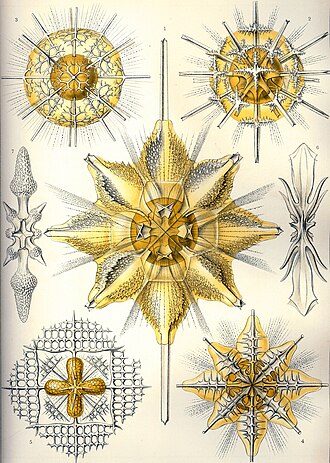
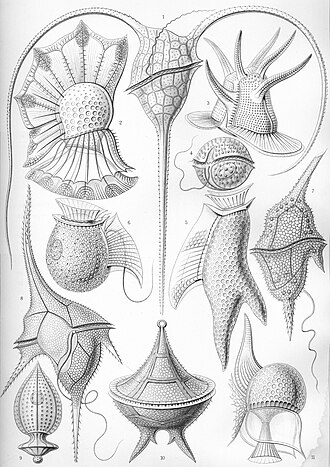
图:Ernst Haeckel · Public domain · Wikimedia Commons
生命之树 › 真核生物 › AH/SAR 总类群
等辐骨虫纲纲
Acantharia
等辐骨虫纲 为原生动物界的一个纲。门的地位未定。过去为辐足纲下的一个亚纲,称为等辐骨亚纲或棘骨虫亚纲,多为微生物。
摘自维基百科「等辐骨虫纲」,CC BY-SA 4.0
- 学名
- Acantharia
- 分类等级
- 纲
- 上级类群
- AH/SAR 总类群
- 大类
- 其他真核生物
- 中文别名
- 放射棘纲、等辐骨纲
- 数据库
- NCBI 分类 · GBIF
百科正文
下级分类
- 本纲包括以下目:
- 节棘目 Arthracanthida
- 未指定目的科:
- Acanthocollidae
- Acanthoplegmidae
- Astrolonchidae
- Conaconidae
- Stauraconidae
- 未指定目和科的属:
- Chiastolus
- Litholophus Haeckel, 1860
以上内容摘自维基百科「等辐骨虫纲」,按 CC BY-SA 4.0 使用,去掉了参考文献、外部链接等尾部小节,公式改写成了纯文本。全文、配图和出处见原文。
英文维基百科补充中文条目比较短,下面是英文条目「Acantharia」的原文
The Acantharia are a group of radiolarian protozoa, distinguished mainly by their strontium sulfate skeletons. Acantharians are heterotrophic marine microplankton that range in size from about 200 microns in diameter up to several millimeters. Some acantharians have photosynthetic endosymbionts and hence are considered mixotrophs.
Morphology
Acantharian skeletons are composed of strontium sulfate, SrSO4, in the form of mineral celestine crystal. Celestine is named for the delicate blue colour of its crystals, and is the heaviest mineral in the ocean. The denseness of their celestine ensures acantharian shells function as mineral ballast, resulting in fast sedimentation to bathypelagic depths. High settling fluxes of acantharian cysts have been observed at times in the Iceland Basin and the Southern Ocean, as much as half of the total gravitational organic carbon flux.
The strontium sulfate crystals are secreted by vacuoles surrounding each spicule or spine. Acantharians are unique among marine organisms for their ability to biomineralize strontium sulfate as the main component of their skeletons. However, unlike other radiolarians whose skeletons are made of silica, acantharian skeletons do not fossilize, primarily because strontium sulfate is very scarce in seawater and the crystals dissolve after the acantharians die.
Taxonomy
The way that the spines are joined at the center of the cell varies and is one of the primary characteristics by which acantharians are classified. The skeletons are made up of either ten diametric or twenty radial spicules. Diametric spicules cross the center of the cell, whereas radial spicules terminate at the center of the cell where they either form a tight or flexible junction depending on species. Acantharians with diametric spicules or loosely attached radial spicules are able to rearrange or shed spicules and form cysts.
Holacanthida – 10 diametric spicules, simply crossed, no central junction, capable of encystment
- Chaunacanthida – 20 radial spicules, loosely attached, capable of encystment
- Symphiacanthida – 20 radial spicules, tight central junction
- Arthracanthida – 20 radial spines, tight central junction
The morphological classification system roughly agrees with phylogenetic trees based on the alignment of ribosomal RNA genes, although the groups are mostly polyphyletic.
Symbiosis
Many acantharians, including some in clade B (Holacanthida) and all in clades E & F (Symphiacanthida and Arthracanthida), host single-celled algae within their inner cytoplasm (endoplasm). By participating in this photosymbiosis, acantharians are essentially mixotrophs: they acquire energy through both heterotrophy and autotrophy. The relationship may make it possible for acantharians to be abundant in low-nutrient regions of the oceans and may also provide extra energy necessary to maintain their elaborate strontium sulfate skeletons. It is hypothesized that the acantharians provide the algae with nutrients (N & P) that they acquire by capturing and digesting prey in return for sugar that the algae produces during photosynthesis. It is not known, however, whether the algal symbionts benefit from the relationship or if they are simply being exploited and then digested by the acantharians.
Life cycle
Adults are usually multinucleated. Earlier diverging clades are able to shed their spines and form cysts, which are often referred to as reproductive cysts. Reproduction is thought to take place by formation of swarmer cells (formerly referred to as "spores"), which may be flagellate, and cysts have been observed to release these swarmers. Non-encysted cells have also been seen releasing swarmers in laboratory conditions. Not all life cycle stages have been observed, however, and no one has witnessed the fusion of swarmers to produce a new acantharian. Cysts are often found in sediment traps and it is therefore believed that the cysts help acantharians sink into deep water. Genetic data and some imaging suggests that non-cyst-forming acantharians may also sink to deep water to release swarmers. Releasing swarmer cells in deeper water may improve the survival chances of juveniles.
以上节选摘自英文维基百科「Acantharia」,按 CC BY-SA 4.0 使用,去掉了参考文献、外部链接等尾部小节,公式改写成了纯文本。篇幅所限,较长的小节只摘了开头一部分,有的小节没有收;全文、配图和出处见原文。