 格物

图:Rasbak · CC BY-SA 3.0 · Wikimedia Commons
- 学名
- Apiaceae
- 分类等级
- 科
- 上级类群
- 伞形目
- 大类
- 被子植物
- 命名
- 约翰·林德利,1836 年
- 异名
- 伞形科
- 数据库
- NCBI 分类 · GBIF
下级类群(30)

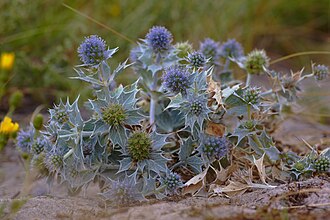
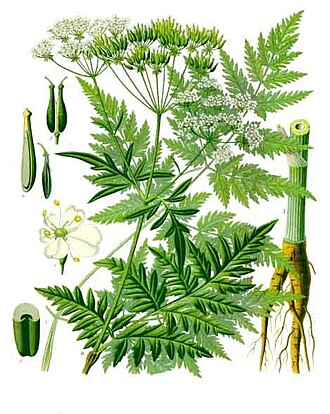
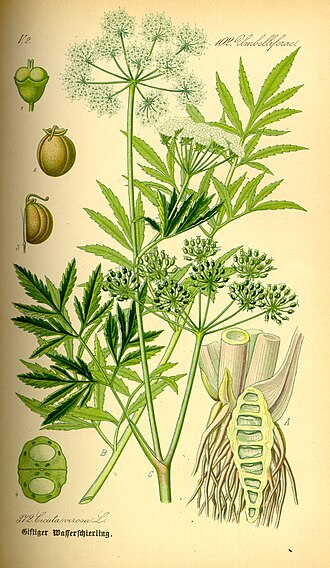
- 当归属 Angelica 属
- 刺芹属 Eryngium 属
- 峨参属 Anthriscus 属
- 毒芹属 Cicuta 属
- 星芹属 Astrantia 属
- 茴香属 Foeniculum 属
- 水芹属 Oenanthe 属
- 泽芹属 Sium 属
- 莳萝属 Anethum 属
- 孜然芹属 Cuminum 属
- 积雪草属 Centella 属
- 亮蛇床属 Selinum 属
- 芹亚科 Apioideae 亚科
- Bifora 属
- 针叶芹属 Aciphylla 属
- Caucalis 属
- 刺果芹属 Turgenia 属
- 欧当归属 Levisticum 属
- 香根芹属 Osmorhiza 属
- Tordylium 属
- Opopanax 属
- Thapsia 属
- Astrodaucus 属
- Ferulago 属
- 芹薯属 Arracacia 属
- Conopodium 属
- Actinolema 属
- Azorelloideae 亚科
- 参棕科 Mackinlayoideae 亚科
- 变豆菜亚科 Saniculoideae 亚科
百科正文
此科下包含有孜然、香芹、香菜、茴香、胡萝卜、莳萝、葛缕子、当归、白芷、独活、毒芹和明日叶等植物。此科约有446属、3,800种,分布在北温带、亚热带或热带的高山上。中国大陆大约有90属、500多种,全国均有分布。伞形科包括很多日常食用的蔬菜和调料。
形态
通常为茎部中空的芳香植物,大多为多年生草本。
叶子互生,大部分为多回分裂、三裂或羽状浅裂的复叶,但在某些属(例如柴胡属)中是单裂且完整的叶片。叶柄基部扩大成鞘状。
花小,通常两性,常为顶生或腋生的复伞形花序;萼片微小或缺少;花瓣5枚,顶端常凹陷,具有一内折的小舌片;雄蕊5枚,着生于上位花盘的周围;花柱2枚,有垫状或圆锥形花柱基;子房下位两室,每室有胚珠1枚。
果实为双悬果:成熟时两个心皮由合生面分离成两个悬垂的分果,各有1种子;通常具有5条明显果棱,有时主棱间有次棱,棱与棱之间和合生面有油管一至多数,油管通常明显。许多伞形科的果实以风传播,但有些伞形科(例如胡萝卜属)植物的果实被刚毛覆盖,这些刚毛可能会钩在软雀花上,从而挂在动物的毛皮上。
用途
本科中有几种植物是重要的粮食作物,例如:胡萝卜和美洲防风。而许多其他成员还可做为香料或用于制药伞形科约有3000种。
分类
- 本科包含约446属,可归类于4个亚科:
- 芹亚科 Apioideae
- 卧芹亚科 Azorelloideae
- 参棕亚科 Mackinlayoideae
- 变豆菜亚科 Saniculoideae
以上内容摘自维基百科「伞形科」,按 CC BY-SA 4.0 使用,去掉了参考文献、外部链接等尾部小节,公式改写成了纯文本。全文、配图和出处见原文。
英文维基百科补充中文条目比较短,下面是英文条目「Apiaceae」的原文
Apiaceae , also called Umbelliferae, is a family of mostly aromatic flowering plants named after the type genus Apium, and commonly known as the celery, carrot, or parsley family, or as umbellifers. It is the 16th-largest family of flowering plants, with more than 3,800 species in about 446 genera, including such well-known, and economically important plants as ajwain, angelica, anise, asafoetida, caraway, carrot, celery, chervil, coriander, cumin, dill, fennel, lovage, cow parsley, parsley, parsnip and sea holly, as well as silphium, a plant whose exact identity is unclear and which may be extinct.
The family Apiaceae also includes a significant number of phototoxic species, such as giant hogweed and parsnip, alongside a smaller number of deadly toxic paralytic species, such as poison hemlock, water hemlock, spotted cowbane, fool's parsley, and various species of water dropwort.
Description
Most Apiaceae are annual, biennial or perennial herbs, and frequently have their leaves aggregated toward the base; a minority are woody shrubs or small trees such as Bupleurum fruticosum. Their leaves are of variable size, and alternately arranged, or with the upper leaves becoming nearly opposite. The leaves may be petiolate or sessile. There are no stipules but the petioles are frequently sheathing, and the leaves may be perfoliate. The leaf blade is usually dissected, ternate, or pinnatifid, but simple, and entire in some genera, e.g. Bupleurum. Commonly, their leaves emit a marked smell when crushed, aromatic to fetid, but absent in some species.
The defining characteristic of this family is the inflorescence, the flowers nearly always aggregated in terminal umbels, that may be simple or more commonly compound, often umbelliform cymes.
Taxonomy
Apiaceae was first described by John Lindley in 1836. The name is derived from the type genus Apium, which was originally used by Pliny the Elder circa 50 AD for a celery-like plant. The alternative name for the family, Umbelliferae, derives from the inflorescence being generally in the form of a compound umbel. The family was one of the first to be recognized as a distinct group in Jacques Daleschamps' 1586 Historia generalis plantarum. With Robert Morison's 1672 Plantarum umbelliferarum distribution nova it became the first group of plants for which a systematic study was published.
The family is solidly placed within the Apiales order in the APG III system. It is closely related to Araliaceae and the boundaries between these families remain unclear.
Ecology
The black swallowtail butterfly, Papilio polyxenes, uses the family Apiaceae for food and host plants for oviposition. The 22-spot ladybird is also commonly found eating mildew on these plants.
Uses
Many members of this family are cultivated for various purposes. Parsnip (Pastinaca sativa), carrot (Daucus carota) and Hamburg parsley (Petroselinum crispum) produce tap roots that are large enough to be useful as food. Many species produce essential oils in their leaves or fruits and as a result are flavourful aromatic herbs. Examples are parsley (Petroselinum crispum), coriander (Coriandrum sativum), culantro, and dill (Anethum graveolens). The seeds may be used in cuisine, as with coriander (Coriandrum sativum), fennel (Foeniculum vulgare), cumin (Cuminum cyminum), and caraway (Carum carvi).
Toxicity
Many species in the family Apiaceae produce phototoxic substances (called furanocoumarins) that sensitize human skin to sunlight. Contact with plant parts that contain furanocoumarins, followed by exposure to sunlight, may cause phytophotodermatitis, a serious skin inflammation. Phototoxic species include Ammi majus, Notobubon galbanum, the parsnip (Pastinaca sativa) and numerous species of the genus Heracleum, especially the giant hogweed (Heracleum mantegazzianum). Of all the plant species that have been reported to induce phytophotodermatitis, approximately half belong to the family Apiaceae.
The family Apiaceae also includes a smaller number of neurotoxic species, including poison hemlock, water hemlock, spotted cowbane, fool's parsley, and various species of water dropwort.
以上节选摘自英文维基百科「Apiaceae」,按 CC BY-SA 4.0 使用,去掉了参考文献、外部链接等尾部小节,公式改写成了纯文本。篇幅所限,较长的小节只摘了开头一部分,有的小节没有收;全文、配图和出处见原文。