 格物
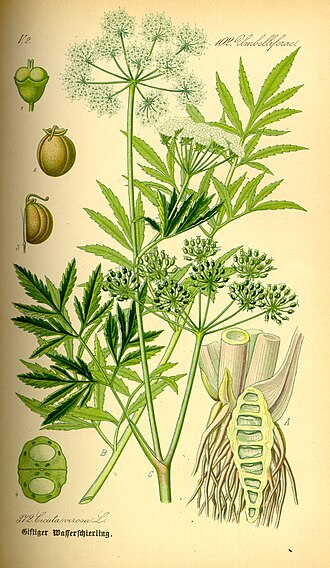
图:Public domain · Wikimedia Commons
- 学名
- Cicuta
- 分类等级
- 属
- 上级类群
- 伞形科
- 大类
- 被子植物
- 命名
- 卡尔·林奈,1753 年
- 数据库
- NCBI 分类 · GBIF
下级类群(1)

- 毒芹 Cicuta virosa 种
百科正文
物种
本属包括以下物种:
Cicuta bulbifera L.
Cicuta douglasii (DC.) J. M. Coult. & Rose
Cicuta maculata L.
毒芹 Cicuta virosa L.
以上内容摘自维基百科「毒芹属」,按 CC BY-SA 4.0 使用,去掉了参考文献、外部链接等尾部小节,公式改写成了纯文本。全文、配图和出处见原文。
英文维基百科补充中文条目比较短,下面是英文条目「Cicuta」的原文
Cicuta, commonly known as water hemlock, is a genus of four species of highly poisonous plants in the family Apiaceae. They are perennial herbaceous plants which grow up to 2.5 meters (8 ft) tall, having distinctive small green or white flowers arranged in an umbrella shape (umbel). Plants in this genus may also be referred to as cowbane or poison parsnip. Cicuta is native to temperate regions of the Northern Hemisphere, mainly North America and Europe, typically growing in wet meadows, along streambanks and other wet and marshy areas. In the United Kingdom it is frequently found along canals. These plants bear a close resemblance to other members in the family Apiaceae and may be confused with a number of edible or poisonous plants. The common name hemlock may also be confused with poison hemlock (Conium maculatum), or with the Hemlock tree.
Water hemlock is considered one of the most toxic plants in North America and Europe, being highly poisonous to humans. Three members of the genus contain a toxin named cicutoxin which causes central nervous system stimulatory effects including seizures following ingestion. Medical treatment of poisoning may include the use of activated charcoal to decrease gastrointestinal absorption of the toxic principle along with supportive care including anticonvulsant drugs such as a benzodiazepine. High doses of anticonvulsant medicine are often required to halt seizure activity and further medical care including intubation and mechanical ventilation may be required.
Description
Cicuta spp. are biennial plants that are all similar in morphology, growing up to a maximum of 2.5 meters (8 ft) in height. The stem of the plant is branching, erect, smooth and hollow (except for partitions at the junction of the leaves and stem), sometimes being purple-striped, or mottled (typically only C. maculata has the purple stripes or spots). Attached to the base of the stem is a tuberous root with thickened rootstocks.
Taxonomy
The genus Cicuta is one of many genera in the family Apiaceae, which is in the order Apiales. Apiaceae is also known as Umbelliferae, and both of these family names are permitted to be used by the International Code of Nomenclature for algae, fungi, and plants. In Europe, Cicuta was not distinguished from the similar genus Conium before the year 1500. The first mention of the genus in the United States was in the eighteenth century. Carl Linnaeus formally described three species in 1753. The type species is Cicuta virosa. The genus is now recognized to comprise four species:
Similar species
Members of the family Apiaceae bear close resemblance to each other, and have many characteristics in common. Cicuta spp. are often mistaken for edible plants such as wild celery (Angelica archangelica), celery (Apium graveolens), pignut (Conopodium majus), wild carrot (Daucus carota), wild parsnip (Pastinaca sativa), and water parsnip (Berula spp.). One of the more common misidentifications is between water hemlock and water parsnip; both have clusters of small white flowers shaped like umbrellas, and both have the same habitat near the shoreline of lakes and rivers.
Distribution and habitat
Cicuta spp. are found growing across North America and Europe. Typically, they grow in wet habitats usually alongside ponds and streams, in marshes or swamps, or areas that are swampy at least part of the year. Plants can also be found growing in water. Of the four species, Cicuta maculata has the most widespread distribution occurring across the majority of North America. Cicuta bulbifera also has a relatively large distribution, found throughout Northern North America.
Toxicity
All members of Cicuta contain high levels of the poisonous principle cicutoxin, an unsaturated aliphatic alcohol that is structurally closely related to the toxin oenanthotoxin found in the plant hemlock water dropwort. Cicutoxin is present at all stages of growth and in all parts of the plant, but is most concentrated in the roots which appear to be the most toxic in the early spring. Its primary toxic effect is to act as a stimulant in the central nervous system. It is a non-competitive gamma-aminobutyric acid (GABA) receptor antagonist.
以上节选摘自英文维基百科「Cicuta」,按 CC BY-SA 4.0 使用,去掉了参考文献、外部链接等尾部小节,公式改写成了纯文本。篇幅所限,较长的小节只摘了开头一部分,有的小节没有收;全文、配图和出处见原文。