格物

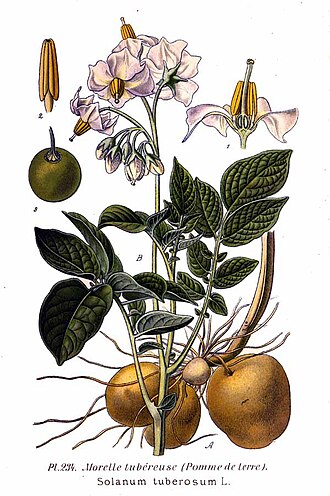
图:Giuseppe Frizzi · Public domain · Wikimedia Commons
- 学名
- Solanum nigrum
- 分类等级
- 种
- 上级类群
- 茄属
- 大类
- 被子植物
- 命名
- 卡尔·林奈,1753 年
- 中文别名
- 红果龙葵、白花菜、灯龙草、地泡子、飞天龙
- 用途
- 蔬菜、药用植物、水果、饲料、食用色素、杀虫剂
- 数据库
- NCBI 分类 · GBIF
百科正文
外型与光果龙葵非常相似。
形态
一年生草本植物,全草高30-120厘米;茎直立,多分枝;卵形或长椭圆型叶子互生,近全缘;夏季开白色小花,4-10朵成聚伞花序;球形浆果,成熟后为黑紫色。浆果和叶子均可食用,但未熟果及嫩叶子含有大量龙葵碱;龙葵碱经久煮仍具毒性,传统食用上必须借由多次换水减毒。
分布
广泛分布于欧亚大陆,荒地普遍野生,现亦已移植到美洲和澳大利亚。
异名
龙葵一名始见于《药性论》,异名有苦菜(《唐本草》)、苦葵、老鸦眼睛草、天茄子(《本草图经》)、天茄苗儿(《救荒本草》)、水茄、天泡草、老鸦酸浆草(《本草纲目》)、天泡果(《植物名实图考》)等。
药用
龙葵全草及根、种子可入药。
药理
龙葵提取物有抗炎作用。
性味
《唐本草》:味苦,寒,无毒。
《本草纲目》:苦微甘,滑,寒,无毒。
功用主治
清热解毒,活血消肿。主治疔疮、痈肿、跌打损伤等。现代有应用于癌症者。
以上内容摘自维基百科「龙葵」,按 CC BY-SA 4.0 使用,去掉了参考文献、外部链接等尾部小节,公式改写成了纯文本。全文、配图和出处见原文。
英文维基百科补充中文条目比较短,下面是英文条目「Solanum nigrum」的原文
Solanum nigrum, the European black nightshade or simply black nightshade or blackberry nightshade, is a species of flowering plant in the family Solanaceae, native to Eurasia and introduced in the Americas, Australasia, and South Africa. Ripe berries and cooked leaves of edible strains are used as food in some locales, and plant parts are used as a traditional medicine. Some other species may also be referred to as "black nightshade".
Solanum nigrum has been recorded from deposits of the Paleolithic and Mesolithic era of ancient Britain and it is suggested by the botanist and ecologist Edward Salisbury that it was part of the native flora there before Neolithic agriculture emerged. The plant was known and mentioned by ancient herbalists, including Dioscorides. In 1753, Carl Linnaeus described six varieties of Solanum nigrum in Species Plantarum.
Description
Black nightshade is a common herb or short-lived perennial shrub, found in many wooded areas, as well as disturbed habitats. It reaches a height of 30 to 120 cm (12 to 47 in), leaves 4.0 to 7.5 cm (1.6 to 3.0 in) long and 2 to 5 cm (1 to 2 in) wide; ovate to heart-shaped, with wavy or large-toothed edges; both surfaces hairy or hairless; petiole 1 to 3 cm (0.5 to 1 in) long with a winged upper portion. The flowers have petals greenish to whitish, recurved when aged and surround prominent bright yellow anthers. The berry is mostly 6 to 8 mm (0.24 to 0.31 in) in diameter, dull black or purple-black. In India, another strain is found with berries that turn red when ripe.
Taxonomy
Solanum nigrum is a highly variable species with many varieties and forms described. The recognized subspecies are:
1. S. nigrum L. subsp. nigrum – glabrous to slightly hairy with appressed non-glandular hairs
2. S. nigrum L. subsp. schultesii (Opiz) Wessley – densely hairy with patent, glandular hairs
3. S. nigrum L. subsp. vulgare – found in cooler regions, has a more spreading habit and its leaves might be more wrinkled compared to the typical subspecies.
The Solanum nigrum complex — also known as Solanum L. section Solanum – is the group of black nightshade species characterized by their lack of prickles and stellate hairs, their white flowers, and their green or black fruits arranged in an umbelliform fashion.
Toxicity
Solanine levels in S. nigrum have been tested, and the plant is rarely fatal.
Solanine poisoning symptoms may occur when immature green fruit or mature leaves are ingested raw. There is typically a delay of 6 to 12 hours after ingestion for symptoms to occur. Initial symptoms of toxicity include fever, sweating, vomiting, abdominal pain, diarrhea, confusion, and drowsiness. Death from ingesting large amounts of the plant results from cardiac arrhythmias and respiratory failure. Livestock have also been poisoned from nitrate toxicity by grazing the mature leaves and green berries of S. nigrum. In central Spain, the great bustard (Otis tarda) may act as a seed disperser of European black nightshade (Solanum nigrum).
Uses
Some of the uses ascribed to S. nigrum in literature may actually apply to other black nightshade species within the same species complex, and proper species identification is essential for food and medicinal uses (see Taxonomy section).
Culinary use
S. nigrum has been widely used as a food since early times, and the fruit was recorded as a famine food in 15th-century China. Despite toxicity issues with some forms, the ripe berries and boiled leaves of edible strains are eaten. The thoroughly boiled leaves – although strong and slightly bitter flavours – are used like spinach as horta and in fataya pies and quiches. The ripe black berries are described as sweet and salty, with hints of liquorice and melon.
Cultivation
Black nightshade is cultivated as a food crop on several continents, including Africa and North America. The leaves of cultivated strains are eaten after cooking. A garden form with fruit about 1.27 cm (0.50 in) diam. is occasionally cultivated.
Weed
Black nightshade can be a serious agricultural weed when it competes with crops. It has been reported as a weed in 61 countries and 37 crops. Herbicides are used extensively to control it in field crops such as cotton.
以上节选摘自英文维基百科「Solanum nigrum」,按 CC BY-SA 4.0 使用,去掉了参考文献、外部链接等尾部小节,公式改写成了纯文本。篇幅所限,较长的小节只摘了开头一部分,有的小节没有收;全文、配图和出处见原文。