 格物
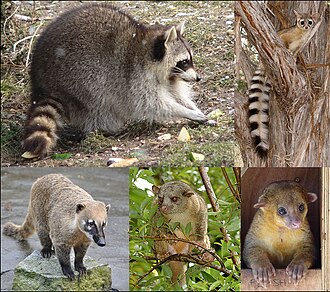
图:MathKnight · CC BY-SA 4.0 · Wikimedia Commons
- 学名
- Procyonidae
- 分类等级
- 科
- 上级类群
- 鼬总科
- 大类
- 哺乳动物
- 命名
- 约翰·爱德华·格雷,1825 年
- 数据库
- NCBI 分类 · GBIF
下级类群(4)

百科正文
本科的分类在历史上有一些变动。小熊猫曾一度被归入本科,但现在系统发育研究证明其应被单独列为小熊猫科。
- 一般包括两个亚科六个属:
- 浣熊亚科 Procyoninae
- 浣熊属(Procyon)
- 食蟹浣熊(Procyon cancrivorus)
- 特岛浣熊(Procyon insularis)
- 科苏梅尔岛浣熊(Procyon pygmaeus)
- 浣熊(Procyon lotor)
- 南美浣熊属(Nasua)
- 南美浣熊(Nasua nasua)
- 柯岛浣熊(Nasua nelsoni)
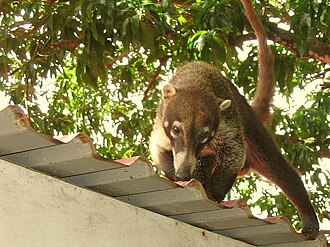
- 白鼻浣熊(Nasua narica)
- 长鼻浣熊属(Nasuella)
- 长鼻浣熊(Nasuella olivacea)
- 蓬尾浣熊属(Bassariscus)
- 蓬尾浣熊(Bassariscus astutus)
- 中美蓬尾浣熊(Bassariscus sumichrasti)
- 蜜熊亚科 Potosinae
- 蜜熊属(Potos)
- 蜜熊(Potos flavus)
- 犬浣熊属(Bassaricyon)
- 秘鲁犬浣熊(Bassaricyon alleni)
- 毛尾犬浣熊(Bassaricyon beddardi)
- 巴拿马犬浣熊(Bassaricyon pauli)
- 加氏犬浣熊(Bassaricyon gabbii)
- 毛犬浣熊(Bassaricyon lasius)
- 小型犬浣熊 (Bassaricyon neblina)
以上内容摘自维基百科「浣熊科」,按 CC BY-SA 4.0 使用,去掉了参考文献、外部链接等尾部小节,公式改写成了纯文本。全文、配图和出处见原文。
英文维基百科补充中文条目比较短,下面是英文条目「Procyonidae」的原文
Procyonidae ( PROH-see-ON-i-dee) is a New World family of the order Carnivora. It includes the raccoons, ringtails, cacomistles, coatis, kinkajous, olingos, and olinguitos. Procyonids inhabit a wide range of environments and are generally omnivorous.
Characteristics
Procyonids are relatively small animals, with generally slender bodies and long tails, though the common raccoon tends to be bulky.
Because of their general build, the Procyonidae are often popularly viewed as smaller cousins of the bear family. This is apparent in their German name, Kleinbären (small bears), including the names of the species: a raccoon is called a Waschbär (washing bear, as it "washes" its food before eating), a coati is a Nasenbär (nose-bear), while a kinkajou is a Honigbär (honey-bear). Dutch follows suit, calling the animals wasbeer, neusbeer and rolstaartbeer (curl-tail bear) respectively. However, it is now believed that procyonids are more closely related to mustelids than to bears. Procyonids share common morphological characteristics including a shortened rostrum, absent alisphenoid canals, and a relatively flat mandibular fossa. Kinkajous have unique morphological characteristics consistent with their arboreally adapted locomotion, including a prehensile tail and unique femoral structure.
Due to their omnivorous diet, procyonids have lost some of the adaptations for flesh-eating found in their carnivorous relatives. While they do have carnassial teeth, these are poorly developed in most species, especially the raccoons. Apart from the kinkajou, procyonids have the dental formula: 3.1.4.23.1.4.2 for a total of 40 teeth. The kinkajou has one fewer premolar in each row: 3.1.3.23.1.3.2 for a total of 36 teeth.
Most members of Procyonidae are solitary; however, some species form groups. Coati females will form bands of 4 to 24 individuals that forage together, while kinkajous have been found to form social groups of two males and one female. Certain procyonids give birth to one offspring like ringtails, olingos, and kinkajous while raccoons and coatis give birth to litters that range in size from 2 to 6 offspring.
Evolution
Procyonid fossils once thought to belong to the genus Bassariscus, which includes the modern ringtail and cacomistle, have been identified from the Miocene epoch, around 20 million years (Ma) ago.
Classification
There has been considerable historical uncertainty over the correct classification of several members. The red panda was previously classified in this family, but it is now classified in its own family, the Ailuridae, based on molecular biology studies. The status of the various olingos was disputed: some regarded them all as subspecies of Bassaricyon gabbii before DNA sequence data demonstrated otherwise.
The traditional classification scheme shown below on the left predates the recent revolution in our understanding of procyonid phylogeny based on genetic sequence analysis. This outdated classification groups kinkajous and olingos together on the basis of similarities in morphology that are now known to be an example of parallel evolution; similarly, coatis are shown as being most closely related to raccoons, when in fact they are closest to olingos. Below right is a cladogram showing the results of molecular studies as of 2013. Genus Nasuella was not included in these studies, but in a separate study was found to nest within Nasua.
- FAMILY PROCYONIDAE
- Subfamily Procyoninae (nine species in four genera)
- Tribe Procyonini
- Subtribe Procyonina
- Raccoons, Procyon
- Crab-eating raccoon, Procyon cancrivorus
- Cozumel raccoon, Procyon pygmaeus
- Common raccoon, Procyon lotor
- Subtribe Nasuina
- Nasua
- South American coati or ring-tailed coati, Nasua nasua
- White-nosed coati, Nasua narica
- Nasuella
- Western mountain coati, Nasuella olivacea
- Eastern mountain coati, Nasuella meridensis
- Tribe Bassariscini
- Bassariscus
- Ringtail, Bassariscus astutus
- Cacomistle, Bassariscus sumichrasti
- Subfamily Potosinae (five species in two genera)
- Potos
- Kinkajou, Potos flavus
- Bassaricyon
- Northern olingo or Gabbi's olingo, Bassaricyon gabbii
- Eastern lowland olingo, Bassaricyon alleni
- Western lowland olingo, Bassaricyon medius
- Olinguito, Bassaricyon neblina
Phylogeny
Several recent molecular studies have resolved the phylogenetic relationships between the procyonids, as illustrated in the cladogram below.
Extinct taxa
Below is a list of extinct taxa (many of which are fossil genera and species) compiled in alphabetical order under their respective subfamilies.
以上节选摘自英文维基百科「Procyonidae」,按 CC BY-SA 4.0 使用,去掉了参考文献、外部链接等尾部小节,公式改写成了纯文本。篇幅所限,较长的小节只摘了开头一部分,有的小节没有收;全文、配图和出处见原文。