 格物

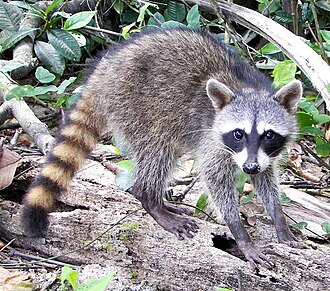
图:Cary Bass-Deschênes · CC BY 3.0 · Wikimedia Commons
- 学名
- Procyon
- 分类等级
- 属
- 上级类群
- 浣熊科
- 大类
- 哺乳动物
- 命名
- 戈特利布·史托尔,1780 年
- 数据库
- NCBI 分类 · GBIF
下级类群(3)

百科正文
- 浣熊属(学名:Procyon)是食肉目浣熊科的一属,包括以下几种:
- 食蟹浣熊(Procyon cancrivorus)
- 浣熊(Procyon lotor)
- †巴岛浣熊(Procyon lotor gloveralleni)
- 特岛浣熊(Procyon lotor insularis)
- 梅氏浣熊(Procyon lotor maynardi),也作瓜达卢浣熊
- 科苏梅尔浣熊(Procyon pygmaeus)
以上内容摘自维基百科「浣熊屬」,按 CC BY-SA 4.0 使用,去掉了参考文献、外部链接等尾部小节,公式改写成了纯文本。全文、配图和出处见原文。
英文维基百科补充中文条目比较短,下面是英文条目「Procyon (genus)」的原文
Procyon is a genus of nocturnal mammals comprising three species commonly known as raccoons in the family Procyonidae. The most familiar species, the common raccoon (P. lotor), is often known simply as "the" raccoon, as the two other raccoon species in the genus are native only to the tropics and are less well known. Genetic studies have shown that the closest relatives of raccoons are the ring-tailed cats and cacomistles of genus Bassariscus, from which they diverged about 10 million years ago.
General attributes
Raccoons are unusual, for their thumbs (though not opposable) enable them to open many closed containers (such as garbage cans and doors). They are omnivores with a reputation for being clever and mischievous; their intelligence and dexterity equip them to survive in a wide range of environments and are one of the few medium-to-large-sized animals that have enlarged their range since human encroachment began (another is the coyote). Raccoon hindfeet are plantigrade similar to those of humans and bears. Raccoons are sometimes considered vermin or a nuisance. They have readily adapted to urban environments (compare urban opossums, skunks and foxes), scavenging garbage bins and other food sources.
Although there is some variation depending on species, raccoons range from 20–40 inches (51–102 cm) in length (including the tail) and weigh between 10 and 35 lb (4.5 and 15.9 kg). The raccoon's tail ranges from 8 to 16 inches (20 to 41 cm) in length. Male raccoons are generally larger than females. A baby raccoon is called a kit.
Raccoons can live up to 16 years in the wild, though most do not make it through their second year. A raccoon that survives past its youth will live an average of five years. Primary causes of mortality include humans (hunting, trapping, cars) and malnutrition.
Species
There are three extant species of raccoon:
Some raccoons once considered as separate species are now thought to be the same as or subspecies of the common raccoon, including the Barbados raccoon (P. gloveralleni), Nassau raccoon (P. maynardi), Guadeloupe raccoon (P. minor), and Tres Marias raccoon (P. insularis) (Helgen and Wilson 2005). Procyon brachyurus Wiegmann, 1837 was described from captive specimens; its identity is undeterminable as the remains of the two animals assigned to this taxon cannot be located and may have been lost.
Nomenclature
The word "raccoon" is derived from the Algonquian word aroughcoune, "he who scratches with his hands". Spanish-speaking colonists similarly adopted their term, mapache, from mapachtli the Nahuatl word for the animal, meaning roughly "that which has hands".
The genus name, Procyon, comes from the Greek for "before the dog"; this term is also used for the star Procyon of the constellation Canis Minor.
Raccoons are today understood to have a relatively loose evolutionary relationship with bears, which was nonetheless seen as significant by the early taxonomists; Carl Linnaeus initially placed the raccoon in the genus Ursus. In many languages, the raccoon is named for its characteristic dousing behavior in conjunction with that language's term for "bear": Waschbär in German, mosómedve in Hungarian, vaskebjørn in Danish and Norwegian, tvättbjörn in Swedish, wasbeer in Dutch, pesukaru in Estonian and pesukarhu in Finnish, araiguma (アライグマ) in Japanese, orsetto lavatore in Italian, huànxióng (浣熊) in Chinese and mieshta mechka (миеща мечка) in Bulgarian all mean "washing bear". One exception is Russian, where raccoon is named yenot (енот) due to similarity between raccoon and genet furs. However, the full name of the common raccoon in Russian is also water-related: it is called yenot-poloskun (енот-полоскун), which means "rinsing raccoon".
In some cases, the "washing" descriptor is applied only to the common raccoon species: for example, in French the common raccoon is called raton laveur or "washing rat", while its Linnaean binomial is Procyon lotor or, roughly, "washing pre-dog".
General and cited references
Helgen, K.M.; Wilson, D.E. (2003). "Taxonomic status and conservation relevance of the raccoons (Procyon spp.) of the West Indies". Journal of Zoology. 259. London: 69–76. doi:10.1017/S0952836902002972. S2CID 86210627.
Helgen, K.M. & Wilson, D.E. 2005. A systematic and zoogeographic overview of the raccoons of Mexico and Central America. Pp. 219–234 in Sanchez-Cordero, V. & Medellin, R.A. (eds.). Contribuciones Mastozoologicas: en Homenaje a Bernardo Villa. Mexico City: Instituto de Biologia e Instituto de Ecologia, UNAM.
以上节选摘自英文维基百科「Procyon (genus)」,按 CC BY-SA 4.0 使用,去掉了参考文献、外部链接等尾部小节,公式改写成了纯文本。篇幅所限,较长的小节只摘了开头一部分,有的小节没有收;全文、配图和出处见原文。