 格物

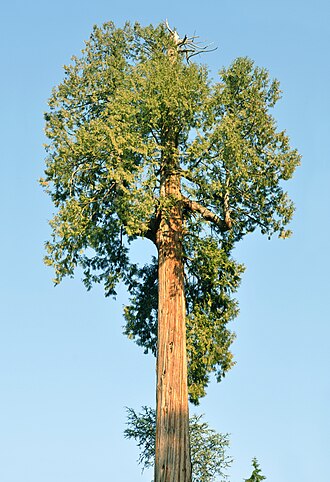
图:James St. John · CC BY 2.0 · Wikimedia Commons
- 学名
- Thuja
- 分类等级
- 属
- 上级类群
- 柏科
- 大类
- 其他植物
- 命名
- 卡尔·林奈,1753 年
- 数据库
- NCBI 分类 · GBIF
下级类群(5)

百科正文
物种
- 本属包括以下物种:
- 朝鲜崖柏 Thuja koraiensis
- 北美香柏 Thuja occidentalis
- 北美乔柏 Thuja plicata
- 日本黑桧 Thuja standishii
- 崖柏 Thuja sutchuenensis
以上内容摘自维基百科「崖柏属」,按 CC BY-SA 4.0 使用,去掉了参考文献、外部链接等尾部小节,公式改写成了纯文本。全文、配图和出处见原文。
英文维基百科补充中文条目比较短,下面是英文条目「Thuja」的原文
Thuja ( THEW-yə) is a genus of coniferous trees or shrubs in the cypress family, Cupressaceae. There are five species, two native to North America and three native to eastern Asia. The genus is most closely related to Thujopsis. Members are commonly known as arborvitaes (from the Latin term for 'tree of life'), thujas, or New World cedars.
Description
Thuja are coniferous trees that grow up to 10 to 200 feet (3 to 61 metres) tall, with stringy-textured reddish-brown bark. The shoots are flat, with side shoots only in a single plane. The leaves are scale-like and 1 to 10 mm (0.039 to 0.394 in) long, except young seedlings in their first year, which have needle-like leaves. The scale leaves are arranged in alternating decussate pairs in four rows along the twigs. The male cones are small, inconspicuous, and are located at the tips of the twigs.
Taxonomy
Species
- The five extant species are:
- Species formerly placed in Thuja include:
- Austrocedrus chilensis (D.Don) Pic.Serm. & Bizzarri (as T. chilensis D.Don)
- Callitris rhomboidea R.Br. ex Rich. (as T. australis Poir.)
- Cupressus nootkatensis D.Don (as T. excelsa Bong.)
- Dacrycarpus imbricatus (Blume) de Laub (as T. javanica Burm.f.)
- Glyptostrobus pensilis (Staunton ex D.Don) K.Koch (as T. pensilis Staunton ex D.Don)
- Libocedrus plumosa (D.Don) Sarg. (as T. doniana Hook.)
- Platycladus orientalis (L.) Franco (as T. orientalis L.)
- Tamarix aphylla (L.) H.Karst. (as T. aphylla L.)
- Tetraclinis articulata (Vahl) Mast. (as T. articulata Vahl)
Ecology
Thuja species are used as food plants by the larvae of some Lepidoptera species including autumnal moth, the engrailed and juniper pug. The foliage is also readily eaten by deer, and where deer population density is high, can adversely affect the growth of young trees and the establishment of seedlings.
Distribution
The genus Thuja has current populations in both North America and East Asia. T. plicata has wide distribution in the Pacific Northwest from Northern California to Alaska, reaching East into Idaho and central British Columbia. T. occidentalis has populations in the Northeastern United States, reaching north into Ontario and Quebec, with some distribution as far south as Tennessee.
T. standishii has populations in mountainous regions of Honshu and Shikoku islands in Japan, with no recorded population in the north of the country. T.
Evolution and paleobiogeography
Current research suggests that Thuja originated in the Americas and migrated to East Asia via the Bering land bridge in the Miocene. Fossil records show that Thuja was significantly more widely distributed during the late Cretaceous and early Tertiary than we see today. The oldest known Thuja fossil is of T. polaris (an extinct species) from the Paleocene of Ellesmere Island in present-day Nunavut, Canada.
Systematics
Thuja is a monophyletic genus that sits within the order Pinales in the Cupressaceae. Thuja is in the Cupressoid clade and is sister to the genus Thujopsis. The sister relationship between Thuja and Thujopsis is supported with 100% bootstrap support and 1.0 posterior probability.
Within the genus the taxonomy is in flux, but most recent research based on molecular analysis of plastomes in the genus Thuja showed evidence for a new grouping, with two sister clades: T. standishii and T. koraiensis together and T. occidentalis and T. sutchuenensis together, with T. plicata sister to T. occidentalis and T. sutchuenensis.
Uses of thuja
They are widely grown as ornamental trees, and extensively used for hedges. A number of cultivars are grown and used in landscapes. Homeowners will sometimes plant them as privacy trees. The cultivar 'Green Giant' is popular as a very vigorous hedging plant, growing up to 80 cm/year when young.
The wood is light, soft and aromatic. It can be easily split and resists decay. The wood has been used for many applications from making chests that repel moths to shingles. Thuja poles are also often used to make fence posts and rails. The wood of Thuja plicata is commonly used for guitar sound boards.
以上节选摘自英文维基百科「Thuja」,按 CC BY-SA 4.0 使用,去掉了参考文献、外部链接等尾部小节,公式改写成了纯文本。篇幅所限,较长的小节只摘了开头一部分,有的小节没有收;全文、配图和出处见原文。