 格物
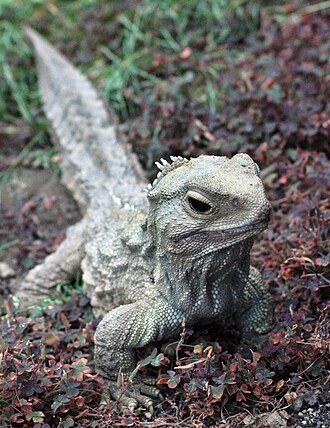
图:KeresH · CC BY 3.0 · Wikimedia Commons
- 学名
- Rhynchocephalia
- 分类等级
- 目
- 上级类群
- 爬行动物
- 大类
- 爬行动物
- 命名
- 阿尔贝特·金特,1867 年
- 特有于
- 新西兰
- 数据库
- GBIF
下级类群(1)
- 楔齿蜥科 Sphenodontidae 科
百科正文
分类
1831年,喙头蜥的头骨被送至大英博物馆,因被当成一种蜥蜴,而使整个属被错误分类。
1867年,大英博物馆的阿尔伯特·甘瑟(Albert Günther)注意到喙头蜥与鸟、龟和鳄的相似点,建立了喙头目以包含喙头蜥与相关的化石种。然而许多无关的种随后都被添加到喙头目下。
1925年, 塞缪尔·温德尔·威利斯顿(Samuel Wendell Williston)提出新的楔齿蜥类(Sphenodontia),仅包含现今生存的楔齿蜥与相关的化石种,以区别于混杂的喙头目。
如今喙头目的用法包含 Gephyrosaurus 与楔齿蜥类。
演化树
以下是 Rauhut 等人于2012年提出的喙头目的演化树。
以上内容摘自维基百科「喙头目」,按 CC BY-SA 4.0 使用,去掉了参考文献、外部链接等尾部小节,公式改写成了纯文本。全文、配图和出处见原文。
英文维基百科补充中文条目比较短,下面是英文条目「Rhynchocephalia」的原文
Rhynchocephalia (; lit. 'beak-heads') is an order of lizard-like reptiles that includes only one living species, the tuatara (Sphenodon punctatus) of New Zealand. Despite its current lack of diversity, during the Mesozoic rhynchocephalians were a speciose group with high morphological and ecological diversity. The oldest record of the group is dated to the Middle Triassic around 244 million years ago, and they had achieved global distribution by the Early Jurassic. Most rhynchocephalians belong to the suborder Sphenodontia ('wedge-teeth'). Their closest living relatives are lizards and snakes in the order Squamata, with the two orders being grouped together in the superorder Lepidosauria.
Rhynchocephalians are distinguished from squamates by a number of traits, including the retention of rib-like gastralia bones in the belly, and a proatlas bone in the neck as well as most rhynchocephalians having acrodont teeth that are fused to the crests of the jaws (the latter also found among a small number of modern lizard groups like agamids).
Once representing the world's dominant group of small reptiles, many of the niches occupied by lizards today were held by rhynchocephalians during the Triassic and Jurassic. Rhynchocephalians underwent a great decline during the Cretaceous, and they had disappeared almost entirely by the beginning of the Cenozoic. While the modern tuatara is primarily insectivorous and carnivorous, the diversity of the group also included the herbivorous eilenodontines, and there were other rhynchocephalians with specialised ecologies like the durophagous sapheosaurs. There were even successful groups of aquatic sphenodontians, such as the elongate-bodied pleurosaurs.
Research history
Tuatara were originally classified as agamid lizards when they were first described by John Edward Gray in 1831. They remained misclassified until 1867, when Albert Günther of the British Museum noted features similar to birds, turtles, and crocodiles. He proposed the order Rhynchocephalia (from Ancient Greek ῥύγχος (rhúnkhos) 'beak' and κεφαλή (kephalḗ) 'head', meaning "beak head") for the tuatara and its fossil relatives. In 1925, Samuel Wendell Williston proposed the Sphenodontia to include only tuatara and their closest fossil relatives.
Anatomy
Rhynchocephalia and their sister group Squamata (which includes lizards, snakes and amphisbaenians) belong to the superorder Lepidosauria, the only surviving taxon within Lepidosauromorpha.
Classification
While the grouping of Rhynchocephalia is well supported, the relationships of many taxa to each other are uncertain, varying substantially between studies. In modern cladistics, the clade Sphenodontia includes all rhynchocephalians other than Wirtembergia, as well as Gephyrosaurus and other gephyrosaurids. Gephyrosaurids have been found as more closely related to squamates in some analyses.
Ecology
The fossil record of rhynchocephalians demonstrates that they were a diverse group that exploited a wide array of ecological niches. Early rhynchocephalians possess small ovoid teeth designed for piercing, and were probably insectivores. Like modern tuatara, extinct members of Sphenodontinae were likely generalists with a carnivorous/insectivorous diet.
Evolutionary history
The timing of when Rhynchocephalia is estimated to have diverged from Squamata is disputed. Older estimates place the divergence between the Middle Permian and earliest Triassic, around 270 to 252 million years ago, while other authors posit a younger date of around 242 million years ago. The oldest known definitive rhynchocephalian is Agriodontosaurus from the Helsby Sandstone Formation of Devon, UK dating to the upper Anisian stage of the Middle Triassic, approximately 244 to 241.5 million years ago.
以上节选摘自英文维基百科「Rhynchocephalia」,按 CC BY-SA 4.0 使用,去掉了参考文献、外部链接等尾部小节,公式改写成了纯文本。篇幅所限,较长的小节只摘了开头一部分,有的小节没有收;全文、配图和出处见原文。