 格物
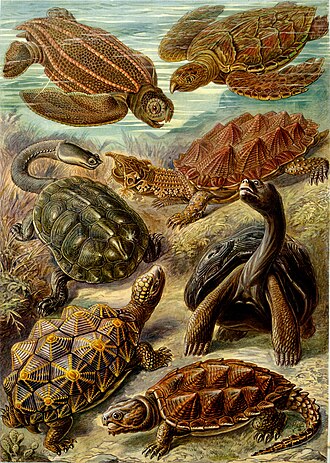
图:Ernst Haeckel · Public domain · Wikimedia Commons
生命之树 › 真核生物 › 动物界 › 真后生动物亚界 › 两侧对称动物 › 后口动物总门 › 脊索动物门 › 脊椎动物亚门 › 有颌下门 › 肉鳍鱼总纲 › 四足形类 › 希望螈目 › 四足总纲 › 爬行动物
无孔亚纲亚纲
Anapsida
无孔亚纲(Anapsida)属于羊膜动物,头骨上没有颞颥孔。它们是羊膜动物中最原始的一群,出现于石炭纪晚期。由于龟鳖目演化自双孔亚纲,所以无孔亚纲全部灭绝,其中的米勒古蜥科、夜守龙科、锯齿龙科,都在二叠纪-三叠纪灭绝事件中绝种,只有前棱蜥科仍存活到三叠纪。
无孔亚纲是种传统上的用法,有学者提出这些无孔类动物的彼此关系很远,所以应该被分为几个演化支:出现在晚石炭纪的原始爬行动物(大鼻龙目)、生存在二叠纪的多样性无孔类爬行动物(前棱蜥形目)、以及现存的龟鳖目(海龟、陆龟、水龟)。
摘自维基百科「無孔亞綱」,CC BY-SA 4.0
- 学名
- Anapsida
- 分类等级
- 亚纲
- 英文名
- Anapsid
- 上级类群
- 爬行动物
- 大类
- 爬行动物
- 命名
- Samuel Williston,1917 年
下级类群(1)
- 杯龙目 Cotylosauria 目
百科正文
最早的龟鳖目化石来自晚三叠纪中国的半甲齿龟(Odontochelys semitestacea),已经很类似现代乌龟。近年有科学家提出,龟鳖目的无孔类形态头颅骨,是种演化逆行现象。这个理论认为龟鳖目演化自双孔类爬行动物,在演化过程中失去两个颞颥孔,这理论还已经被普遍的接受。近期的一些种系发生学研究,根据形态学而将龟鳖目归类于双孔亚纲。一些研究人员将龟鳖目列为主龙类的姊妹分类单元,其中多数研究人员是将龟鳖目归类于鳞龙形下纲。
大部分分子系统发生学的研究结果,都支持龟鳖目属于双孔亚纲的分类法。某些研究将龟鳖目归类于主龙类,大部分研究则是将龟鳖目列为主龙类的姊妹分类单元。另有一个分子系统发生学研究,将龟鳖目归类于双孔亚纲的鳞龙形下纲,是鳞龙类(蜥蜴、蛇、喙头蜥)的近亲。他们认为龟鳖目原先被归类于无孔亚纲的原因,是因为原本研究是将龟鳖目作为无孔亚纲的研究主体、参照点,而且原本研究并没有广泛地研究远古无孔类的化石、现存龟鳖目的骨头,以建立演化树。有研究认为,龟鳖目是在2亿7900万到2亿年前演化自双孔类爬行动物。
以上内容摘自维基百科「無孔亞綱」,按 CC BY-SA 4.0 使用,去掉了参考文献、外部链接等尾部小节,公式改写成了纯文本。全文、配图和出处见原文。
英文维基百科补充中文条目比较短,下面是英文条目「Anapsid」的原文
An anapsid is an amniote whose skull lacks one or more skull openings (fenestra, or fossae) near the temples. Traditionally, the Anapsida are considered the most primitive subclass of amniotes, the ancestral stock from which Synapsida and Diapsida evolved, making anapsids paraphyletic. It is, however, doubtful that all anapsids lack temporal fenestra as a primitive trait, and that all the groups traditionally seen as anapsids truly lacked fenestra.
Anapsids and the turtles
While "anapsid reptiles" or "Anapsida" were traditionally spoken of as if they were a monophyletic group, it has been suggested that several groups of reptiles that had anapsid skulls might be only distantly related. Scientists still debate the exact relationship between the basal (original) reptiles that first appeared in the late Carboniferous, the various Permian reptiles that had anapsid skulls, and the Testudines (turtles, tortoises, and terrapins). However, it was later suggested that the anapsid-like turtle skull is due to reversion rather than to anapsid descent. The majority of modern paleontologists believe that the Testudines are descended from diapsid reptiles that lost their temporal fenestrae. More recent morphological phylogenetic studies with this in mind placed turtles firmly within diapsids, most commonly within Archelosauria.
Phylogenetic position of turtles
All molecular studies have strongly upheld the placement of turtles within diapsids; some place turtles within Archosauria, or, more commonly, as a sister group to extant archosaurs. One molecular study, published in 2012, suggests that turtles are lepidosauromorph diapsids, most closely related to the lepidosaurs (lizards, snakes, and tuataras). However, in a later paper from the same authors, published in 2014, based on more extensive data, the archosauromorph hypothesis is supported.
Reanalysis of prior phylogenies suggests that they classified turtles as anapsids both because they assumed this classification (most of them were studying what sort of anapsid turtles are) and because they did not sample fossil and extant taxa broadly enough for constructing the cladogram. Testudines is suggested to have diverged from other diapsids between 200 and 279 million years ago, though the debate is far from settled. Although procolophonids managed to survive into the Triassic, most of the other reptiles with anapsid skulls, including the millerettids, nycteroleterids, and pareiasaurs, became extinct in the Late Permian period by the Permian-Triassic extinction event.
Anapsida in modern taxonomy
Anapsida is still sporadically recognized as a valid group, but is not favoured by current workers. Anapsids in the traditional meaning of the word are not a clade, but rather a paraphyletic group composed of all the early reptiles retaining the primitive skull morphology, grouped together by the absence of temporal openings. Gauthier, Kluge & Rowe (1988) attempted to redefine 'Anapsida' so it would be monophyletic, defining it as the clade containing "extant turtles and all other extinct taxa that are more closely related to them than they are to other reptiles".
This definition explicitly includes turtles in Anapsida; because the phylogenetic placement of turtles within Amniota is very uncertain, it is unclear what taxa, other than turtles themselves, would be included in such defined Anapsida, and whether its content would be similar to the Anapsida of tradition. Indeed, Gauthier, Kluge & Rowe (1988) themselves included only turtles and Captorhinidae in their Anapsida, while excluding the majority of clades from it that had been traditionally included under the older definition of anapsids.
Temporal openings in traditional anapsids
Tsuji and Müller (2009) noted that the name Anapsida implies a morphology (lack of temporal openings) that is in fact absent in the skeletons of a number of taxa traditionally included in the group. A temporal opening in the skull roof behind each eye, similar to that present in the skulls of synapsids, has been discovered in the skulls of a number of members of Parareptilia (the group containing most of reptiles traditionally referred to as anapsids), including lanthanosuchoids, millerettids, bolosaurids, some nycteroleterids, some procolophonoids and at least some mesosaurs. The presence of temporal openings in the skulls of these taxa makes it uncertain whether the ancestral reptiles had an anapsid-like skull as traditionally assumed or a synapsid-like skull instead.
以上内容摘自英文维基百科「Anapsid」,按 CC BY-SA 4.0 使用,去掉了参考文献、外部链接等尾部小节,公式改写成了纯文本。全文、配图和出处见原文。