 格物
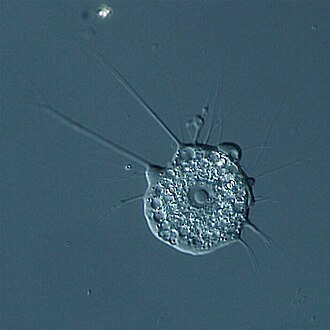
图:ja:User:NEON / User:NEON_ja · CC BY-SA 2.5 · Wikimedia Commons
- 学名
- Cristidiscoidea
- 分类等级
- 纲
- 上级类群
- 菌物总界
- 大类
- 其他真核生物
- 命名
- Frederick C. Page,1987 年
百科正文
种系发生
下面的系统发生树显示出核形虫纲所在之位置。
分类
核形虫纲 Cristidiscoidea (Cavalier-Smith 1998)
泉生虫目 Fonticulida (Cavalier-Smith 1993)
泉生虫科 Fonticulidae (Worley, Raper & Hohl 1979)
泉生虫属 Fonticula (Worley, Raper & Hohl 1979)
泉生虫 Fonticula alba (Worley, Raper & Hohl 1979)
- 核形虫目 Nucleariida (Cavalier-Smith 1993)
- 核形虫科 Nucleariidae (Cann & Page 1979)
- 核形虫属 Nuclearia (Cienkowski 1865)
亚特兰大核形虫属 Parvularia (López-Escardó 2017)
亚特兰大核形虫 P. atlantis (López-Escardó 2017)
以上内容摘自维基百科「核形蟲綱」,按 CC BY-SA 4.0 使用,去掉了参考文献、外部链接等尾部小节,公式改写成了纯文本。全文、配图和出处见原文。
英文维基百科补充中文条目比较短,下面是英文条目「Nucleariid」的原文
The nucleariids, or nucleariid amoebae, are a group of amoebae that comprise the sister clade of the fungi. Together, they form the clade Holomycota. They are aquatic organisms found in freshwater and marine habitats, as well as in faeces. They are free-living phagotrophic predators that mostly consume algae and bacteria.
Nucleariids are characterized by simple, spherical or flattened single-celled bodies with filopodia (fine, thread-like pseudopods), covered by a mucous coat. They lack flagella and microtubules. Inside the cytoplasm of some species are endosymbiotic proteobacteria. Some species are naked, with only the mucous coat as cover, while others (known as 'scaled' nucleariids) have silica-based or exogenous particles of various shapes.
An exceptional nucleariid, Fonticula alba, develops multicellular fruiting bodies (sorocarps) for spore dispersal. It is one of several cases of independently evolved multicellularity within Opisthokonta, the clade that houses both Holozoa (which includes animals) and Holomycota.
Initially, nucleariids were grouped with other filose amoebae (i.e., with filopodia) based on their superficial similarity. Silica-scaled and naked nucleariids were classified into separate families from one another, Pompholyxophryidae and Nucleariidae, respectively. Due to its nature as a slime mold, the genus Fonticula has also been classified separatedly, particularly with acrasids and other slime molds. With advancements in electron microscopy and molecular phylogenetics, the three groups were revealed to belong to the same clade as sister to the fungi. Due to lack of molecular data, the three groups are treated as one family, under the name of Nucleariidae.
Various conflicting systems of above-family classification exist for nucleariids, with older systems grouping them as a class Cristidiscoidea composed of two orders: one for Fonticula and another for the remaining species. Mycologists regard them as an independent kingdom of life, Nucleariae, with two phyla that mirror those two orders. They are generally accepted by protistologists as a single order Rotosphaerida, which is the oldest taxonomic name for these organisms.
Description
Nucleariids are single-celled amoebae that lack flagella and have radiating filopodia (i.e., thread-like pseudopodia). They have a spherical or sometimes flattened cell bodies with one or few conspicuous nuclei, each with a prominent central nucleolus except for Fonticula and Parvularia: Parvularia can also have peripheral nucleoral material instead, and Fonticula has an indistinct nucleolus. The cytoplasm contains multiple vacuoles, including food vesicles, contractile vacuoles in freshwater species, and lipid globules.
Ecology
Nucleariids thrive in water bodies worldwide. Most live in a variety of freshwater environments, including hot spring waters of around 30 °C. Others are found in marine environments (e.g., Lithocolla), and others inhabit faeces (Fonticula).
Nucleariids are free-living phagotrophs, and preferably consume cyanobacteria and other algae. Small-celled species like those of Parvularia and Fonticula feed on small bacteria, while larger cells such as Nuclearia, Pompholyxophrys and Lithocolla can also feed on detritus and unicellular eukaryotic algae (e.g., diatoms).
Evolution
Nucleariids are among the closest relatives of fungi, together forming the clade Holomycota. This clade is, in turn, closely related to Holozoa, the clade containing animals and their closest protist relatives. Together, they form the clade Opisthokonta. After animals and fungi, nucleariids include the third known occurrence of multicellularity among opisthokonts: the species Fonticula alba, a type of slime mold, capable of aggregative multicellular fruiting that develops sorocarps (stalks with masses of spores) for dispersal.
Classification
History
The history of the classification of nucleariids is full of incongruence between morphology and molecular phylogeny. Toward the end of the 19th century, most nucleariid species had already been described, and were classified with other naked or scaled filose amoebae. During the second half of the 20th century, naturalist Heinrich Rainer described a subgroup of heliozoans, Rotosphaeridia, to accommodate non-flagellated, scaled, filose amoebae without axopodia (the nucleariids Pompholyxophrys, Pinaciophora, Lithocolla and Rhabdiophrys).
以上节选摘自英文维基百科「Nucleariid」,按 CC BY-SA 4.0 使用,去掉了参考文献、外部链接等尾部小节,公式改写成了纯文本。篇幅所限,较长的小节只摘了开头一部分,有的小节没有收;全文、配图和出处见原文。