 格物
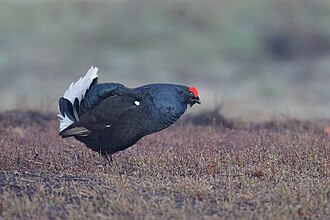
图:Vnp at de.wikipedia · CC BY-SA 3.0 · Wikimedia Commons
- 学名
- Lyrurus tetrix
- 分类等级
- 种
- 英文名
- Black Grouse
- 上级类群
- 琴鸡属
- 大类
- 鸟类
- 命名
- 卡尔·林奈,1758 年
- 保护状况(IUCN)
- 无危物种
- 异名
- Tetrao tetrix
- 体重
- 1.175 千克(成年体重、雄性);925 克(成年体重、雌性);35.5 克(出生体重)
- 数据库
- NCBI 分类 · GBIF · IUCN 红色名录
百科正文
保护
中国国家重点保护动物等级:二级
亚种
黑琴鸡北方亚种(学名:Lyrurus tetrix baikalensis)。分布于俄罗斯、蒙古以及中国大陆的东北等地。该物种的模式产地在外贝加尔。
黑琴鸡新疆亚种(学名:Lyrurus tetrix mongolicus)。分布于俄罗斯、蒙古以及中国大陆的新疆等地。该物种的模式产地在天山山脉。
黑琴鸡东北亚种(学名:Lyrurus tetrix ussuriensis)。分布于俄罗斯以及中国大陆的小兴安岭等地。该物种的模式产地在乌苏里江流域。
以上内容摘自维基百科「黑琴鸡」,按 CC BY-SA 4.0 使用,去掉了参考文献、外部链接等尾部小节,公式改写成了纯文本。全文、配图和出处见原文。
英文维基百科补充中文条目比较短,下面是英文条目「Black grouse」的原文
The black grouse (Lyrurus tetrix), also known as northern black grouse, Eurasian black grouse, blackgame or blackcock, is a large bird in the grouse tribe. It is a sedentary species, spanning across the Palearctic in moorland and steppe habitat when breeding, often near wooded areas. They will spend the winter perched in dense forests, feeding almost exclusively on the needles of conifers. The black grouse is one of two species of grouse in the genus Lyrurus, the other being the lesser-known Caucasian grouse.
The female is greyish-brown and has a cackling or warbling call. She takes all responsibility for nesting and caring for the chicks, as typical with most galliforms.
The black grouse's genome was sequenced in 2014.
Taxonomy and naming
The black grouse was formally described by the Swedish naturalist Carl Linnaeus in 1758 in the tenth edition of his Systema Naturae under the binomial name Tetrao tetrix. Both Tetrao and tetrix come from Ancient Greek words referring to some form of game bird. The black grouse is now placed in the genus Lyrurus that was introduced in 1832 by the English naturalist William Swainson.
The male and female are sometimes referred to by their folk names, blackcock and greyhen, respectively. These names first occur in the literature with John Ray in 1674. Heathcock and Heathhen are also common names.
Description and appearance
The black grouse is a large bird with males measuring roughly around 60 centimetres (24 inches) in length and weighing 1,100–1,250 g (2 lb 7 oz – 2 lb 12 oz), sometimes up to 2,100 g (4 lb 10 oz), with females approximately 45 cm (18 in) and weighing 750–1,100 g (1 lb 10 oz – 2 lb 7 oz). The cock's fancy plumage is predominantly black with deep-blue hues on his neck and back, which contrasts the white wingline and undertail coverts, as well as red bare skin above each eye. On the other hand, the hen is much drabber and cryptically colored to blend in easily with the dense undergrowth, especially when nesting.
Distribution and habitat
Black grouse can be found on open habitats across Europe (Swiss-Italian-French Alps especially) from Great Britain through Scandinavia, Estonia and across Russia. Although believed once to have lived in Ireland, it now no longer resides there. In Eastern Europe they can be found in Hungary, Latvia, Lithuania, Poland, Belarus, Romania and Ukraine. There is a population in the Alps, and isolated remnants in Germany, France, Belgium and the Netherlands. It formerly occurred in Denmark, but the Danish Ornithological Society (DOF) has considered it extinct since 2001. The species disappeared from Bulgaria in the 19th century.
Conservation status
Although this species has declined throughout most of its range in western Europe, it is not considered to be vulnerable globally due to the large population (global estimate is 15–40 million individuals) and slow rate of decline. Its decline is due to loss of habitat, disturbance, predation by foxes, crows, etc., and small populations gradually dying out.
The IUCN implemented a Black Grouse Action Plan 2007–2010. This has looked at local populations that are vulnerable to the extinction vortex. For example, in Styria, Austria.
Breeding and nesting
Black grouse have a very distinctive and well-recorded courtship ritual. Every dawn in the spring, male grouse begin competition with other males to attract a hen to mate with. They will display to signal their territory and vigor by fanning out their lyre-shaped tails and inflating their necks on designated open ground called a lek. Their song consists of a long, bubbling coo or murmur. Black grouse hens visiting the lek decide the overall healthiest male, though not all females may arrive at every lek.
In western Europe, these leks seldom contain more than 40 birds; in Russia, 150 is not uncommon and up to 200 have been recorded.
Relationship to humans
The tails of black-cocks have, since late Victorian times, been popular adornments for hats worn with Highland Dress. Most commonly associated with Glengarry and Balmoral or Tam o' Shanter caps, they still continue to be worn by pipers of civilian and military pipe bands. Since 1904, all ranks of the Royal Scots and King's Own Scottish Borderers have worn them in their full-dress headgear and that tradition is carried on in the dress glengarries of the current Scottish super regiment, the Royal Regiment of Scotland.
以上节选摘自英文维基百科「Black grouse」,按 CC BY-SA 4.0 使用,去掉了参考文献、外部链接等尾部小节,公式改写成了纯文本。篇幅所限,较长的小节只摘了开头一部分,有的小节没有收;全文、配图和出处见原文。