 格物
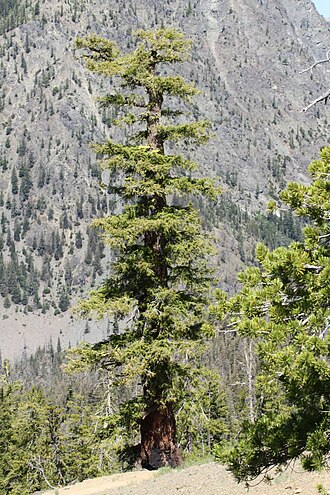
图:Walter Siegmund (talk) · CC BY-SA 3.0 · Wikimedia Commons
- 学名
- Pseudotsuga menziesii
- 分类等级
- 种
- 上级类群
- 黄杉属
- 大类
- 其他植物
- 命名
- João Manuel Antonio do Amaral Franco,1950 年
- 保护状况(IUCN)
- 无危物种
- 数据库
- NCBI 分类 · GBIF · IUCN 红色名录
百科正文
分布
其中一个变种海滨黄杉(Pseudotsuga menziesii var. menziesii)生长在海岸区域,从加拿大不列颠哥伦比亚中西部向南延伸至美国加州中部,分布区域包括喀斯喀特山脉、太平洋海岸山脉、克拉马斯山脉、加州海岸山脉、圣塔露西亚山脉与尤塞米提谷,最南可分布到圣塔芭芭拉的普尔斯马山,分布海拔由海平面至海拔1800米,最高可达100.3米,海滨黄杉是世界第二高的针叶树(仅次于最高的加州红木以及在第三高的北美云杉之上)。
在内陆区域分布的则是落矶山黄杉(Pseudotsuga menziesii var. glauca),在华盛顿州北部与不列颠哥伦比亚南部的喀斯喀特山脉与海滨黄杉过渡,并从此向北延伸至不列颠哥伦比亚中部,向东南延伸至墨西哥边界,随着纬度下降其分布点越趋破碎,海拔高度限制也提高。
墨西哥黄杉(Pseudotsuga lindleyana)有时也被视为花旗松的另一个变种,分布于墨西哥的瓦哈卡州。
名称
本种的种小名menziesii来自苏格兰植物学家阿奇博尔德·孟席斯,他于1791年首度于温哥华岛上描述了这个物种。
以上内容摘自维基百科「花旗松」,按 CC BY-SA 4.0 使用,去掉了参考文献、外部链接等尾部小节,公式改写成了纯文本。全文、配图和出处见原文。
英文维基百科补充中文条目比较短,下面是英文条目「Douglas fir」的原文
The Douglas fir (Pseudotsuga menziesii) is a conifer species in the pine family, Pinaceae. It is the tallest tree in the family. It is native to western North America and is also known as Douglas-fir, Douglas spruce, Oregon pine, and Columbian pine. There are three varieties: coast Douglas-fir (P. menziesii var. menziesii), Rocky Mountain Douglas-fir (P. menziesii var. glauca) and Mexican Douglas-fir (P. menziesii var. lindleyana).
Despite its common names, it is not a true fir (genus Abies), spruce (genus Picea), or pine (genus Pinus). It is also not a hemlock (genus Tsuga); the genus name Pseudotsuga means "false hemlock".
Description
Douglas-firs are medium-sized to extremely large trees, 20–100 metres (70–330 feet) tall (although only coast Douglas-firs reach heights near 100 m) and commonly reach 2.4 m (8 ft) in diameter, although trees with diameters of almost 5 m (16 ft) exist. The largest coast Douglas-firs regularly live over 500 years, with the oldest specimens living for over 1,300 years. Rocky Mountain Douglas-firs, found further to the east, are less long-lived, usually not exceeding 400 years in age.
There are records of former coast Douglas-firs exceeding 120 m (390 ft) in height, which if alive today would make it the tallest tree species on Earth.
Taxonomy
The common name honors David Douglas, a Scottish botanist and collector who first reported the extraordinary nature and potential of the species. The common name is misleading since it is not a true fir, i.e., not a member of the genus Abies. For this reason, the name is often written as Douglas-fir (a name also used for the genus Pseudotsuga as a whole).
The specific epithet menziesii is after Archibald Menzies, a Scottish physician and rival naturalist to David Douglas. Menzies first documented the tree on Vancouver Island in 1791.
Distribution
Pseudotsuga menziesii var. menziesii, the coast Douglas-fir, grows in the coastal regions from west-central British Columbia southward to Central California. In Oregon and Washington, its range is continuous from the eastern edge of the Cascades west to the Pacific Coast Ranges and Pacific Ocean. In California, it is found in the Klamath and California Coast Ranges as far south as the Santa Lucia Range, with a small stand as far south as the Purisima Hills in Santa Barbara County. One of the last remaining old growth stands of conifers is in the Mattole Watershed, and is under threat of logging.
Ecology
Preferred sites
Douglas-fir prefers acidic or neutral soils, such as Olympic soil. However, it exhibits considerable morphological plasticity, and on drier sites P. menziesii var. menziesii will generate deeper taproots. Pseudotsuga menziesii var. glauca exhibits even greater plasticity, occurring in stands of interior temperate rainforest in British Columbia, as well as at the edge of semi-arid sagebrush steppe throughout much of its range, where it generates even deeper taproots still.
The coast Douglas-fir variety is the dominant tree west of the Cascade Mountains in the Pacific Northwest.
Uses
Many different Native American groups use the bark, resin, and needles to make herbal treatments for various diseases. Historically, Native Hawaiians built waʻa kaulua (double-hulled canoes) from coast Douglas-fir logs that had drifted ashore. The wood and bark have historically been favored as firewood, especially from the coastal variety. Additionally, Douglas-fir has long been used as a building material by both Native American groups and settlers.
The species is extensively used in forestry management as a plantation tree for softwood timber.
Notable examples
The immense size and long lifespan of the Douglas fir has produced some acclaimed individual trees. Historical examples include the Lynn Valley Tree near Vancouver, British Columbia and the Nooksack Giant in Maple Falls in Washington State.
Living examples in Canada include the Red Creek Fir in the San Juan Valley of Vancouver Island, the largest known Douglas-fir in Canada and one of the largest in the world; the Bonin Giant in the Coquitlam River watershed in British Columbia's Lower Mainland and Big Lonely Doug north of Port Renfrew on Vancouver Island.
以上节选摘自英文维基百科「Douglas fir」,按 CC BY-SA 4.0 使用,去掉了参考文献、外部链接等尾部小节,公式改写成了纯文本。篇幅所限,较长的小节只摘了开头一部分,有的小节没有收;全文、配图和出处见原文。