 格物
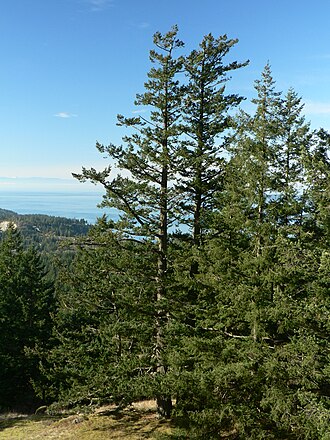
图:Walter Siegmund · CC BY 2.5 · Wikimedia Commons
- 学名
- Pseudotsuga
- 分类等级
- 属
- 上级类群
- 松科
- 大类
- 其他植物
- 命名
- 伊利-阿贝尔·卡里埃,1867 年
- 数据库
- NCBI 分类 · GBIF
下级类群(4)
百科正文
分类
- 黄杉属植物比较稀少,常和其他针叶林混生,所有物种都是受保护物种:
- 北美洲
- 北美黄杉 Pseudotsuga menziesii
海滨黄杉 Pseudotsuga menziesii var. menziesii
- 落矶山黄杉 Pseudotsuga menziesii var. glauca
- 灰黄杉 Pseudotsuga menziesii var. caesia
- 墨西哥黄杉 Pseudotsuga lindleyana
- 大果黄杉 Pseudotsuga macrocarpa
- 亚洲
- 日本黄杉 Pseudotsuga japonica
- 黄杉 Pseudotsuga sinensis
华东黄杉 Pseudotsuga sinensis var. gaussenii
短叶黄杉 Pseudotsuga sinensis var. brevifolia
澜沧黄杉 Pseudotsuga sinensis var. forrestii
台湾黄杉 Pseudotsuga sinensis var. wilsoniana
利用
黄杉木是可以应用到建筑方面的木材,幼树在北美洲常用做圣诞树。
以上内容摘自维基百科「黄杉属」,按 CC BY-SA 4.0 使用,去掉了参考文献、外部链接等尾部小节,公式改写成了纯文本。全文、配图和出处见原文。
英文维基百科补充中文条目比较短,下面是英文条目「Pseudotsuga」的原文
Pseudotsuga is a genus of coniferous trees in the pine family, Pinaceae (subfamily Laricoideae). Common names for species in the genus include Douglas fir, Douglas-fir, Douglas tree, Oregon pine and Bigcone spruce. Pseudotsuga menziesii (Douglas fir proper) is widespread in western North America and is an important source of timber. The number of species has long been debated, but two in western North America and two to four in eastern Asia are commonly acknowledged.
Nineteenth-century botanists had problems in classifying Douglas firs, due to the species' similarity to various other conifers better known at the time; they have at times been classified in Pinus, Picea, Abies, Tsuga, and even Sequoia. Because of their distinctive cones, Douglas firs were finally placed in the new genus Pseudotsuga (meaning "false hemlock") by the French botanist Carrière in 1867.
Name
The tree takes its English name from David Douglas, the Scottish botanist who introduced Pseudotsuga menziesii into cultivation at Scone Palace in 1827. Douglas is known for introducing many native American tree species to Europe. The hyphenated form "Douglas-fir" is used by some to indicate that Pseudotsuga species are not true firs, which belong to the genus Abies.
Description
Douglas-firs are medium-size to extremely large coniferous trees, 20–120 metres (70–390 ft) tall (although only coast Douglas-firs reach such great height). The leaves are flat, soft, linear, 2–4 centimetres (0.8–1.6 in) long, generally resembling those of the firs, occurring singly rather than in fascicles; they completely encircle the branches, which can be useful in recognizing the species. The female cones are pendulous, with persistent scales (unlike true firs), and are distinctive in having a long tridentine (three-pointed) bract that protrudes prominently above each scale (it resembles the back half of a mouse, with two feet and a tail).
Pseudotsuga menziesii var. menziesii has attained heights of 393 feet (120* m).
Taxonomy
Phylogeny of Pseudotsuga according to Stull 2021:
By far the best-known is the widespread and abundant North American species Pseudotsuga menziesii, a taxonomically complex species divided into two major varieties (treated as distinct species or subspecies by some botanists): coast Douglas-fir or "green Douglas-fir", on the Pacific coast; and Rocky Mountain Douglas-fir or "interior Douglas-fir", in the interior west of the continent. According to some botanists, Rocky Mountain Douglas-fir extends south into Mexico to include all Mexican Douglas-fir populations, whereas others have proposed multiple separate species in Mexico and multiple varieties in the United States. Morphological and genetic evidence suggest that Mexican Douglas-fir should probably be considered a distinct variety within P. menziesii.
Uses
Douglas-fir wood is used for structural applications that are required to withstand high loads. It is used extensively in the construction industry. Other examples include its use for homebuilt aircraft such as the RJ.03 IBIS canard. Very often, these aircraft were designed to utilize Sitka spruce, which is becoming increasingly difficult to source in aviation quality grades. Oregon pine is also used in boat building when it is available in long, fairly knot-free lengths. Most timber now comes from plantation forests in North America which are managed to produce faster growing timber with fewer knots. This timber is generally lighter but weaker. Traditionally, Oregon pine was used in mast building due to its ability to resist bending loads without fracturing.
Pests and diseases
Douglas-firs are used as food plants by the larvae of some Lepidoptera species, including autumnal moth, bordered white, engrailed moth, pine beauty and turnip moth. The gelechiids Chionodes abella and Chionodes periculella and the tortrix moth Cydia illutana have been specifically recorded on P. menziesii.
Culture
A California Native American myth explains that each three-ended bract is the tail and two tiny legs of a mouse that hid inside the scales of the tree's cones during forest fires, and the tree was kind enough to be its enduring sanctuary.
A Douglas-fir species, Pseudotsuga menziesii, is the state tree of Oregon and is also used as a symbol of the Cascadia Movement, being pictured on the Doug Flag.
以上节选摘自英文维基百科「Pseudotsuga」,按 CC BY-SA 4.0 使用,去掉了参考文献、外部链接等尾部小节,公式改写成了纯文本。篇幅所限,较长的小节只摘了开头一部分,有的小节没有收;全文、配图和出处见原文。