 格物
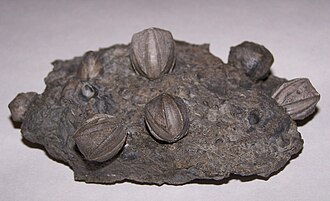
- 学名
- Blastoidea
- 分类等级
- 纲
- 英文名
- Blastoid
- 上级类群
- 海蕾亚门
- 大类
- 其他动物
百科正文
海蕾纲(Blastoidea)在分类上属于海百合亚门(Crinozoa),也有学者将海蕾纲、拟海蕾纲(Parablastoidea)、海林檎纲(Cystoidea)及始海百合纲(Eocrinoidea)4纲划归为一个亚门,称为海蕾亚门(Blastozoa)。
特征
海蕾的身体构造包括根、茎(柄)及冠(包含萼和腕羽)。萼(theca)较小,多为梨形或球形,由三圈钙质骨板组成,分别为底板、辐板和三棱板。底板3块,下连接茎(柄)。海蕾像有柄海百合一样,利用柄固着在海床上,不过海蕾的柄通常相对较短,有些物种无柄。口位于萼部顶端,五条食物沟(步带)以口为中心像花瓣一样辐射出,上有短腕,用来滤取水中的微生物和有机颗粒,并沿着步带将其运至口中。口附近有五个小呼吸孔用于排水,其中较大的一个兼具肛门的功能。
以上内容摘自维基百科「海蕾」,按 CC BY-SA 4.0 使用,去掉了参考文献、外部链接等尾部小节,公式改写成了纯文本。全文、配图和出处见原文。
英文维基百科补充中文条目比较短,下面是英文条目「Blastoid」的原文
Blastoids (class Blastoidea) are an extinct type of stemmed echinoderm, often referred to as sea buds. They first appear, along with many other echinoderm classes, in the Ordovician period, and reached their greatest diversity in the Mississippian subperiod of the Carboniferous period. However, blastoids may have originated in the Cambrian. Blastoids persisted until their extinction at the end of Permian, about 250 million years ago. Although never as diverse as their contemporary relatives, the crinoids, blastoids are common fossils, especially in many Mississippian-age rocks.
Description
Like most echinoderms, blastoids were protected by a set of interlocking plates of calcium carbonate, which formed the main body, or theca. In life, the theca of a typical blastoid was attached to a stalk or column made up of stacked disc-shaped plates. The other end of the column was attached to the ocean floor by a holdfast, very much like stalked crinoids. The stalk was usually relatively short, and in some species, was absent, with the holdfast being attached directly to the base of the theca.
The mouth was at the summit of the theca. Radiating like flower petals from the center were five food grooves, or ambulacra. Each ambulacrum had many long thin fine structures called brachioles, which were used to trap food particles and bring them to the mouth. Brachioles were delicate structures, and in fossils are not usually preserved in place. A series of five spiracle plates surrounded the star-shaped mouth, which included the anus, mouth and entrances to a set of five complex, folded respiratory organs known as hydrospires. These spiracles prevented mixing of the various fluids. Waste elimination was through the anispiracle, an opening formed by the fusing of anus and adjacent spiracles.
Like crinoids, blastoids were high-level stalked suspension feeders (feeding mainly on planktonic organisms) that inhabited clear-to-silty, moderately agitated ocean waters from shelf to basin. The food gathering system of blastoids consisted of several types of ambulacra. Food entered the brachiolar ambulacra, was transferred to the side ambulacra through the brachiolar pit, then transferred to the main (median) ambulacra, and finally entered the mouth. Each of these ambulacra was roofed by cover plates. The cover plates of the brachiolar groove were movable and could open, allowing food to enter, or close as needed. Other cover plates may also have been movable.
Taxonomy
Blastoids are assumed to have evolved from the Cystoids. Blastoids are subdivided into two orders: Fissiculata, which are characterized by direct entrance to the individual hydrospires by way of slits; and Spiraculata, which are characterized by indirect entrance to the hydrospires through canals by way of pores. The earliest blastoid yet found, Macurdablastus from the Middle Ordovician of Tennessee, cannot be classified as either order.
以上内容摘自英文维基百科「Blastoid」,按 CC BY-SA 4.0 使用,去掉了参考文献、外部链接等尾部小节,公式改写成了纯文本。全文、配图和出处见原文。