 格物
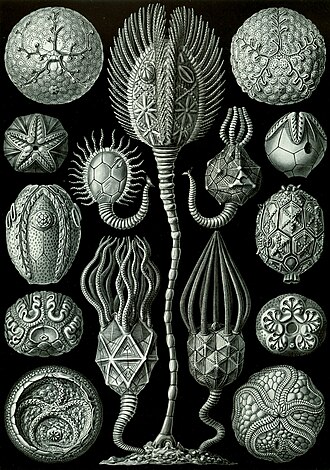
图:Ernst Haeckel · Public domain · Wikimedia Commons
- 学名
- Cystoidea
- 分类等级
- 纲
- 英文名
- Cystoids
- 上级类群
- 海蕾亚门
- 大类
- 其他动物
百科正文
特征
海林檎和有柄海百合一样,都是以茎(柄)固着在海底基质上的底栖生物,有些种类无茎。茎顶连接萼部,萼形状不一,有卵形、球形、瓶形等,而海百合的萼则多为杯形。萼由许多排列不规则的多边形骨板(萼板)组成,萼板少则13,多则达200块以上。萼板上具有小孔,称为萼孔,作用尚不清楚,可能与水管系统有关,萼孔排列方式可分四种类型:单孔(单个散乱排列)、双孔(成对出现)、孔菱(排成菱形)和栉孔菱(类似孔菱,但水管部分露出板面,形如栉)。口位于萼顶中央或近中央处,呈裂隙状、圆形或多边形。由口孔辐射出5条或更少的短食物沟(步带),呈简单或分叉状,步带上有许多短小、不分叉的腕羽,可滤取海水中的微生物。肛孔位于口的下方,常覆有5~7块小肛板,形成低矮的肛锥。在口孔与肛孔之间,还有水孔及生殖孔。
分类
海林檎纲过往被归为海百合亚门,并根据萼孔类型、壳体对称程度而分为两个目:
孔菱目(Rhombifera):萼板具孔菱。
双孔目(Diploporita):萼板小孔为双孔或兼有单孔。
较新的研究则多把海林檎纲的两个目各自独立成纲,且归于海蕾亚门之下。
以上内容摘自维基百科「海林檎」,按 CC BY-SA 4.0 使用,去掉了参考文献、外部链接等尾部小节,公式改写成了纯文本。全文、配图和出处见原文。
英文维基百科补充中文条目比较短,下面是英文条目「Cystoidea」的原文
Cystoidea was defined as a class of extinct paleozoic blastozoan echinoderms established to encompass stalked taxa that were neither crinoids nor blastoids. It was shown to be polyphyletic in the late 1960s but continues to be used even in recent (as of 2022) literature to discuss both rhombiferans and diploporitans.
History
The concept of Cystoidea has a complex history, with many emendations from its original conception. Early versions included the homalozoans, eocrinoids, paracrinoids, blastoids, and edrioblastoids. By 1967 the modern usage encompassing only rhombiferans and diploporitans had been established, although questions remained regarding the possible inclusion of blastoids. Despite these removals, speculation continued as to whether cystoids were ancestral to blastoids, crinoids, or echinoids.
Work published in 1967 and 1968 questioned whether Cystoidea formed a natural group, and in 1972 the former orders Rhombifera and Diploporita were elevated to class rank and Cystoidea was no longer used as a formal taxon. As an informal group, it encompasses those two former orders (which are no longer thought to be monophyletic either), but not the Blastoidea.
Description
Cystoids have a theca featuring many plates, with distinctive pores. These pores are central to the identification of cystoids, and either sit on one plate (in diploporitans) or are shared by adjacent plates (in rhombiferans). These pores have a respiratory function.
The shape of the theca itself varies dramatically in shape, with some forms described as "rather bizarre." Some cystoids lost their stems as adults, or possibly do not have stems at all.
以上内容摘自英文维基百科「Cystoidea」,按 CC BY-SA 4.0 使用,去掉了参考文献、外部链接等尾部小节,公式改写成了纯文本。全文、配图和出处见原文。