格物
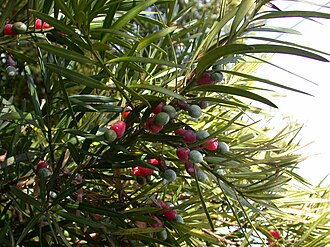
图:No machine-readable author provided. Keisotyo assumed (based… · CC BY-SA 3.0 · Wikimedia Commons
- 学名
- Podocarpaceae
- 分类等级
- 科
- 上级类群
- 松柏目
- 大类
- 其他植物
- 命名
- 斯特凡·恩德利歇,1847 年
- 数据库
- NCBI 分类 · GBIF
下级类群(11)

- 罗汉松属 Podocarpus 属
- 陆均松属 Dacrydium 属
- Phyllocladus 属
- 非洲杉属 Afrocarpus 属
- Acmopyle 属
- Falcatifolium 属
- 竹柏属 Nageia 属
- 鸡毛松属 Dacrycarpus 属
- Retrophyllum 属
- 核果杉 Prumnopitys 属
- Halocarpus 属
百科正文
罗汉松科植物都是常绿乔木或灌木,叶互生或有时对生,针状、鳞片状或线形;花单性异株或同株,雄花顶生或腋生,雌花腋生或生于枝顶,有苞片;种子当年成熟,核果状、坚果状或鲜有浆果状。
寄生陆均松(Parasitaxus usta)是已知的裸子植物中唯一一种寄生植物,生长在新喀里多尼亚,寄生在新喀里多尼亚陆均松(Falcatifolium taxoides)上。
有的分类学家将芹叶松属单独列为一个科。
直到1970年以前,罗汉松科还只分为7属,最新的研究将罗汉松属根据叶子结构、胚珠形态等分为8个新属,以后又陆续分出其他新属。
在中国,罗汉松科植物因其球果形似罗汉而得名, 导致中国南方一些地区认为罗汉松科能结出类似球果的植物能带来好运而进行采挖收集,造成生态破坏。
以上内容摘自维基百科「罗汉松科」,按 CC BY-SA 4.0 使用,去掉了参考文献、外部链接等尾部小节,公式改写成了纯文本。全文、配图和出处见原文。
英文维基百科补充中文条目比较短,下面是英文条目「Podocarpaceae」的原文
Podocarpaceae is a large family of mainly southern hemisphere conifers, known in English as podocarps, comprising about 201 species of trees and shrubs. It contains 20 genera if Phyllocladus is included and Manoao and Sundacarpus are accepted. The family achieved its maximum diversity in the Cenozoic, making it one of the most diverse in the southern hemisphere.
The family is a classic member of the Antarctic flora, with its main centres of diversity in Australasia, particularly New Caledonia, Tasmania, and New Zealand, and to a slightly lesser extent Malesia and South America (primarily in the Andes Mountains). Several genera extend north of the equator into Indochina and the Philippines. Podocarpus reaches as far north as southern Japan and southern China in Asia, and Mexico in the Americas, and Nageia into southern China and southern India. Two genera also occur in sub-Saharan Africa, the widespread Podocarpus and the endemic Afrocarpus.
Parasitaxus usta is unique as the only known parasitic gymnosperm. It occurs on New Caledonia, where it is parasitic on another member of the Podocarpaceae, Falcatifolium taxoides.
Except for the two genera Pherosphaera and Saxegothaea, all members of Podocarpaceae have fleshy seed cones, which appears to be an ancestral trait.
The genus Phyllocladus is sister to the Podocarpaceae sensu stricto. It is treated by some botanists in its own family, the Phyllocladaceae.
Taxonomy
The Podocarpaceae show great diversity, both morphologically and ecologically. Members occur mainly in the Southern Hemisphere, with most genetic variety taking place in New Caledonia, New Zealand, and Tasmania. Species diversity of Podocarpus is found mainly in South America and the Indonesian islands, the latter also being rich in Dacrydium and Dacrycarpus species.
Podocarpus (with 82 to 100 species) and Dacrydium (with 21 species) are the largest genera. A few genera are common to New Zealand and South America, supporting the view that podocarps had an extensive distribution over southern Gondwanaland. The breaking up of Gondwanaland led to large-scale speciation of the Podocarpaceae.
Until 1970, only seven Podocarpaceae genera were accepted: Podocarpus, Dacrydium, Phyllocladus, Acmopyle, Microcachrys, Saxegothaea, and Pherosphaera. All four of the African species fell under Podocarpus – P. falcatus, P. elongatus, P. henkelii, and P. latifolius. Taxonomists divided Podocarpus species into eight species groups based on leaf anatomy: Afrocarpus J.Buchholz & N.E.Gray, Dacrycarpus Endl., Eupodocarpus Endl., Microcarpus Pilg., Nageia (Gaertn.) Endl., Polypodiopsis C.E.Bertrand (non Polypodiopsis Carriére nom. rej. prop. 6), Stachycarpus Endl. and Sundacarpus J.Buchholz and N.E.Gray.
Studies of embryology, gametophyte development, female cone structure, and cytology led to the belief that the eight categories probably deserved generic status. Researchers agreed on the need to recognize "fairly natural groupings which prove to have good geographic and probably evolutionary cohesion" and took the necessary steps to raise each section to generic status.
In 1990, a treatment of the Podocarpaceae accepted 17 genera, excluding Phyllocladus from the family, while recognizing Sundacarpus, but not Manoao. In 1995, Manoao was segregated from Lagarostrobus, based on morphological characteristics.
Evolution
Molecular evidence supports Podocarpaceae being the sister group to the Araucariaceae, and having diverged from it during the late Permian. While some fossils attributed to the family have been reported from the Late Permian and Triassic, like Rissikia, these cannot be unambiguously assigned to the family. The oldest unambiguous members of the family are known from the Jurassic period, found across both hemispheres, such as Scarburgia and Harrisiocarpus from the Middle Jurassic of England, as well as unnamed species from the Middle-Late Jurassic of Patagonia. Modern genera of the family first appeared during the Early Cretaceous, with the family probably reaching an apex of diversity during the early Cenozoic.
Genera
Extinct genera
Genera that have been moved into a new subfamily are tagged with ±. Genera that are woody are tagged with #.
- †Podocarpoxylon ± #
- †Protophyllocladoxylon #
- †Dacrycarpites
- †Dacrydiumites
†Lygistepollenites?
†Gamerroites? Moved to Coniferae incertae sedis
†Conites?
- †Microcachryidites
- †Microcachryoxylon #
- †Phyllocladidites
- †Podocarpidites
- †Podosporites
- †Metapodocarpoxylon #
- †Protopodocarpoxylon #
- †Phyllocladoxylon ± #
- †Rissikia
- †Scarburgia
- †Harrisiocarpus
以上节选摘自英文维基百科「Podocarpaceae」,按 CC BY-SA 4.0 使用,去掉了参考文献、外部链接等尾部小节,公式改写成了纯文本。篇幅所限,较长的小节只摘了开头一部分,有的小节没有收;全文、配图和出处见原文。