格物
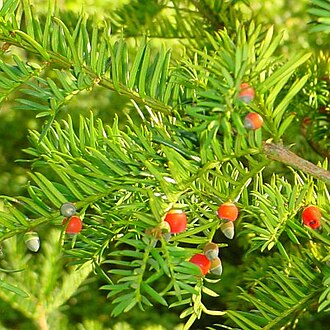
图:User RKraasch on de.wikipedia · CC BY-SA 3.0 · Wikimedia Commons
- 学名
- Taxaceae
- 分类等级
- 科
- 上级类群
- 松柏目
- 大类
- 其他植物
- 命名
- 塞缪尔·弗雷德里克·格雷,1822 年
- 异名
- 三尖杉科
- 数据库
- NCBI 分类 · GBIF
下级类群(4)
百科正文
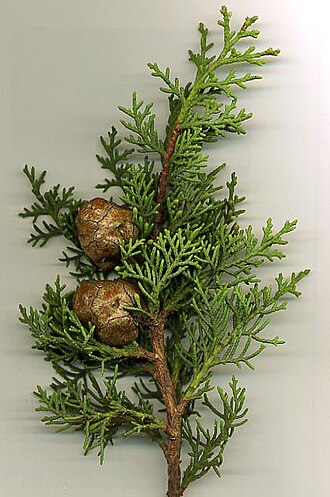
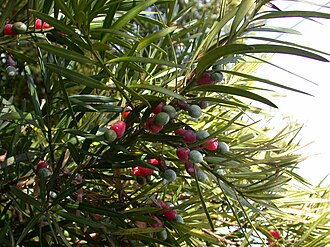
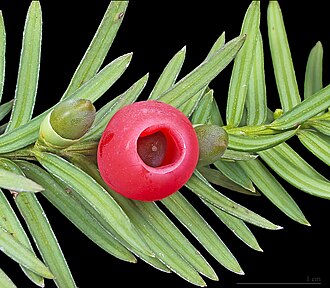
红豆杉科物种多是分枝的小乔木和灌木。是常绿树种,叶螺旋状排列,呈线形至披针形,底面有淡绿色或白色的气孔带。雌雄异株,很少雌雄同株。种子坚果状,包于肉质假种皮内。成熟的假种皮颜色鲜艳,柔软,多汁,甜,吸引鸟进食,然后透过粪便把种子传播到其他地方。然而,种子对人体有毒,含剧毒物质紫杉碱和紫杉醇。
分布
除了新喀里多尼亚产的穗花澳大利亚杉属一种产于南半球外,其他分别分布在北半球的温带至亚热带地区。
分类
红豆杉科有不同的分类方法。台湾物种名录将其分类为维管植物门裸子植物亚门松纲松亚纲柏目。
以上内容摘自维基百科「紅豆杉科」,按 CC BY-SA 4.0 使用,去掉了参考文献、外部链接等尾部小节,公式改写成了纯文本。全文、配图和出处见原文。
英文维基百科补充中文条目比较短,下面是英文条目「Taxaceae」的原文
Taxaceae, the yew family, is a family of coniferous trees and shrubs which includes six extant and two extinct genera, and about 30 species of plants, or in older interpretations three genera and 7 to 12 species.
Description
They are many-branched, small trees and shrubs. The leaves are spirally arranged, often twisted at the base to appear 2-ranked. They are linear to lanceolate, and have pale green or white stomatal bands on the undersides.
The plants are dioecious, or rarely monoecious. The catkin like male cones are 2–5 millimetres (0.079–0.197 in) long, and shed pollen in the early spring. They are sometimes externally only slightly differentiated from the branches. The fertile bracts have 2-8 pollen sacs.
The female 'cones' are highly reduced. Only the upper or uppermost bracts are fertile and bear one or rarely two seeds. They may be found on the ends of branches or on the branches. They may grow singly or in groups or clumps.
As the seed matures, a fleshy aril partly (Amentotaxus, Austrotaxus, Pseudotaxus, Taxus) or fully (Cephalotaxus, Torreya) encloses it. The developmental origin of the aril is unclear, but it may represent a fused pair of swollen leaves. The seeds in some genera are highly poisonous, containing the poisons taxine and taxol, but the mature aril that surrounds them is soft and juicy, often brightly coloured and sweet, but resinous-flavoured in others; it is eaten by birds which then disperse the hard seed undamaged in their droppings. However, if damaged the seeds could release their poisons, which is dangerous for humans.
Distribution
Species are mostly found in the tropics and temperate zones in the northern temperate. There are only a few species in the southern hemisphere.
Classification
Taxaceae is now generally included with all other conifers in the order Pinales, as DNA analysis has shown that the yews are phylogenetically nested in the Pinales, a conclusion supported by micromorphology studies. Formerly they were often treated as distinct from other conifers by placing them in a separate order Taxales. Ernest Henry Wilson referred to Taxaceae as "taxads" in his 1916 book. Taxaceae is thought to be the sister group to Cupressaceae, from which it diverged during the early-mid Triassic. The clade comprising both is sister to Sciadopityaceae, which diverged from them during the early-mid Permian. The oldest confirmed member of Taxaceae is Palaeotaxus rediviva from the earliest Jurassic (Hettangian) of Sweden. Fossils belonging to the living genus Amentotaxus from the Middle Jurassic of China indicate that Taxaceae had already substantially diversified during the Jurassic.
The broadly defined Taxaceae (including Cephalotaxus) comprises six extant genera and about 30 species. There is debate among botanists which family Cephalotaxus belongs to, being recognised by some as the core of its own family, Cephalotaxaceae, and others in the Taxaceae, particularly close to Amentotaxus and Torreya, forming a clade, other studies have found it basal in the family. Phylogenetic evidence strongly supports a very close relationship between Cephalotaxus and other members of Taxaceae, and morphological differences between them are not substantial. Previous recognition of two distinct families, Taxaceae and Cephalotaxaceae (e.g.,), was based on relatively minor morphological details: Taxaceae (excluding Cephalotaxus) has smaller mature seeds growing to 5–8 millimetres (0.20–0.31 in) in 6–8 months, that are not fully enclosed by the aril; in contrast, Cephalotaxus seeds have a longer maturation period (from 18 to 20 months), and larger mature seeds (12–40 millimetres (0.47–1.57 in)) fully enclosed by the aril. However, there are also very clear morphological connections between Cephalotaxus and other members of Taxaceae, and considered in tandem with the phylogenetic evidence, there is no compelling need to recognize Cephalotaxus (or other genera in Taxaceae) as a distinct family.
Phylogeny
Multiple different phylogenies for the family have been suggested by different studies:
Phylogeny according to Ghimire & Heo, 2013.
Phylogeny according to Byng, 2015.
Extinct genera
Several genera have been described from the fossil record and placed within Taxaceae
†Cephalotaxospermum E.W. Berry, 1910
†Diploporus Manchester, 1994 Eocene Clarno Formation, Oregon, Late Paleocene, North Dakota
- †Florinia Sveshn., 1967
- †Palaeotaxus Nathorst, 1908
- †Taxaceoxylon Kräusel & Jain, 1964
- †Taxacites Reyre, 1973
- †Taxites A.T. Brongniart, 1828
- †Taxocladus Prynada ex Vassilevsk., 1959
- †Taxoxylon Houlbert, 1910
以上节选摘自英文维基百科「Taxaceae」,按 CC BY-SA 4.0 使用,去掉了参考文献、外部链接等尾部小节,公式改写成了纯文本。篇幅所限,较长的小节只摘了开头一部分,有的小节没有收;全文、配图和出处见原文。