 格物
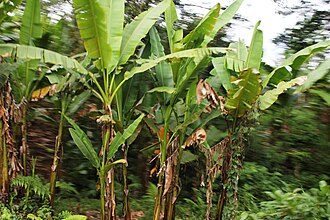
图:MarvinBikolano · CC BY-SA 4.0 · Wikimedia Commons
- 学名
- Musa textilis
- 分类等级
- 种
- 上级类群
- 芭蕉属
- 大类
- 被子植物
- 命名
- Luis Née,1801 年
- 中文别名
- 蕉麻
- 保护状况(IUCN)
- 近危物种
- 用途
- 纤维
- 数据库
- NCBI 分类 · GBIF · IUCN 红色名录
百科正文
多年生草本,形似芭蕉,茎直立柔软,由粗厚的叶鞘包迭而成柱状;叶很大,巨圆形,螺旋排列;穗状花序,单性花。浆果似香蕉。从根茎可生长出多至25个不含有纤维的肉质枝茎,丛生成环形。
叶柄中可提取纤维,其重要性在叶纤维中排第二位。最外面、最老的叶柄产生的纤维最坚实,色也最暗,其纤维长可达0.9-2.7米,并且坚实、有浮力,用于系船引索、钓鱼线、造纸和地毯等。
以上内容摘自维基百科「馬尼拉麻蕉」,按 CC BY-SA 4.0 使用,去掉了参考文献、外部链接等尾部小节,公式改写成了纯文本。全文、配图和出处见原文。
英文维基百科补充中文条目比较短,下面是英文条目「Abacá」的原文
Abacá ( ah-bə-KAH; Filipino: abaka [ɐbɐˈka]), also known as Manila hemp, is a species of banana, Musa textilis, endemic to the Philippines. The plant grows to 13–22 feet (4.0–6.7 m) and has great economic importance, being harvested for its fiber extracted from the leaf-stems.
The lustrous fiber is traditionally hand-loomed into various indigenous textiles (abaca cloth or medriñaque) in the Philippines. They are still featured prominently as the traditional material of the barong tagalog, the national male attire of the Philippines, as well as in sheer lace-like fabrics called nipis used in various clothing components. Native abaca textiles also survive into the modern era among various ethnic groups, like the t'nalak of the T'boli people and the dagmay of the Bagobo people. Abaca is also used in traditional Philippine millinery, as well as for bags, shawls, and other decorative items. The hatmaking straw made from Manila hemp is called tagal or tagal straw.
The fiber is also exceptionally strong, stronger than hemp and naturally salt-resistant, making it ideal for making twines and ropes (especially for maritime shipping). It became a major trade commodity in the colonial era for this reason. The abaca industry declined sharply in the mid-20th century when abaca plantations were decimated by World War II and plant diseases, as well as the invention of nylon in the 1930s. Today, abaca is mostly used in a variety of specialized paper products including tea bags, filter paper and banknotes. Manila envelopes and Manila paper derive their name from this fiber.
Abaca is classified as a hard fiber, along with coir, henequin and sisal. Abaca is grown as a commercial crop in the Philippines, Ecuador, and Costa Rica.
Description
The abacá plant is stoloniferous, meaning that the plant produces runners or shoots along the ground that then root at each segment. Cutting and transplanting rooted runners is the primary technique for creating new plants, since seed growth is substantially slower. Abacá has a "false trunk" or pseudostem about 6–15 inches (15–38 cm) in diameter. The leaf stalks (petioles) are expanded at the base to form sheaths that are tightly wrapped together to form the pseudostem.
Systematics
The abacá plant belongs to the banana family, Musaceae; it resembles the closely related wild seeded bananas, Musa acuminata and Musa balbisiana. Its scientific name is Musa textilis. Within the genus Musa, it is placed in section Callimusa (now including the former section Australimusa), members of which have a diploid chromosome number of 2n = 20.
Genetic diversity
The Philippines, especially the Bicol region in Luzon, has the most abaca genotypes and cultivars. Genetic analysis using simple sequence repeats (SSR) markers revealed that the Philippines' abaca germplasm is genetically diverse. Abaca genotypes in Luzon had higher genetic diversity than Visayas and Mindanao. Ninety-five (95) percent was attributed to molecular variance within the population, and only 5% of the molecular variance to variation among populations.
History
Before synthetic textiles came into use, M. textilis was a major source of high quality fiber: soft, silky and fine. Ancestors of the modern abacá are thought to have originated from the eastern Philippines, where there is significant rainfall throughout the year. Wild varieties of abacá can still be found in the interior forests of the island province of Catanduanes, away from cultivated areas.
Cultivation
The plant is normally grown in well-drained loamy soil, using rhizomes planted at the start of the rainy season. In addition, new plants can be started by seeds. Growers harvest abacá fields every three to eight months after an initial growth period of 12–25 months. Harvesting is done by removing the leaf-stems after flowering but before the fruit appears. The plant loses productivity between 15 and 40 years. The slopes of volcanoes provide a preferred growing environment.
Uses
Due to its strength, it is a sought after product and is the strongest of the natural fibers. It is used by the paper industry for such specialty uses such as tea bags, banknotes and decorative papers. It can be used to make handcrafts such as hats, bags, carpets, clothing and furniture.
Lupis is the finest quality of abacá. Sinamay is woven chiefly from abacá.
Textiles
Abacá fibers were traditionally woven into sturdy textiles and clothing in the Philippines since pre-colonial times.
以上节选摘自英文维基百科「Abacá」,按 CC BY-SA 4.0 使用,去掉了参考文献、外部链接等尾部小节,公式改写成了纯文本。篇幅所限,较长的小节只摘了开头一部分,有的小节没有收;全文、配图和出处见原文。